
Introduction
The democratization of the written word has reshaped the global media landscape. Today, the barriers to entry in the publishing world have not just been lowered; they have been entirely dismantled. With a few clicks, anyone with a word processor and an internet connection can transform a manuscript into a globally distributed book. Platforms like Amazon Kindle Direct Publishing (KDP), IngramSpark, and Draft2Digital have turned every writer into a potential publisher. However, this accessibility has created a profound paradox: while the technical act of publishing has become universally accessible, the commercial act of selling a book has become exponentially more difficult.
Every year, millions of new titles are uploaded to digital retail shelves, joining an existing catalog of tens of millions of active books. According to industry estimates, over two million books are self-published annually, alongside hundreds of thousands of traditionally published titles. In this hyper-saturated marketplace, the primary challenge is no longer production, but discovery. This is the core reality that every modern author must confront, and it explains Why Publishing a Book Is Easier Than Selling One. Writing and formatting a book requires discipline and technical execution; selling a book requires a mastery of psychology, algorithm optimization, paid advertising, and long-term brand building.
For aspiring authors and industry professionals alike, understanding this disparity is crucial. If you treat the act of publishing as the finish line, your book is highly likely to join the vast archives of unread digital content. To succeed, you must view publishing as merely the administrative setup for the true challenge: the sustained marketing and sales campaign. This article will dissect the structural, economic, and psychological reasons Why Publishing a Book Is Easier Than Selling One, and provide actionable strategies to bridge the gap between production and profit.
The Modern Publishing Landscape: Low Barriers to Entry
To understand why the balance of difficulty has shifted so dramatically, we must first look at how easy the publishing process itself has become. Historically, publishing was guarded by strict gatekeepers: literary agents, acquisitions editors, publishers, printers, and physical distributors. An author could spend years querying agents only to receive a stack of rejection letters. Even if a book was accepted, the production timeline took twelve to eighteen months, requiring capital-intensive offset printing runs and complex logistics to secure space on bookstore shelves.
The Rise of Kindle Direct Publishing (KDP) and Print-on-Demand
The introduction of Print-on-Demand (POD) technology and digital e-readers changed everything. POD allows books to be printed only when a customer places an order, eliminating the need for costly inventory, warehousing, and upfront printing expenses. Platforms like Amazon KDP charge zero upfront fees to publish. An author can upload a PDF for a paperback cover, a formatted manuscript document, and have their book live and available for purchase worldwide within 24 to 72 hours. The gatekeeper has been replaced by an upload portal.
The Automated Production Pipeline
Additionally, the ecosystem supporting book production has become highly streamlined. AI-powered formatting tools, pre-made cover templates, and global freelance marketplaces like Reedsy and Fiverr make it possible to assemble a professional-looking book on a shoe-string budget. Software like Vellum and Atticus allows writers to format complex layouts for print and digital formats in minutes, a task that once required specialized graphic designers using expensive desktop publishing software. The technical friction of publishing has been reduced to near zero.
The Illusion of Completion
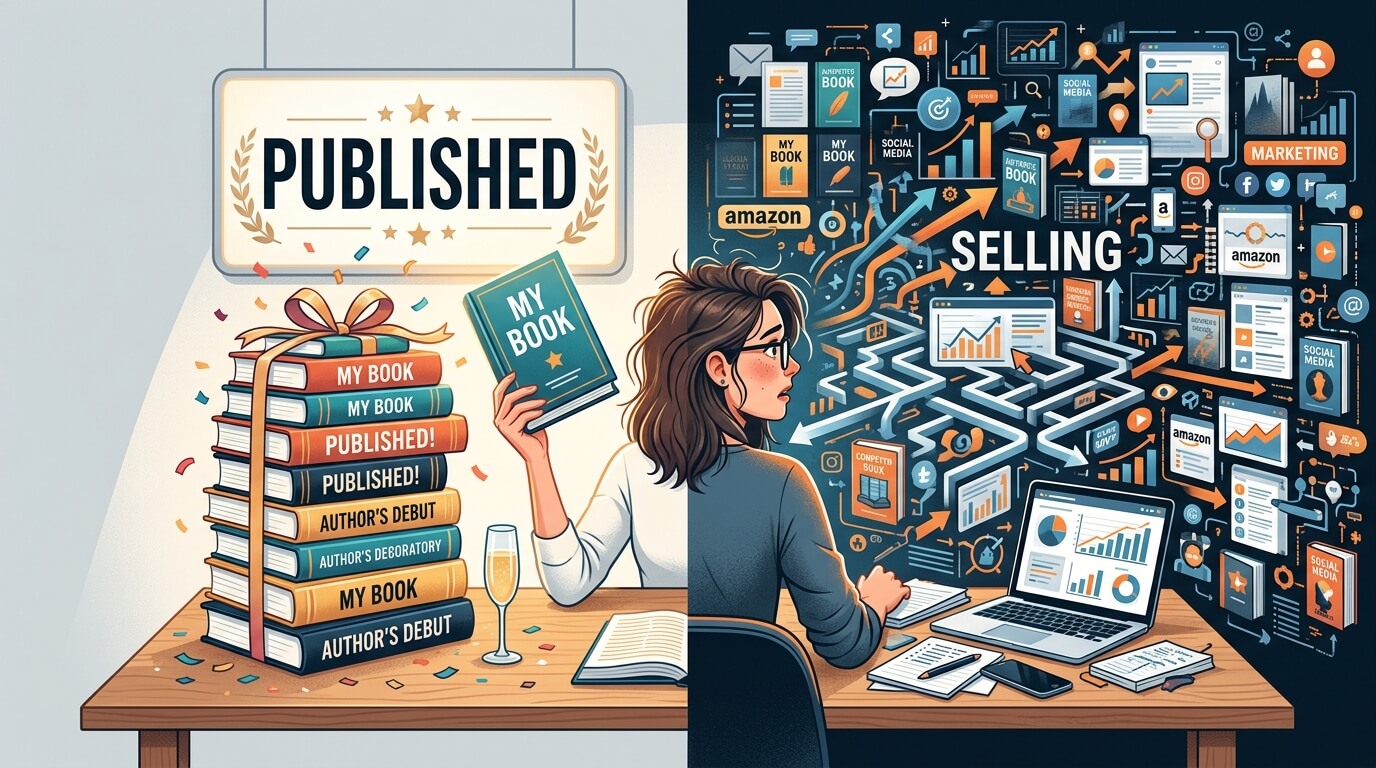
Because the publishing pipeline is so automated, authors often fall victim to the “illusion of completion.” The physical receipt of a proof copy or the appearance of a live Amazon product page feels like a monumental victory. It is indeed a milestone of creative endurance, but it is a operational starting line. The ease of this process lures writers into a false sense of security, leading them to believe that because the book is live, the market will naturally find it. This disconnect is the fundamental reason Why Publishing a Book Is Easier Than Selling One.
The Marketing Chasm: Why Selling Requires a Different Skillset
Writing a book is an act of introversion, deep focus, and creative synthesis. It requires an author to retreat from the world to construct narratives, analyze concepts, or share personal experiences. Selling a book, conversely, is an act of extroversion, analytical calculation, and commercial persuasion. The primary reason Why Publishing a Book Is Easier Than Selling One lies in this profound psychological and operational mismatch. The skills that make someone an excellent writer do not naturally translate into the skills required to run a profitable business.
From Creator to Marketer: The Psychological Shift
Many authors struggle with the transition from artist to entrepreneur. Selling requires you to view your creative work as a commodity. It forces you to ask hard questions: Who is the target demographic? What pain point does this book solve? What is the customer acquisition cost (CAC)? For many writers, framing their art in terms of profit margins and conversion rates feels cold or even manipulative. However, without this shift, a book is dead on arrival. Marketing requires active outreach, public vulnerability, and the resilience to handle public criticism and low sales data.
The Overcrowded Digital Shelf
When you publish a book on Amazon, you are not just competing with other new releases in your specific sub-genre. You are competing with every book ever written that remains in print. More importantly, you are competing with Netflix, TikTok, video games, podcasts, and the infinite stream of free content on the internet. Attention is the ultimate scarce resource in the modern economy. Your book is a tiny drop in a digital ocean of distractions. Securing a reader’s attention long enough for them to click “Buy Now” requires a sophisticated understanding of digital marketing.
The Algorithms of Discoverability
Online retailers do not display books based on literary merit; they display them based on probability of sale. Algorithms track user behavior, click-through rates (CTR), conversion rates (CR), and historical sales velocity. If your book does not generate immediate, consistent traffic and conversions, the retail algorithms will quickly deprioritize it, burying it deep within search results where no organic browser will ever find it. Understanding metadata, search engine optimization (SEO) for retail search engines, and category placement is a highly technical discipline that most writers have never studied.
Comparing the Two Worlds: Publishing vs. Selling
To clearly illustrate the operational differences between these two phases of an author’s journey, let us compare the requirements, skills, and resources associated with publishing versus those required for sustained sales success.
| Operational Dimension | The Publishing Phase (Easy to Moderate) | The Selling Phase (Difficult to Complex) |
| To transform a manuscript into a physically and digitally distributable format. | To generate consistent, profitable attention and drive conversion among target readers. | Primary Objective |
| Writing, basic formatting, cover design coordination, metadata entry. | Data analysis, copywriting, paid advertising, public relations, funnel optimization. | Skillsets Required |
| Upload completion, proof approval, launch date scheduling. | Conversion Rate (CR), Click-Through Rate (CTR), Return on Ad Spend (ROAS), Customer Acquisition Cost (CAC). | Key Performance Indicators (KPIs) |
| Finite. Once the files are uploaded and approved, the task is complete. | Infinite. Requires continuous optimization, campaign management, and engagement. | Time Horizon |
| Low to moderate (can be done for free; professional editing/cover coverts cost $500–$3,000). | High and ongoing (requires continuous ad spend, newsletter fees, and promotional budgets). | Financial Commitment |
The Economics of Book Distribution and Retail Algorithmic Realities
To build a sustainable author career, one must understand the economic machinery of the book trade. Many authors believe that getting their book distributed to major retailers like Barnes & Noble, Apple Books, and Kobo is the ultimate key to sales. However, distribution is merely pipeline placement; it is not demand generation. This economic reality is another primary reason Why Publishing a Book Is Easier Than Selling One.
Wholesale Discounts and Return Policies
For a physical bookstore to stock your book, you must offer them a standard industry discount—typically 53% to 55% off the retail cover price—and you must make the book fully returnable. If the books do not sell, the bookstore will ship them back to the distributor (or destroy them) and demand a full refund. For self-published or hybrid-published authors, this return policy represents a massive financial risk. If a marketing campaign fails to move inventory off the shelves, the author can end up owing thousands of dollars to their distributor for returned and damaged stock. Publishing the book to the wholesale catalog is easy; managing the financial risk of retail sales is extraordinarily complex.
The Myth of “If You Build It, They Will Come”
In the physical retail world, foot traffic is organic. People walk into bookstores and browse. In the digital retail world, browsing is highly mediated by personalized algorithms. Amazon does not show the same homepage to any two users. If your book does not already have sales momentum, it will not be shown to organic browsers. You cannot rely on the platform to do the selling for you. You must drive your own external traffic to your book’s product page to prove to the retailer’s algorithm that your book is worth promoting. This is a circular problem: you need sales to get algorithm visibility, but you need visibility to get sales.
Paid Advertising (AMS, Facebook Ads, BookBub) ROI Challenges
To break through this algorithmic barrier, most successful authors rely on paid advertising. Amazon Marketing Services (AMS), Meta (Facebook/Instagram) Ads, and BookBub Featured Deals are the primary engines of modern book sales. However, running profitable ad campaigns for books is notoriously difficult. With average ebook prices ranging from $2.99 to $4.99, the profit margin per unit sold (royalties are typically 70% on Amazon for books priced between $2.99 and $9.99) is highly constrained. If your Cost Per Click (CPC) on an ad campaign is $0.50, and your sales page converts at a standard 10%, you are spending $5.00 in advertising to secure a single sale that may only net you $2.00 in royalties. Managing these tight margins requires advanced mathematical optimization and a deep understanding of read-through value for multi-book series.
Building an Audience: The Real Work Begins Before the Book
If publishing is a technical task and marketing is an analytical system, then audience building is the relational foundation that makes both meaningful. Authors who succeed in selling high volumes of books rarely do so by launching to a cold audience. They succeed because they have spent months, often years, cultivating a dedicated community of readers before their book ever goes live. This long-term relationship-building is hard work, further highlighting Why Publishing a Book Is Easier Than Selling One.
The Power of an Email List
An author’s single most valuable asset is not their book catalog; it is their direct connection to their readership. Social media algorithms can change overnight, cutting off your reach to your followers. An email newsletter list, however, is an asset you own. Successful authors use “reader magnets”—free novellas, prequel stories, or valuable resources—to entice readers to join their mailing lists. When a new book is published, these authors do not rely on cold ads; they email thousands of warm leads who are already invested in their work, generating immediate sales velocity that triggers the retailer’s algorithms.
Leveraging ARC (Advance Review Copy) Teams
Social proof is the cornerstone of online conversion. A book with zero reviews will struggle to convert even the most targeted advertising traffic. To solve this, successful publishers build “ARC Teams” (Advance Review Copy teams). These are groups of dedicated readers who receive an early, free copy of the book in exchange for an honest review on launch day. Coordinating these teams, managing distribution via platforms like Booksprout or NetGalley, and ensuring compliance with retail review guidelines is an administrative marathon that requires superb organizational and interpersonal skills.
Organic Content Marketing and Platform Building
For non-fiction authors, selling books is often about establishing authority. This requires a consistent output of high-value organic content: blog posts, podcast appearances, YouTube videos, and active participation in professional communities. For fiction writers, it involves engaging with communities on platforms like TikTok (BookTok) and Instagram (Bookstagram). This constant public presence requires a level of emotional energy and daily commitment that far exceeds the effort required to upload a manuscript to a publishing portal.
Key Takeaways
- Democratization of Tools: Modern software and distribution platforms have made publishing a book a virtually cost-free, automated process that can be completed in hours.
- The Attention Economy: The real challenge of modern publishing is discoverability. Authors must compete not just with millions of other books, but with all digital entertainment.
- Skillset Divergence: Writing requires creative introversion, whereas selling requires analytical business acumen, data analysis, and direct customer engagement.
- Algorithmic Dependency: Retail platforms operate on sales velocity and conversion data. Without external traffic generation, algorithms will bury a newly published book.
- Audience Ownership: A dedicated email list and a warm review team are the most reliable predictors of long-term book sales success, far outweighing simple distribution.
Frequently Asked Questions
Why do most self-published books sell fewer than 250 copies in their lifetime?
Most self-published books fail to cross this threshold because their creators focus entirely on the act of publishing rather than marketing. Without a pre-existing audience, an active advertising strategy, or optimized metadata, the book remains invisible to the market. Additionally, many books are launched without professional editing or market-aligned cover designs, which severely hurts conversion rates even if traffic is driven to the page.
Is traditional publishing a guarantee that my book will sell?
No, traditional publishing is not a guarantee of sales success. While traditional publishers provide professional editing, cover design, and physical distribution, their marketing budgets are increasingly reserved for lead titles by established, high-profile authors. Mid-list and debut authors in traditional publishing houses are often expected to do the majority of their own marketing and audience building. If a traditionally published book does not perform well in its first few weeks, the publisher will quickly shift their attention and resources to other titles.
How much should I expect to spend on marketing a new book?
A healthy marketing budget depends on your publishing goals and whether you are a fiction or non-fiction author. For a competitive launch, a baseline budget of $500 to $2,000 is common. This budget is typically allocated toward professional cover design (which is your primary marketing tool), newsletter promotions (such as BookBub, Robin Reads, or Bargain Booksy), advance review copy distribution, and initial paid advertising on Amazon or Facebook. For long-term success, marketing spend should be scaled based on your Return on Ad Spend (ROAS).
What is “Metadata” and why is it so important for book sales?
Metadata refers to all the textual information that describes your book, including your title, subtitle, author bio, book description, BISAC subject categories, and backend search keywords. In digital retail environments, metadata is the primary way search engines index your book. If your metadata is poorly optimized or does not align with actual reader search queries, your book will not appear in search results, making organic sales virtually impossible.
Can I sell books without using paid advertising?
Yes, it is possible, but it requires a significant investment of time to build organic marketing channels. Authors can drive sales through content marketing (blogging, podcasting, YouTube), active social media engagement (such as building a presence on BookTok), public speaking, local media coverage, and cultivating a highly responsive email newsletter list. Organic marketing is slower to build than paid advertising but often results in higher-quality, long-term reader loyalty.
Conclusion
The realization that publishing a book is easier than selling one should not discourage writers; rather, it should empower them. By stripping away the romantic illusion that the world will automatically discover your masterpiece, you can approach your author career with the pragmatic mindset of an entrepreneur. Publishing is a mechanical event; selling is an ongoing relationship with a market. Once you master the tools of conversion, audience building, and algorithmic optimization, you can ensure that your book does not simply exist on a digital shelf, but actually reaches the hands of the readers who need it most.
To transition from a writer who publishes to an author who sells, start small. Focus on building your email list, optimizing your book’s metadata, and understanding your target audience’s purchasing behavior. By treating the business of books with the same dedication and craft that you bring to your writing, you can bridge the marketing chasm and achieve lasting success in the modern publishing arena.
