
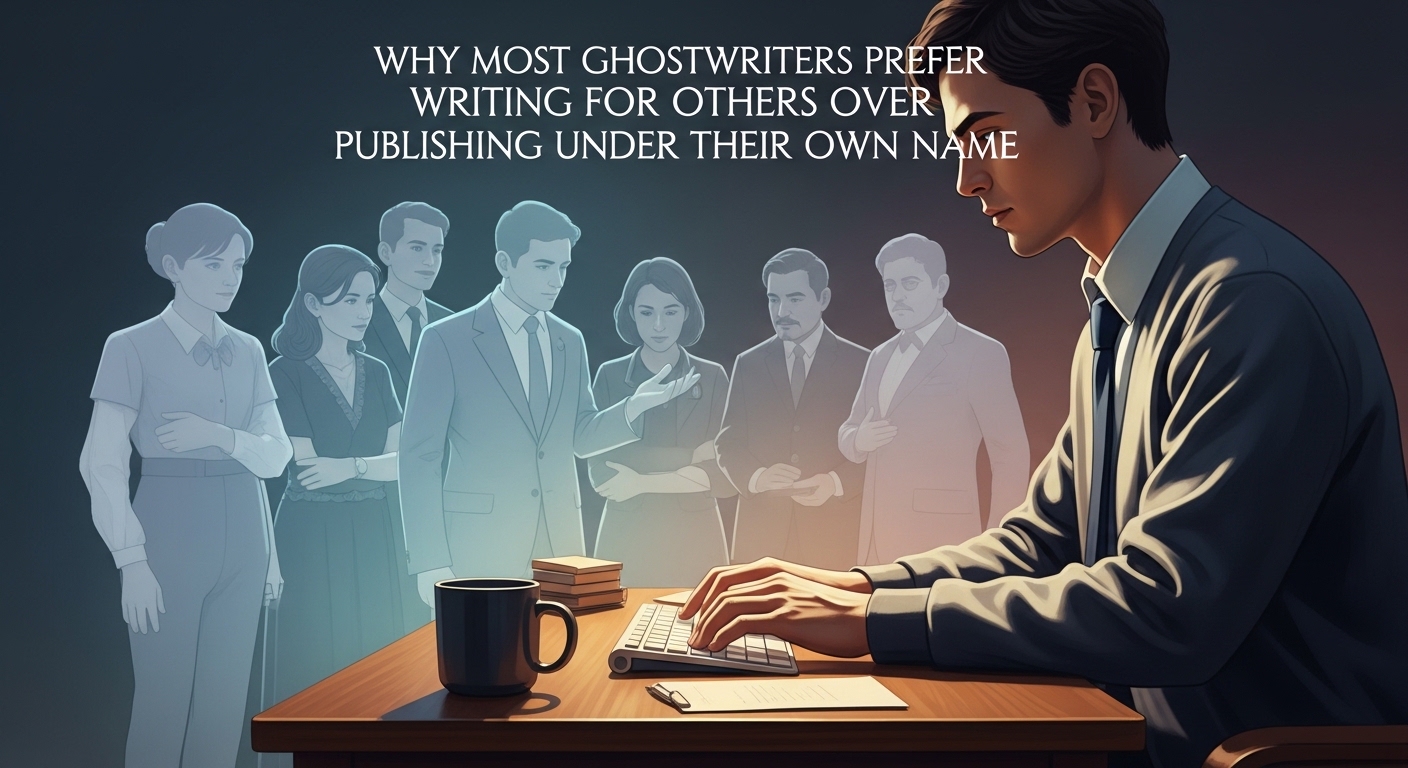
The idea of a writer choosing anonymity over recognition feels almost contradictory in a culture obsessed with personal branding and authorship. Yet ghostwriting remains one of the most stable, profitable, and quietly influential careers in modern publishing. Behind bestselling memoirs, leadership books, thought-leadership articles, and even novels, ghostwriters shape stories that millions read — often without their names appearing anywhere on the cover.
To outsiders, the obvious question arises: Why would someone capable of writing entire books choose not to publish under their own name? The answer lies not in a lack of ambition, but in the unique economics, psychology, and professional realities of the ghostwriting world. For many writers, ghostwriting offers creative fulfillment, financial stability, and professional freedom that traditional authorship rarely guarantees.
This article explores the deeper reasons most ghostwriters deliberately choose to remain behind the scenes — and why, for many professionals, anonymity is not a compromise but a strategic career decision.
The Myth of the “Hidden Writer”
Popular imagination often paints ghostwriters as frustrated authors who failed to publish their own work. Industry data tells a different story. Most professional ghostwriters are highly educated writers with backgrounds in journalism, publishing, or communications, and many possess decades of writing experience. Around 80% hold at least a bachelor’s degree, and a significant number have written multiple books throughout their careers.
Ghostwriting is not an accidental career; it is usually a conscious specialization. Writers enter the field because they discover that storytelling skills can be applied not only to personal expression but also to collaboration. Instead of building a single author identity, ghostwriters build expertise in shaping other people’s voices.
In this sense, ghostwriting is closer to architecture than painting. The architect designs the structure but does not live in it. The work exists publicly, even if the creator remains invisible.
Financial Stability Often Outweighs Author Fame
One of the most practical reasons ghostwriters prefer writing for others is simple economics.
Traditional publishing rarely provides consistent income. Advances for debut or midlist authors can be modest, and royalties depend on unpredictable sales performance. By contrast, ghostwriting operates on a work-for-hire model where payment is agreed upon upfront.
Many ghostwriters earn substantial fixed fees per project, sometimes far exceeding what an unknown author would earn publishing independently. Industry discussions frequently note that ghostwriters may receive tens of thousands of dollars for a manuscript regardless of market success — while authors publishing under their own names bear financial risk.
This shift changes the writer’s relationship with creativity. Instead of gambling months or years on uncertain outcomes, ghostwriters exchange recognition for reliability.
For professionals supporting families or seeking sustainable careers, predictable income often matters more than public visibility.
Ghostwriting Removes the Burden of Self-Marketing
Modern authorship requires far more than writing. Writers today must also become marketers, content creators, social media personalities, and brand managers.
Publishing under one’s own name means constant visibility: promoting books online, building audiences, networking publicly, and maintaining a personal platform. Many writers discover they enjoy writing far more than selling themselves.
Ghostwriting eliminates this pressure entirely.
Clients — whether CEOs, influencers, or public figures — already possess platforms. The ghostwriter’s responsibility ends with producing excellent content. Marketing, publicity, and reputation management belong to the named author.
This division allows ghostwriters to focus exclusively on craft rather than performance.
Collaboration Can Be More Creatively Stimulating Than Solo Writing
Contrary to assumptions, many ghostwriters genuinely prefer collaborative storytelling.
Ghostwriting involves interviews, psychological listening, and translating lived experiences into narrative form. Writers must capture tone, rhythm, and worldview so convincingly that readers believe the named author wrote every word.
Businesses and professionals rely on ghostwriters precisely because they can transform raw ideas into polished narratives while preserving authenticity.
For some writers, this challenge is intellectually richer than writing from personal imagination alone. Each project becomes an immersion into a new life — a scientist’s memoir, an entrepreneur’s philosophy, or a survivor’s personal history.
Rather than repeating one artistic identity, ghostwriters inhabit many.
Anonymity Offers Creative Freedom
Publishing under one’s own name ties every work to a permanent personal brand. Writers may feel pressured to remain consistent in genre, tone, or ideology to maintain audience expectations.
Ghostwriters operate outside these constraints.
They can write business books one month, romance fiction the next, and technical content afterward without confusing readers or damaging a public reputation. Anonymity allows experimentation without consequence.
Research into anonymous creative environments shows that removing public identity can encourage expression and collaboration by reducing social pressure and reputational risk.
For ghostwriters, invisibility becomes liberation rather than limitation.
Emotional Distance Protects Creative Energy
Publishing personal work often involves emotional exposure. Reviews, criticism, and public opinion target not only the writing but the author’s identity.
Ghostwriters experience a different emotional dynamic. Praise and criticism are directed toward the client, not the writer.
This distance can reduce anxiety and burnout associated with public reception. Ironically, some writers produce more work — and better work — when their ego is not directly attached to outcomes.
Industry surveys reveal that emotional management of clients, not public criticism, is considered one of the most challenging aspects of ghostwriting, suggesting that writers are largely shielded from reader backlash.
Clients Provide Built-In Audiences
Another practical reason ghostwriters rarely publish the same work themselves is audience access.
A celebrity memoir, executive leadership book, or influencer guide succeeds partly because readers already care about the person attached to it. Even an excellent manuscript may struggle commercially without a recognizable name.
Ghostwriters understand this reality. The same story published under an unknown writer might reach far fewer readers.
From a strategic standpoint, collaborating with someone who already has visibility often leads to greater impact — and higher earnings — than publishing independently.
Ghostwriting Builds Diverse Professional Skills
Publishing under one’s own name usually develops expertise in a single voice or genre. Ghostwriting requires adaptability.
Writers must learn interviewing techniques, research methodologies, narrative structuring, voice mimicry, editing psychology, and client communication. Many ghostwriters spend significant portions of projects conducting interviews and research before writing begins.
These skills often translate into broader opportunities such as book coaching, editorial consulting, or publishing strategy roles.
For career-oriented writers, ghostwriting becomes a professional ecosystem rather than a single artistic pursuit.
Confidentiality Creates Trust — and Repeat Work
Ghostwriting depends on confidentiality agreements. Clients share personal stories, business strategies, and sometimes sensitive experiences.
Because discretion is essential, ghostwriters who respect anonymity build strong reputations and receive repeat clients through referrals. In fact, word-of-mouth remains the primary source of new work for many ghostwriters.
Publishing independently could risk exposing client relationships or diluting professional trust. Remaining behind the scenes strengthens long-term career sustainability.
Many Ghostwriters Still Publish — Just Differently
Choosing ghostwriting does not necessarily mean abandoning personal authorship.
A significant portion of ghostwriters maintain blogs, write under pen names, or publish selectively while continuing client work.
The difference lies in priority. Personal writing becomes creative expression rather than financial dependence.
This balance allows writers to separate artistic identity from livelihood — a distinction many traditional authors struggle to achieve.
The Psychology of Helping Others Tell Their Stories
Beyond practical reasons, there is also a psychological motivation.
Many ghostwriters describe satisfaction in helping others articulate ideas they could not express alone. The process resembles mentorship or translation rather than authorship competition.
Community discussions frequently highlight how ghostwriters enjoy “making people’s dreams come true” and participating in collaborative storytelling rather than seeking individual recognition.
For these writers, fulfillment comes from impact rather than visibility.
The Changing Industry and the Role of AI
Recent industry reports show ghostwriting evolving alongside technology. While AI tools assist with research and workflow, human storytelling remains valued for emotional depth and originality. Publishers continue favoring human-written material because AI output often lacks nuance and authenticity.
Some professional ghostwriters even use AI as a productivity assistant rather than a replacement, allowing them to complete projects faster while maintaining human creative control.
As the industry changes, the collaborative model of ghostwriting may become even more attractive: writers focus on human insight while clients provide platform and visibility.
Recognition Is Not Always the Goal
Western literary culture often equates success with fame, but ghostwriting challenges this assumption.
For many professionals, success means:
- consistent income
- creative variety
- flexible schedules
- intellectual collaboration
- freedom from public scrutiny
When measured by these standards, ghostwriting can appear more appealing than traditional authorship.
The absence of a name on the cover does not mean absence of achievement. Instead, recognition shifts from public applause to professional respect within private networks.
A Different Definition of Authorship
Ghostwriting ultimately reshapes how we think about authorship itself.
Writing is not always an act of individual expression; sometimes it is an act of interpretation. The ghostwriter becomes a translator between experience and language, transforming ideas into stories while allowing someone else to stand at the center.
In many ways, ghostwriters embody one of storytelling’s oldest traditions — the anonymous scribes, historians, and collaborators who preserved voices throughout history without claiming ownership.
Their reward is not fame but continuity of work.
Conclusion: The Power of Invisible Creativity
Most ghostwriters do not avoid publishing under their own names because they lack ambition. They choose ghostwriting because it aligns better with their professional goals, creative preferences, and lifestyle priorities.
Ghostwriting offers stability in an unstable industry, collaboration instead of isolation, and creative freedom without public pressure. It allows writers to practice their craft constantly while avoiding the uncertainties attached to personal publishing careers.
In a world increasingly focused on visibility, ghostwriters remind us that influence does not always require recognition. Some of the most powerful stories shaping culture today are written quietly — by professionals who understand that storytelling itself matters more than whose name appears on the cover.
And for many writers, that quiet power is exactly the point.
