
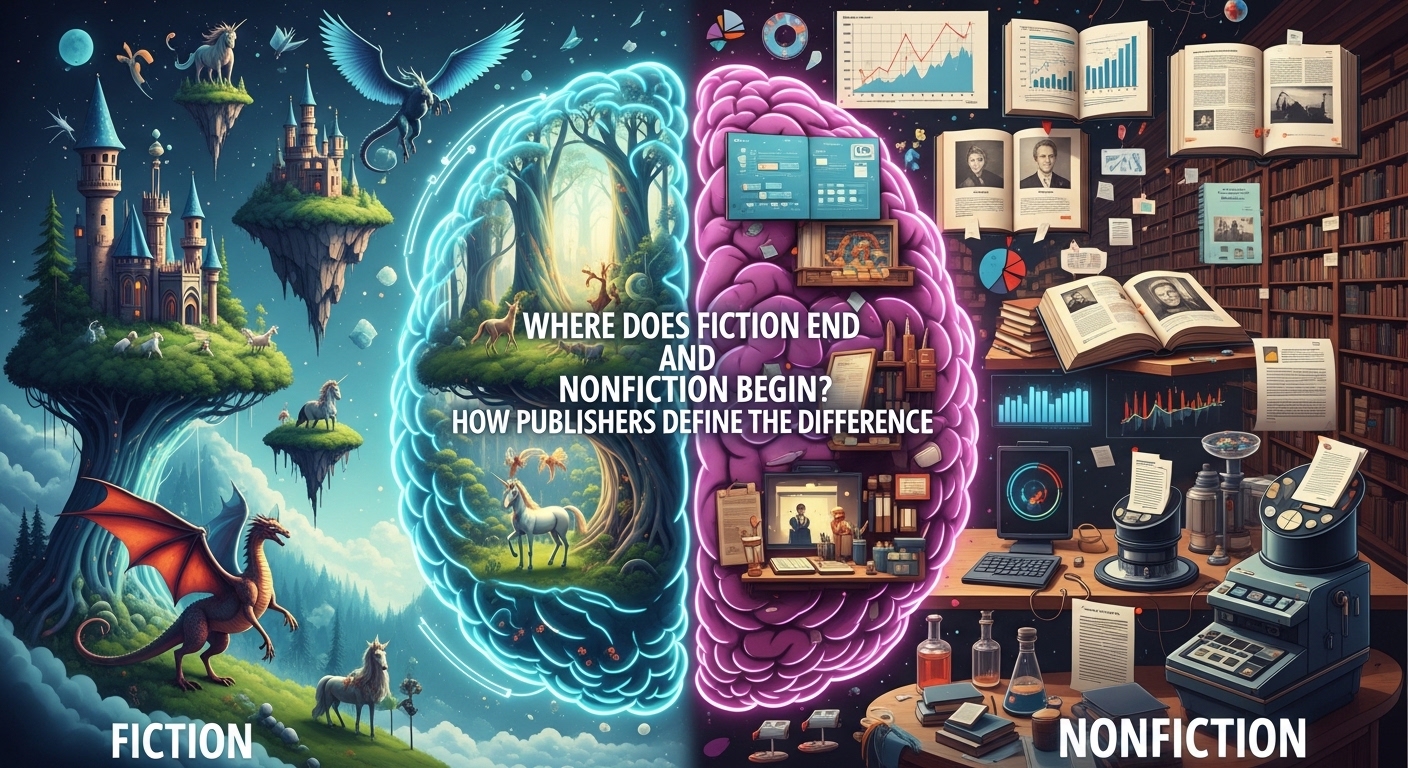
Walk into any bookstore or browse an online catalog, and one of the first divisions you will notice is simple: fiction and nonfiction. At first glance, the categories seem obvious. Fiction tells imagined stories, while nonfiction deals with facts and reality. Yet the more closely readers, writers, and publishers examine that boundary, the less straightforward it becomes.
Many books blend memory with storytelling, research with narrative tension, or real events with reconstructed dialogue. Memoirs may read like novels. Historical books may use dramatic scenes. Novels may borrow heavily from real life. Some works intentionally blur the line, while others accidentally raise questions about accuracy, truth, and classification.
For publishers, this distinction matters far beyond shelf placement. It affects editing standards, marketing strategies, legal review, audience expectations, bookstore categories, awards eligibility, and reader trust. A publisher cannot simply label a manuscript according to instinct. They need a clear framework for deciding where a book belongs and how it should be presented.
So where does fiction end and nonfiction begin? The answer lies not only in content, but in intent, evidence, promises made to the reader, and publishing ethics. Understanding how publishers define the difference helps writers position their work properly and helps readers understand what kind of truth a book is offering.
The Traditional Definition of Fiction
Fiction is generally defined as literature created from imagination. That does not mean it is disconnected from reality. Many novels are inspired by real places, real emotions, and historical events. What makes them fiction is that the author has freedom to invent characters, scenes, dialogue, timelines, and outcomes.
A novelist can combine traits from several people into one character. They can create conversations that never happened. They can change chronology to improve pacing. They can build worlds that never existed or reinterpret worlds that did. The contract with the reader is not factual accuracy but narrative experience.
Publishers classify fiction according to genre, voice, audience, and market appeal. Literary fiction, romance, thriller, fantasy, mystery, historical fiction, and speculative fiction all sit under the broader fiction umbrella. Each may contain emotional truth or social commentary, but none are required to prove factual claims.
That freedom is central to fiction’s value. It allows writers to explore human experience in ways facts alone sometimes cannot.
The Traditional Definition of Nonfiction
Nonfiction is built on reality. It presents subjects, people, events, ideas, or experiences as truthful representations rather than inventions. This category includes memoir, history, biography, journalism, self-help, science, business, travel writing, essays, and many more forms.
When a publisher labels a book nonfiction, readers expect that the core claims are accurate to the best of the author’s knowledge. Dates, names, quotes, sources, and interpretations may still be debated, but the work should not knowingly fabricate material.
Unlike fiction, nonfiction usually carries a burden of verification. Publishers may request source notes, references, interviews, documentation, or legal checks. Even a memoir, which is based on personal memory, is expected to reflect sincere truth rather than deliberate invention.
This expectation creates a stronger trust relationship. Readers approach nonfiction believing they are learning something real, even when the writing style feels dramatic or personal.
The Publisher’s Real Question: What Promise Is the Book Making?
Inside publishing houses, the practical question is often not “Is this true?” but “What promise does this book make to readers?”
If a manuscript says it is a memoir, the promise is that these events happened substantially as described. If it is a biography, readers expect researched facts. If it is a novel, readers understand that invention is part of the design.
That promise determines how a manuscript is edited and marketed. A dramatic family story based on real events may be accepted as a novel if names, scenes, and outcomes are fictionalized. The same manuscript presented as memoir would face fact-checking questions.
This is why classification matters. It is less about purity and more about honesty in presentation.
Why the Line Gets Blurry
Modern publishing includes many books that resist simple labels. Narrative nonfiction uses storytelling tools often associated with fiction. Memoirs rely on memory, which can be imperfect. Historical novels may include real figures and carefully researched settings. Autofiction mixes personal life with deliberate invention.
Readers today often enjoy these hybrid forms because they combine factual depth with emotional engagement. Yet publishers must still decide where to place them.
A travel memoir may include reconstructed dialogue. A history book may narrate scenes using documented evidence. A novel may closely mirror the author’s own life. These books exist in the gray zone where style and substance overlap.
The line becomes blurry when readers mistake style for category. Just because a nonfiction book reads like a novel does not make it fiction. Just because a novel feels autobiographical does not make it nonfiction.
Memoir vs Novel: A Common Publishing Challenge
One of the most common classification questions involves memoir. Many first-time writers produce manuscripts based on their own lives but shaped with novelistic pacing, scenes, and dialogue.
Publishers typically ask several questions. Are the central events true? Are names changed for privacy? Are conversations remembered, approximated, or invented? Has chronology been compressed? Is the emotional core factual?
If the work depends on real identity and real experience, memoir may be appropriate. If major parts are invented, publishers may recommend marketing it as a novel inspired by true events.
This protects both writer and reader. A memoir can contain memory gaps, but it should not knowingly present fabricated scenes as fact.
Historical Fiction and Narrative History
Another frequent area of confusion is historical fiction versus narrative history.
Historical fiction uses real periods, settings, and sometimes real figures, but it invents characters, private conversations, motives, or scenes. The writer’s goal is immersion through imagination grounded in research.
Narrative history, by contrast, uses factual research but tells events in a compelling story structure. It may read dramatically, yet it should rely on evidence.
Publishers distinguish these categories carefully because they attract different readers and require different editorial processes.
How Publishers Evaluate the Difference
The following table shows how publishers often compare fiction and nonfiction when reviewing manuscripts.
| Publishing Factor | Fiction | Nonfiction |
| Core Material | Imagined or invented | Based on real facts or lived experience |
| Reader Expectation | Storytelling and imagination | Accuracy and insight |
| Fact Verification | Limited except sensitive claims | Important and often required |
| Legal Review | Defamation less common but possible | Higher risk depending on claims |
| Marketing Category | Genre and audience driven | Subject and authority driven |
| Author Platform | Helpful but not always necessary | Often very important |
| Editing Focus | Plot, voice, pacing, character | Clarity, structure, evidence, credibility |
Why Accuracy Matters So Much in Nonfiction
Publishing history includes several public controversies where memoirs or reported nonfiction works were later found to contain fabricated elements. When that happens, trust is damaged not only for the author but for publishers, readers, and the wider market.
Because of this, many publishers now apply stronger scrutiny to nonfiction submissions. They may ask for documentation, interview notes, permissions, citations, or legal vetting. In some categories such as health, politics, science, or investigative reporting, standards can be especially high.
Readers can forgive memory limitations. They are less forgiving of deception.
That is why nonfiction is not simply about telling a compelling story. It is about earning belief responsibly.
Where Does Autofiction Fit?
Autofiction has grown in popularity because it openly blends autobiography and fiction. The author may borrow personal experiences, then reshape them into a novel without claiming literal truth.
Publishers often classify autofiction as fiction because the book does not promise factual reporting. Even if readers suspect strong parallels to the author’s life, the label matters.
Autofiction allows writers to explore reality without being bound by documentary standards. It can also offer privacy and artistic freedom.
This category shows that the border between fiction and nonfiction is not always a wall. Sometimes it is a negotiated space with clear labeling.
How Writers Should Choose the Right Category
Many manuscripts struggle not because they are weak, but because they are mispositioned. Writers sometimes submit a personal story as memoir when it functions better as a novel. Others submit an educational manuscript as fiction when readers really want nonfiction guidance.
A useful question is simple: what do you want readers to believe?
If you want them to trust that these events happened, nonfiction may be the right path. If you want freedom to reshape reality for emotional or artistic effect, fiction may serve the work better.
Choosing honestly can improve acceptance chances because publishers know how to market a clearly defined book.
What Readers Really Want
Readers often care less about category than publishers do. Most readers want one of two things: truth they can trust or stories that move them. Problems arise only when expectations are broken.
Someone buying a memoir expects authenticity. Someone buying a novel expects imagination. If a book delivers what it promises, readers are usually satisfied.
That is why labels remain useful even in an era of hybrid writing. They help readers enter the book with the right mindset.
The Future of the Boundary
Digital publishing, personal storytelling platforms, and genre experimentation have made categories more flexible than ever. We now see books described as narrative nonfiction, speculative memoir, documentary poetry, true-crime memoir, and genre-bending literary work.
Even so, the core divide remains important. Fiction grants permission to invent. Nonfiction carries responsibility to represent reality honestly.
Publishers may adapt labels, but they still rely on this principle when deciding how to present a book to the world.
Conclusion
So where does fiction end and nonfiction begin? Not always at the first invented sentence or the first factual detail. The real dividing line is the agreement between author and reader.
Fiction says, enter this imagined world and discover something true within it. Nonfiction says, trust that this account reflects reality as faithfully as possible. Both forms can enlighten, entertain, and endure. Both can contain emotional truth. Both require craft.
For publishers, the challenge is not choosing the superior category. It is identifying what kind of truth the manuscript offers and presenting it honestly. That is where the difference truly begins.
