
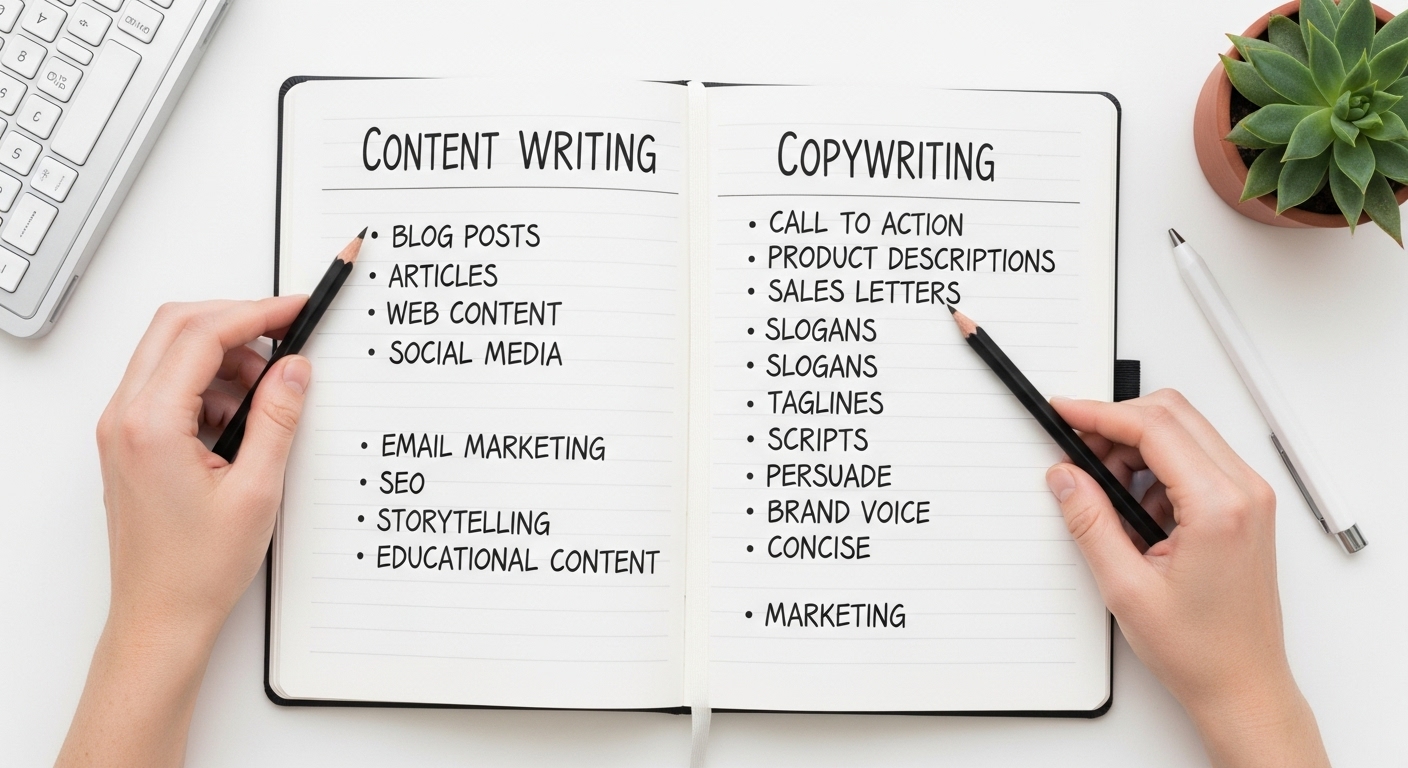
If you’ve ever looked up writing jobs online, you’ve likely seen the terms content writing and copywriting thrown around everywhere—sometimes even used interchangeably. At first glance, they might seem like the same thing: both involve writing, both show up on websites, and both are important for businesses. But the truth is, they’re not the same at all.
Imagine you’re walking into a store. One sign tells you a story about how a product changed someone’s life. Another says: “Limited Stock—Buy Now.” Both are written with a purpose, but they serve very different roles.
That’s the line between content writing and copywriting.
Whether you’re starting a writing career or hiring a writer for your business, knowing this difference isn’t just helpful—it’s essential. Because while both aim to engage the reader, one informs and builds trust, and the other persuades and sells.
In this blog, we will walk through the clear distinctions between content writing and copywriting—without the jargon—and help you understand when, where, and how each one works best.
1. Understanding the Core Purpose
Every type of writing has a purpose, and understanding that purpose is where the real distinction between content writing and copywriting begins. These two forms of writing might overlap in places, but they are driven by very different goals. That core intent is what defines their function in the world of marketing.
Content Writing Builds Relationships
The main goal of content writing is to educate, inform, or entertain. It creates long-term value by building trust with the audience. Think blog posts, articles, how-to guides, or even case studies. These aren’t written to sell immediately—they’re written to connect, offer knowledge, and solve problems.
When done right, content writing builds a loyal audience over time.
Copywriting Drives Action
Copywriting, on the other hand, is all about getting the reader to act—buy, subscribe, click, sign up. It’s short, sharp, and persuasive. You’ll find copy in ad campaigns, sales pages, product descriptions, and email headlines.
Copywriting doesn’t beat around the bush—it grabs attention and urges you to do something now.
2. Where They’re Used: Common Formats
Well, the writing appears to say a lot about its purpose. Content and copy may both live on the same website, but their placement, structure, and tone depend on the desired outcome. Let’s look at where each one is typically used and what kind of platforms or formats they thrive in.
Sometimes it’s easier to see the difference by looking at where each style lives in the real world.
Content Writing Examples:
- Blog posts (like the one you’re reading now)
- How-to guides
- Case studies
- Whitepapers
- E-books
- Informational newsletters
- SEO articles
These are written with depth and often optimized for search engines. They aim to answer questions and provide genuine value.
Copywriting Examples:
- Social media ads
- Website banners
- Product pages
- Google or Facebook ad copy
- Landing pages
- Email subject lines
- Slogans and taglines
These are written to hook the reader fast and lead them toward a conversion.
3. Tone and Style Differences
Tone is what connects with the audience. Even if the subject is similar, the tone of content writing and copywriting can be quite different. One informs with clarity, while the other convinces with urgency. Understanding this helps writers maintain brand identity while still aligning with specific goals.
Content Writing: Conversational, Informative, and Consistent
In content writing, the tone often adapts to the brand voice but remains accessible, clear, and informative. It’s designed to hold attention over longer periods and communicate depth.
Example:
“If you’re new to using SEO tools, don’t worry—we’ve broken down the basics for you in this step-by-step guide.”
It’s helpful and friendly—meant to guide the reader.
Copywriting: Bold, Persuasive, and Emotionally Charged
Copywriting skips the warmup. It’s action-oriented, benefit-driven, and emotional. A good copywriter understands what the customer wants—and isn’t afraid to speak directly to it.
For example:
“Boost your traffic by 200%—Start your free trial today!”
It cuts through noise and uses emotion or urgency to spark a response.
4. Writing Structure: Long-Form vs. Short-Form
Length and structure matter more than most think. Content writing is usually expansive and well-organized. Copywriting, on the other hand, is lean and impactful. Each one is structured to match the attention span, need, and stage of the buyer’s journey.
Content Writing: Structured and Detailed
Content writers are often working on pieces that run 800 to 2000 words or more. These are structured with clear subheadings (like H2s and H3s), bullets, and explanations. The goal is to guide the reader through an idea or topic thoroughly.
You’re not rushing to the point—you’re building a journey.
Copywriting: Concise and Strategic
Copywriters work within tight space limits. Every word counts. A single sentence might take hours to get just right because it’s the one line that could lead to a purchase or sign-up.
Even long-form sales pages are structured to keep the reader emotionally engaged from top to bottom—with clear calls to action sprinkled throughout.
5. SEO and Audience Engagement
In digital marketing, SEO and user engagement are key. Content and copy both play roles in this area—but in very different ways. Content is often used to increase visibility and authority, while copy is what drives user behavior once they’ve landed on the page.
Content Writing Supports Organic Growth
By targeting keywords, answering common questions, and using SEO best practices, content writers help businesses improve their online visibility organically.
For example, if someone searches “how to choose a coffee machine,” a well-written content piece on that topic could pull in thousands of views—without paying for ads.
Copywriting Converts the Traffic
Once that traffic lands on the site, copywriting takes over. That’s when it’s time to encourage a sale, capture an email, or get the user to click something. It’s like this: content brings them in, copy convinces them to stay (or buy).
6. Skills Required for Each Role
While there’s overlap in the skills needed for both roles, the focus and tools vary. A content writer dives deep into topics and context, while a copywriter taps into psychology and persuasion. Knowing which skill set you need can help in hiring—or training—more effectively.
Content Writing Skills
- Research and analysis
- SEO knowledge
- Storytelling
- Organizing long-form information
- Patience and consistency
- Clear, informative writing style
Copywriting Skills
- Psychology and consumer behavior
- Persuasive language
- Emotional triggers
- Crisp and clean sentence structure
- Writing headlines and calls to action
- Brand voice mastery
If content writing is about building trust, copywriting is about creating urgency.
7. Do Content Writing and Copywriting Ever Overlap?
Absolutely. In fact, many writers do both, especially in digital marketing. A good blog post (content) may end with a CTA (copy). A great email newsletter often includes helpful tips (content) and a promotional link (copy).
That said, the mindset for each is different:
- Content writing is long-game thinking.
- Copywriting is short-term action.
Knowing when to switch hats makes all the difference.
8. Which One Is Right for You?
Choosing between content writing and copywriting depends entirely on what you’re trying to achieve. Are you looking to educate and grow organically, or drive quick action and boost conversions?
This section helps you decide what suits your business goals or writing strengths.
personality and strengths.
You might love content writing if:
- You enjoy diving deep into topics
- You like helping others learn or solve problems
- You’re patient and okay with delayed results
- You enjoy storytelling and explaining
You might love copywriting if:
- You’re fascinated by marketing and sales
- You love experimenting with words and headlines
- You enjoy writing punchy, high-impact messages
- You like immediate feedback and conversions
Many professional writers develop both skill sets, but knowing your natural style gives you a head start.
Conclusion
The line between content writing and copywriting isn’t blurry—it’s strategic. One draws people in with value, the other moves them to act. Businesses need both. Writers often learn both. But understanding the difference helps you write with sharper focus, better results, and clearer goals.
Content writing is the blog post that helps someone make a decision. Copywriting is the button they click to say “yes.”
If you’re a business owner, knowing when to use each can transform your marketing. If you’re a writer, mastering both can open new doors in your career.
