
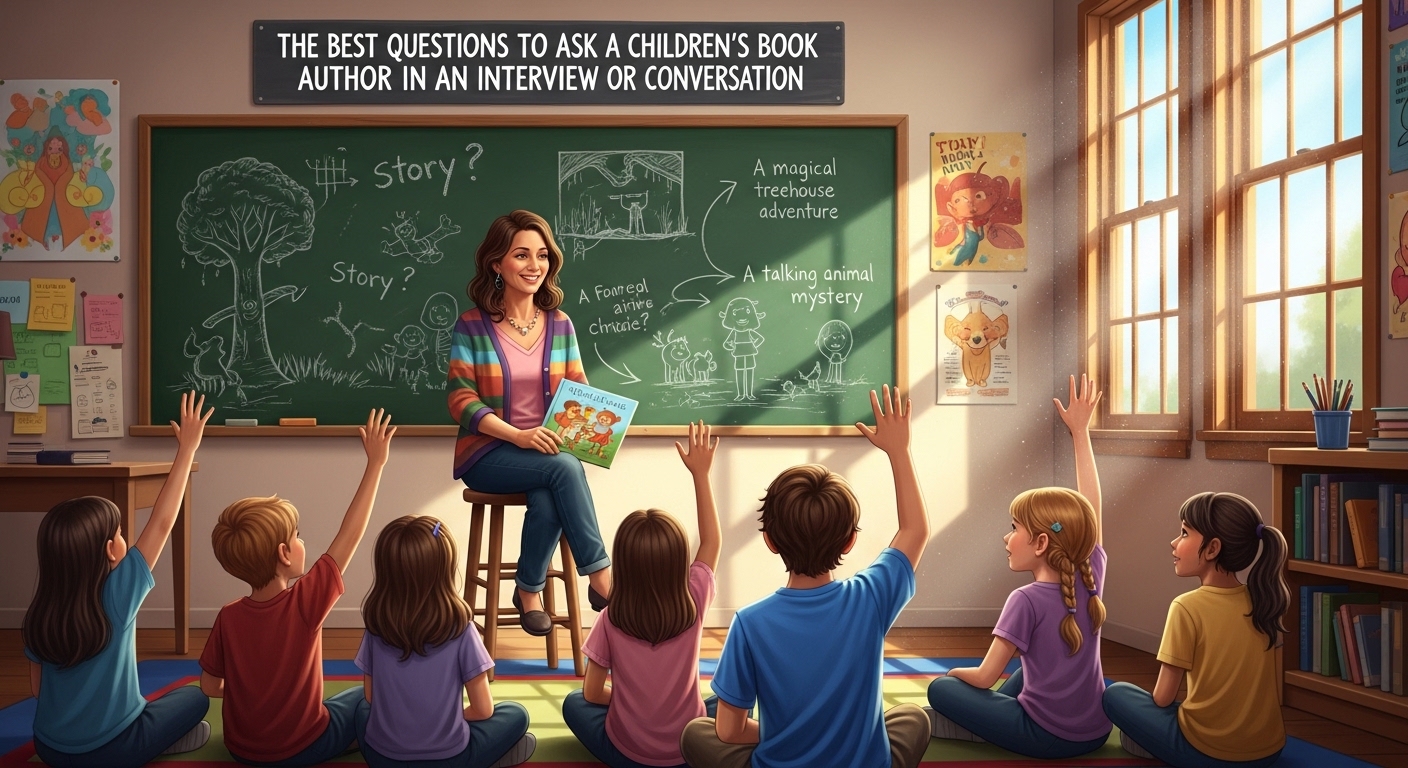
There is something quietly powerful about a well-asked question. When you sit across from a children’s book author, whether at a literary festival, a classroom visit, or a recorded interview, you are not just gathering answers; you are unlocking stories behind the stories. The magic of children’s literature often feels effortless on the page, but behind it lies deliberate craft, emotional intelligence, and an acute awareness of young readers. Asking the right questions transforms a routine conversation into something memorable, insightful, and deeply human. This blog explores the most meaningful, thoughtful, and engaging questions you can ask a children’s book author, not as a checklist, but as a way to spark richer conversations and uncover the layers that shape their work.
Why Asking the Right Questions Matters
Children’s literature occupies a unique space. It is both simple and complex, playful and profound. Authors must balance imagination with developmental awareness, storytelling with subtle teaching. Because of this, interviews with children’s authors demand a different kind of curiosity—one that goes beyond surface-level inquiries.
Research and industry insights suggest that authors often draw from personal experiences, observation, and emotional memory when creating stories for young readers . That means your questions should aim to uncover not just what they write, but why they write it, and how they translate life into language that resonates with children.
Good questions do more than gather information. They invite reflection, encourage storytelling, and reveal the philosophy behind the work.
Questions That Explore Inspiration and Beginnings
Every children’s book begins somewhere, often in a quiet moment, a memory, or a fleeting idea. Starting with inspiration helps establish tone and opens the door to deeper discussion.
Instead of simply asking what inspired the author, consider how their personal experiences shaped specific stories. Many children’s authors cite childhood memories, observations, and emotional experiences as core influences . Asking how those experiences evolved into a narrative often leads to richer answers.
Another compelling direction is to explore the moment they realized they wanted to write for children specifically. Writing for young audiences requires a distinct mindset, and understanding that choice reveals a lot about their creative identity.
You might also ask how their inspirations have changed over time. An author’s early motivations can differ significantly from what drives them later in their career, offering insight into growth and creative evolution.
Questions About the Writing Process
The writing process is where imagination becomes structure. It is also where many aspiring writers look for guidance, making this area particularly valuable.
Children’s authors often describe a process that includes brainstorming, drafting, revising, and seeking feedback. But the real depth comes when you ask how they navigate uncertainty within that process.
Instead of asking for a step-by-step breakdown, focus on the emotional and creative aspects. How do they know when an idea is strong enough to pursue? What does a “bad writing day” look like for them? How do they approach revision when working for a young audience?
Another important angle is collaboration. Children’s books frequently involve illustrators, editors, and publishers. Asking how authors collaborate, especially how they communicate ideas visually, can reveal the unseen teamwork behind the final product.
Questions That Dive Into Characters and Storytelling
Children’s stories live or die by their characters. They must be relatable, memorable, and emotionally resonant, often with fewer words than adult fiction.
Strong interview questions here focus on character creation. Authors often build characters from real-life observations and experiences, adding distinct traits and emotional depth to make them relatable . Asking how they develop a character’s voice or personality can uncover their creative techniques.
You can also explore how they balance simplicity and complexity. Children’s characters must be easy to understand but still layered enough to feel real. Asking how they achieve that balance often leads to fascinating insights.
Another compelling question is how they handle conflict in stories for children. Conflict must be engaging but also appropriate, and authors often have thoughtful approaches to this challenge.
Questions About Writing for Different Age Groups
Children’s literature spans a wide range, from picture books to middle-grade novels. Each age group demands a different tone, vocabulary, and narrative complexity.
Authors frequently adapt their language and themes based on developmental stages . Asking how they approach writing for different age groups can reveal the technical side of their craft.
You might also ask how they test whether their content is age-appropriate. Many authors rely on feedback from children, parents, and educators to refine their work . Understanding this process highlights the collaborative nature of children’s publishing.
Another angle is to explore how they maintain authenticity across age groups. Writing for a five-year-old is vastly different from writing for a twelve-year-old, and authors must constantly adjust their perspective.
Questions About Themes and Messages
Children’s books often carry underlying messages, about kindness, courage, identity, or resilience—but the best ones do so subtly.
A strong question here is how the author incorporates themes without becoming overly didactic. Many writers aim to embed lessons naturally within the narrative rather than presenting them directly .
You can also ask whether they consciously choose themes or if themes emerge organically during the writing process. This distinction often reveals whether the author is message-driven or story-driven.
Another meaningful direction is to ask what they hope young readers take away from their books. This question shifts the focus from craft to impact, offering a glimpse into the author’s purpose.
Questions About Creativity and Imagination
Children’s literature thrives on imagination, but imagination is not random, it is shaped, disciplined, and refined.
Authors often find ideas in everyday moments, conversations, or observations . Asking how they capture and develop these ideas can reveal practical techniques for creativity.
You might also explore how they stay imaginative over time. Creativity can fluctuate, and understanding how authors sustain it provides valuable insight.
Another angle is to ask how they approach originality. In a crowded market, standing out requires both innovation and authenticity. Authors often have unique perspectives on how they achieve this balance.
Questions About Challenges and Growth
No creative journey is without obstacles. Asking about challenges adds depth and realism to the conversation.
Authors often mention balancing creativity with discipline as one of their biggest challenges . Exploring how they manage this tension can lead to honest and relatable answers.
You can also ask about rejection, revision, or creative doubt. These topics resonate with aspiring writers and provide a more complete picture of the author’s journey.
Another meaningful question is how they have evolved over time. Growth is a central part of any creative career, and authors often have insightful reflections on their development.
Questions About the Publishing Journey
The path from manuscript to published book is often complex and collaborative.
Children’s authors typically work closely with editors, illustrators, and publishers to bring their stories to life . Asking about this process can reveal the behind-the-scenes realities of publishing.
You might also explore how they navigate marketing and promotion. In today’s landscape, authors are often involved in promoting their work through events, social media, and school visits .
Another useful angle is to ask what surprised them most about the publishing process. Unexpected insights often emerge from this question.
Questions That Connect With Readers
At its core, children’s literature is about connection. The relationship between author and reader is especially meaningful in this genre.
Asking how authors engage with their readers—through school visits, letters, or events—can reveal how they see their audience.
You might also ask what kind of feedback has impacted them the most. Often, it is a simple comment from a child that leaves a lasting impression.
Another powerful question is how they measure success. For many children’s authors, success is not just about sales, but about emotional impact and reader connection.
A Practical Table of Question Categories
| Category | Purpose | Example Question Style | Insight Gained |
| Inspiration | Understand origins of ideas | What sparked this story for you? | Personal motivations |
| Writing Process | Explore craft and workflow | How do you approach revising a story? | Creative discipline |
| Characters | Reveal storytelling depth | How do you make characters relatable? | Emotional connection |
| Age Groups | Understand audience targeting | How do you adapt writing for different ages? | Technical skill |
| Themes | Explore meaning and message | How do you weave lessons into your stories? | Narrative intention |
| Creativity | Understand idea generation | Where do your best ideas come from? | Imaginative process |
| Challenges | Reveal struggles and growth | What has been your biggest challenge as a writer? | Personal journey |
| Publishing | Show industry realities | What surprised you about publishing? | Professional insight |
| Reader Connection | Highlight impact | What feedback from readers stays with you? | Emotional resonance |
How to Ask Better Questions
The difference between a good interview and a great one often lies in how questions are asked. Open-ended questions tend to produce richer responses, while overly specific or closed questions can limit the conversation.
Research into questioning techniques shows that open-ended and reflective questions encourage deeper thinking and more meaningful responses . This applies just as much to author interviews as it does to education.
Timing also matters. Starting with lighter, more accessible questions helps build rapport, while deeper, more reflective questions can come later in the conversation.
Most importantly, listening is just as important as asking. The best follow-up questions often come from paying attention to what the author has already shared.
Conclusion
Interviewing a children’s book author is not about ticking off a list of questions. It is about creating a space where stories—both written and unwritten, can emerge. The best questions are those that invite honesty, curiosity, and reflection. They explore not just the mechanics of writing, but the emotions, experiences, and intentions behind it.
When done well, an author interview becomes more than a conversation. It becomes a bridge between the creator, the story, and the reader. And in the world of children’s literature, that bridge is where the real magic happens.
