
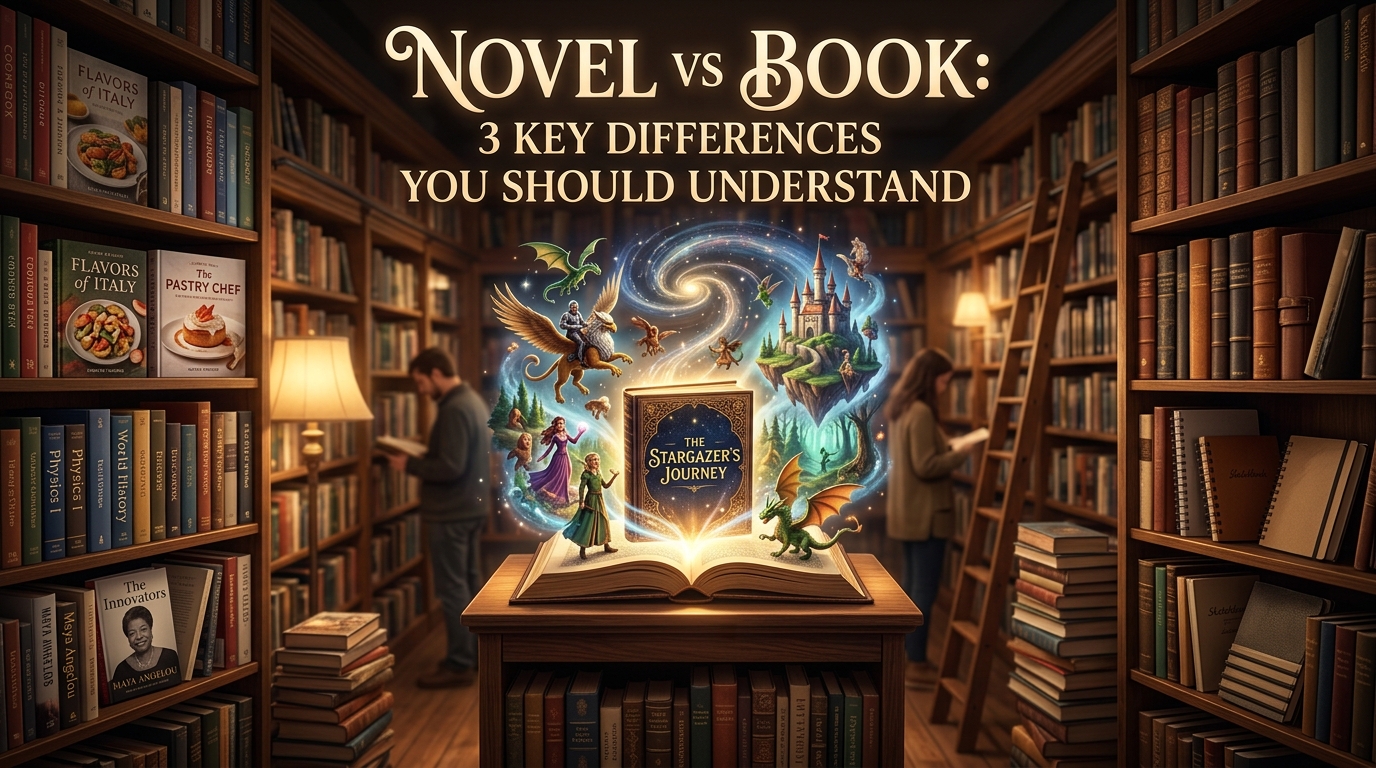
People often use the words “novel” and “book” as if they mean exactly the same thing. In casual conversation, someone may say they bought a new book when they are actually referring to a fictional story. Another person may describe their favorite novel while standing in a bookstore filled with biographies, cookbooks, journals, academic texts, and poetry collections. Because these two terms are so closely related, the distinction between them is frequently overlooked.
However, there is an important difference between a novel and a book, and understanding that difference can completely change the way we think about literature, publishing, writing, and reading itself. A novel belongs to a specific literary category, while a book is a much broader term that includes many forms of written material. Every novel is a book, but not every book is a novel.
This difference matters more than people realize. Readers use these terms when selecting genres. Writers use them when describing their work to publishers. Students encounter them in academic settings, while publishers organize entire markets around these categories. Even digital platforms separate novels from other types of books because audiences search for them differently.
The rise of ebooks, audiobooks, independent publishing, and digital storytelling has also expanded the meaning of what a book can be. Today, the publishing world includes everything from graphic novels and memoirs to interactive learning materials and narrative nonfiction. As literature continues evolving, understanding the difference between a novel and a book becomes even more important for readers and writers alike.
This article explores the three major differences between novels and books, while also examining how these forms developed historically, how publishers classify them, and why the distinction still matters in modern literature.
Understanding the Meaning of a Book
A book is a general term used to describe any written or printed work that is organized into pages or digital sections. It is one of the broadest categories in literature and publishing. Books can contain fiction, nonfiction, educational material, poetry, reference content, photography, or even blank pages intended for note-taking.
The concept of a book has existed for centuries. Ancient civilizations preserved information on clay tablets, scrolls, and handwritten manuscripts before the invention of the modern printed book. Over time, books became one of humanity’s most important tools for preserving knowledge, storytelling, culture, religion, and history.
Today, books exist in countless forms. A cookbook is a book. A dictionary is a book. A history textbook is a book. A memoir is a book. A collection of poems is also a book. The defining feature is not the subject matter or storytelling style but the fact that the content is compiled into a readable format designed for distribution and consumption.
Books can be educational, entertaining, informational, emotional, or practical. Some books teach technical skills, while others inspire imagination. Some are deeply personal narratives, while others focus entirely on factual information.
This broad definition is what separates books from novels. A book can belong to virtually any literary or informational category.
Understanding the Meaning of a Novel
A novel is a specific type of book that tells a fictional narrative through structured storytelling. Novels usually focus on characters, plot development, emotional arcs, settings, themes, and conflicts. They are designed primarily to entertain, provoke thought, or emotionally engage readers through an extended fictional narrative.
The word “novel” originates from the Italian word novella, meaning “something new.” Early novels emerged as long-form fictional prose narratives that differed from myths, epics, and oral storytelling traditions. Over time, novels evolved into one of the most influential literary forms in the world.
Unlike the broader category of books, novels almost always revolve around storytelling. They include central characters who experience challenges, relationships, transformations, or journeys. Whether the story is romantic, dramatic, mysterious, historical, or futuristic, the structure of a novel is built around narrative progression.
Modern novels come in many genres, including literary fiction, science fiction, fantasy, romance, horror, thriller, dystopian fiction, and historical fiction. Despite their differences in tone and style, they all share one essential characteristic: they tell fictional stories in extended prose form.
Novels are often associated with imagination and emotional immersion. Readers enter fictional worlds, connect with characters, and experience stories that may reflect real human emotions even when the events themselves are invented.
This storytelling function is one of the clearest ways novels differ from books in general.
The 3 Key Differences Between a Novel and a Book
1. A Book Is a Broad Category While a Novel Is a Specific Type
The first and most important difference is classification.
A book is an umbrella term that includes many forms of written work. A novel is one specific category within that umbrella. This means that novels are only one part of the larger literary ecosystem.
To understand this more clearly, imagine a library. Every item on the shelves may be considered a book, but only certain sections contain novels. The biography section contains books, but not novels. The science section contains books, but not novels. The self-help aisle contains books, but not novels. The fiction section, however, is where novels primarily belong.
This distinction becomes especially important in publishing and bookselling. Publishers classify books according to genre, audience, purpose, and format. A publisher may release business books, educational books, children’s books, and novels under entirely different editorial divisions because each category serves a different readership.
The broad nature of books allows them to include both factual and fictional material. A novel, however, belongs almost exclusively to the fictional side of literature.
This difference also affects how readers search for content. Someone looking for a novel typically wants an immersive narrative experience. Someone searching for a book may be seeking information, guidance, education, inspiration, or entertainment.
The distinction may seem technical, but it shapes the entire structure of the publishing industry.
Main Difference Between a Book and a Novel
| Feature | Book | Novel |
| Definition | A broad written or printed work | A fictional narrative book |
| Content Type | Fiction or nonfiction | Primarily fiction |
| Purpose | Inform, educate, entertain, guide | Tell a story |
| Structure | Varies widely | Narrative storytelling |
| Genres | Unlimited categories | Fiction-based genres |
| Examples | Biography, textbook, cookbook | Romance, thriller, fantasy |
| Audience Intent | Learning or entertainment | Story immersion |
2. Novels Focus on Fictional Storytelling While Books May Not
The second major difference lies in storytelling.
A novel is fundamentally narrative-driven. Its primary goal is to tell a story through characters, settings, dialogue, conflict, and plot development. Readers follow emotional journeys, dramatic events, and thematic explorations from beginning to end.
Books, however, do not always rely on storytelling at all.
A history book may explain real-world events using analysis and research rather than fictional narrative. A medical textbook may provide scientific information without characters or plotlines. A motivational book may offer life advice, strategies, and reflections instead of storytelling.
Even when nonfiction books use narrative techniques, their purpose remains different from novels. A memoir, for instance, may tell a real-life story, but it is still categorized separately because it is based on factual experiences rather than fictional invention.
Novels rely heavily on imagination. Authors create fictional characters, imagined worlds, dramatic tensions, and emotional arcs. Readers engage with these elements emotionally rather than academically.
This storytelling focus is what gives novels their unique literary power. Great novels allow readers to experience perspectives, emotions, and realities beyond their own lives. They create empathy through fictional experiences.
Books that are not novels often prioritize clarity, knowledge, instruction, or expertise over emotional immersion. Their purpose may be educational or practical rather than narrative.
That is why readers approach novels differently from other books. Reading a novel is often an emotional and imaginative experience, while reading a nonfiction book may be more analytical or goal-oriented.
3. The Structure and Writing Style Are Different
The third major difference involves structure and writing style.
Novels follow a narrative structure designed to sustain reader engagement across a long fictional journey. Most novels include introductions, rising action, conflict, climax, and resolution. Character development is central to the reading experience.
Authors carefully build pacing, suspense, emotional tension, and thematic depth throughout the narrative. Dialogue plays a major role in revealing personality and advancing the story. Descriptive language is often used to create atmosphere and emotional resonance.
Books, on the other hand, can use virtually any structure depending on their purpose.
An academic book may include chapters organized around theories and research findings. A cookbook may focus on recipes and instructions. A poetry collection may contain independent pieces without a continuous narrative. A business book may use case studies, frameworks, and analytical discussions.
Because books serve many functions, their writing styles vary dramatically. Some are formal and technical, while others are conversational and motivational.
Novels usually aim for emotional engagement and immersive storytelling. Other books may prioritize precision, efficiency, authority, or instructional clarity instead.
This difference also influences how writers approach the creative process. Novelists spend significant time developing characters, themes, world-building, and pacing. Nonfiction authors may focus more on research, factual accuracy, and organization.
Both forms require skill, but the writing objectives are often entirely different.
Why People Confuse Novels and Books
The confusion exists largely because novels are among the most popular and commercially visible types of books in the world. Bestsellers, literary awards, movie adaptations, and cultural discussions frequently center around novels.
When people say they love reading books, they are often referring specifically to novels. Fiction dominates many reading communities, social media discussions, and entertainment-focused literary spaces.
Bookstores also contribute to the confusion because novels occupy large sections of retail shelves. Online marketplaces recommend fiction heavily because it generates strong emotional engagement and repeat readership.
Another reason is that the word “book” is easier and more casual in conversation. Saying “I wrote a book” sounds broader and more accessible than specifying “I wrote a historical fiction novel.”
Language naturally simplifies distinctions over time, especially when categories overlap frequently.
Still, understanding the difference helps people communicate more accurately about literature and publishing.
The Historical Evolution of the Novel
The modern novel did not appear overnight. It evolved gradually over centuries as storytelling traditions changed.
Early civilizations relied heavily on oral storytelling, myths, epics, and poetry. Ancient works like heroic epics contained narrative elements but were not considered novels in the modern sense.
The rise of printed literature in Europe during the Renaissance helped shape the development of long-form prose fiction. By the 17th and 18th centuries, novels became increasingly popular among readers seeking realistic stories about human experiences.
Writers began focusing on individual characters, emotional realism, and everyday social life. This marked a major shift away from mythological storytelling toward personal narrative exploration.
Over time, novels became one of the dominant forms of literary expression worldwide. Different cultures developed their own traditions of fiction, contributing to the incredible diversity of novels available today.
The publishing industry eventually recognized novels as a separate commercial and artistic category because their audience expectations differed from nonfiction readers.
Fiction and Nonfiction: The Core Divide
At the heart of the novel-versus-book discussion lies the difference between fiction and nonfiction.
Novels belong primarily to fiction. Their stories are invented, even when inspired by real events or historical settings. Fiction gives writers creative freedom to imagine situations, dialogue, and characters beyond literal reality.
Books as a category include both fiction and nonfiction. Nonfiction focuses on factual accuracy, real-world events, expertise, or lived experiences.
This distinction affects reader expectations. Readers trust nonfiction books for information and insight. Readers approach novels expecting imagination, creativity, and emotional storytelling.
Interestingly, some modern works blur the boundaries between fiction and nonfiction. Narrative nonfiction uses storytelling techniques similar to novels while remaining factually grounded. Autofiction blends autobiography with fictional elements. Hybrid literary forms continue challenging traditional categories.
Even so, the core distinction remains useful because novels are still primarily associated with fictional narrative.
How Publishers Categorize Novels and Books
Publishers rely heavily on categorization because it helps target the right audience.
When a manuscript is submitted to a publishing house, one of the first questions editors ask is whether it is fiction or nonfiction. If it is fiction, they then determine whether it qualifies as a novel, novella, short story collection, or another literary form.
Marketing strategies depend heavily on these classifications. Novels are often promoted through emotional hooks, character-driven summaries, and genre-specific branding. Nonfiction books may focus more on expertise, authority, or practical value.
Bookstores and digital platforms also organize titles according to these categories. Online recommendation algorithms separate fiction readers from nonfiction readers because their interests and purchasing habits differ.
This classification system demonstrates why understanding the difference matters professionally as well as academically.
Can a Novel Be Based on Real Events?
Many people assume novels must be entirely imaginary, but that is not always true.
A novel can absolutely be inspired by real people, historical periods, or actual events. Historical fiction, for example, often incorporates real wars, political movements, and cultural settings while introducing fictional characters and imagined dialogue.
The key distinction is that novels still allow creative invention. Authors are not bound by strict factual accuracy in the same way nonfiction writers are.
This freedom enables novelists to explore emotional truths, symbolic themes, and alternate perspectives even when their stories are grounded in reality.
That is why some novels feel deeply authentic despite being fictional.
The Role of Novels in Modern Culture
Novels continue playing a major role in shaping modern culture, entertainment, and social conversation.
Many films and television series originate from bestselling novels. Literary fiction influences academic discussion and intellectual thought. Young adult novels shape generational reading habits. Fantasy and science fiction novels expand cultural imagination.
Novels also help readers understand different identities, experiences, and worldviews. Through fictional storytelling, readers encounter emotional realities beyond their own lives.
Books in general preserve knowledge, but novels specifically preserve emotional and imaginative exploration.
This cultural impact explains why novels remain such a dominant literary form despite the growth of digital media and short-form content.
Why Understanding the Difference Matters
At first glance, the distinction between a novel and a book may seem minor. However, understanding the difference improves literary awareness, communication, and publishing knowledge.
For readers, it helps clarify expectations when selecting material. For writers, it shapes how projects are developed and marketed. For students, it strengthens understanding of literary classification. For publishers, it guides branding and audience targeting.
More importantly, recognizing the distinction deepens appreciation for literature itself. It reminds us that books are incredibly diverse, ranging from factual instruction to imaginative storytelling.
Novels represent one powerful branch of that larger literary world.
Final Thoughts
The difference between a novel and a book ultimately comes down to scope, purpose, and storytelling. A book is a broad category that includes countless forms of written work, while a novel is a specific type of fictional narrative book designed to immerse readers in story-driven experiences.
The three key differences are simple but significant. Books include many categories, while novels belong to one literary form. Novels focus on fictional storytelling, while books may serve informational or educational purposes. Novels follow narrative structures centered on character and plot, while books can use many different organizational styles.
Understanding these differences helps readers, writers, and students engage more thoughtfully with literature and publishing. It also highlights the incredible range of written expression that exists within the world of books.
Every novel is a book, but not every book is a novel. That single distinction explains an entire universe of literary diversity.
