
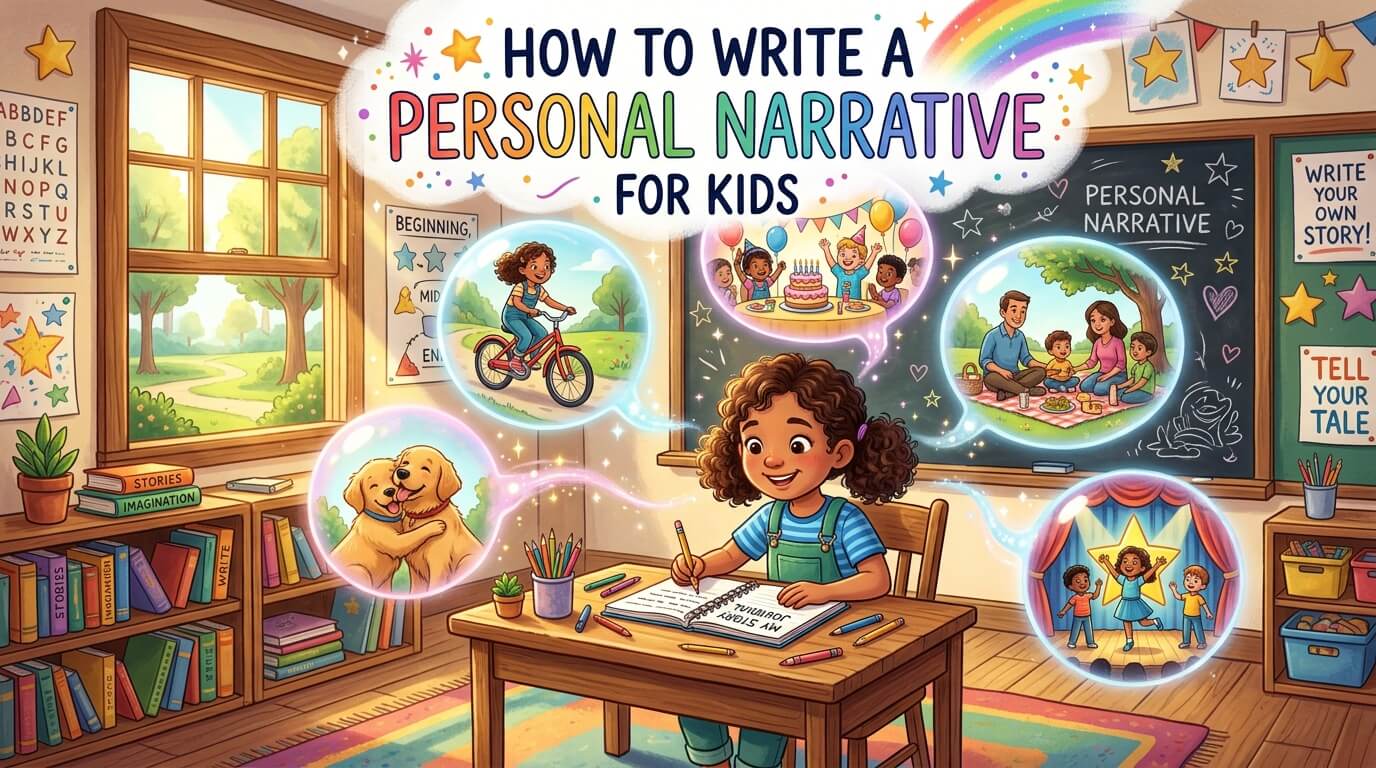
Writing a personal narrative is one of the best ways for children to discover the joy of storytelling. Every child has memories worth sharing, whether it is the excitement of a first school trip, the nervousness before a spelling bee, the thrill of learning to ride a bicycle, or a funny family vacation. A personal narrative transforms these real-life experiences into engaging stories that allow readers to see the world through the writer’s eyes.
Unlike fictional stories, a personal narrative is based on something that actually happened. The goal is not simply to list events but to help readers experience the moment through vivid descriptions, emotions, and meaningful reflections. When children learn to write personal narratives, they strengthen much more than their writing skills. They improve observation, memory, organization, creativity, vocabulary, and communication. These skills become valuable across every school subject and continue to benefit them as they grow.
This guide explains how kids can write interesting, organized, and memorable personal narratives. Whether writing for school assignments, writing competitions, or simply for fun, understanding the fundamentals of personal narrative writing helps young writers tell their stories with confidence and imagination.
What Is a Personal Narrative?
A personal narrative is a true story about something that happened to the writer. It focuses on a single experience or event and tells it from the writer’s point of view using the first-person perspective with words like “I,” “me,” and “my.”
Instead of explaining facts like an informational essay, a personal narrative recreates an experience so readers can picture it in their minds. The writer describes what happened, how they felt, what they learned, and why the experience mattered. Every personal narrative has a beginning, middle, and ending that work together to create a complete story.
Children often wonder if ordinary moments can become great stories. The answer is yes. Sometimes the smallest experiences create the most memorable narratives because they contain genuine emotions and relatable moments.
Why Personal Narrative Writing Is Important for Kids
Writing personal narratives encourages children to look closely at their own lives and recognize meaningful moments that might otherwise be forgotten. It teaches them that every experience has a story waiting to be told.
As children practice narrative writing, they naturally develop stronger language skills. They learn how to organize ideas logically, choose descriptive vocabulary, vary sentence structures, and create smooth transitions between events. These skills also improve reading comprehension and classroom writing assignments.
Personal narratives also help children understand emotions more deeply. Writing about happiness, fear, excitement, disappointment, or surprise encourages emotional awareness and empathy. Readers connect with stories because they recognize similar feelings from their own experiences.
Perhaps most importantly, personal narratives build confidence. Completing a story about a real experience reminds children that their voices matter and that their unique perspectives deserve to be heard.
Choosing the Right Story to Tell
Many young writers struggle because they think they need an extraordinary adventure before they can write an interesting narrative. In reality, the best stories usually come from simple experiences filled with genuine emotions.
A memorable story could describe the first day at a new school, adopting a pet, winning a soccer game, losing a favorite toy, baking cookies with grandparents, learning how to swim, visiting the zoo, performing in a school play, celebrating a birthday, or overcoming a personal fear.
The key is choosing one specific moment instead of trying to tell everything that happened over several days or weeks. Narrowing the focus allows the writer to include richer details and helps readers stay engaged from beginning to end.
Planning Before Writing
Good writers rarely begin with the first sentence. Instead, they spend time thinking about the story before writing it.
Planning helps children organize events in the correct order while identifying the most exciting and meaningful parts of the experience. They can ask themselves simple questions such as what happened first, what happened next, what problem or challenge appeared, how it was solved, and what they learned afterward.
Taking a few minutes to think before writing often makes the drafting process much easier because the story already has a clear direction.
Understanding the Structure of a Personal Narrative
Although every story is different, most successful personal narratives follow a simple structure that guides readers naturally through the experience.
| Story Section | Purpose | Questions It Answers |
| Introduction | Introduces the event and grabs attention | Who? Where? When? |
| Beginning | Sets the scene and introduces the situation | What was happening? |
| Middle | Describes the main events, emotions, and challenges | What happened next? |
| Climax | Shows the most important or exciting moment | What changed everything? |
| Ending | Explains the outcome and lesson learned | Why did this experience matter? |
Following this structure helps young writers avoid confusing readers or leaving out important information.
Writing an Engaging Introduction
The introduction should immediately encourage readers to continue reading. Instead of beginning with a plain sentence such as, “Last summer I went camping,” children can create curiosity by describing an exciting moment or an interesting feeling.
For example, they might begin by describing the loud sound of thunder during a camping trip or the butterflies in their stomach before walking onto a stage for the first time. Starting in the middle of the action often captures attention more effectively than beginning with background information.
An engaging introduction also provides enough context for readers to understand where the story takes place without revealing everything that will happen later.
Bringing the Story to Life with Descriptive Details
One characteristic that separates an average narrative from an excellent one is descriptive writing. Readers enjoy stories that help them imagine every scene clearly.
Instead of saying the park was beautiful, children can describe the colorful flowers, the smell of fresh grass, the bright sunshine, and the cheerful sounds of birds singing in nearby trees. Rather than saying they were scared, they can explain how their hands shook, their heart raced, and their knees felt weak.
Using the five senses makes scenes feel realistic. Writers should think about what they saw, heard, smelled, tasted, and touched during the experience. These sensory details make readers feel as though they are experiencing the event alongside the writer.
Showing Feelings Instead of Simply Telling Them
Emotions are the heart of every personal narrative. Readers connect most strongly when they understand how the writer felt during each important moment.
Instead of writing, “I was nervous,” children can describe the physical signs of nervousness. Perhaps their palms became sweaty, their voice became shaky, or they forgot what they wanted to say. These descriptions allow readers to experience the emotion rather than simply being told about it.
As the story progresses, emotions may change naturally. A child might begin feeling frightened before a race, become determined during the competition, and finish feeling proud regardless of the result. Showing these emotional changes makes the narrative feel authentic and meaningful.
Writing Events in a Logical Order
Readers should never feel confused about what happened first or why something occurred. A personal narrative usually follows chronological order, meaning events happen in the same sequence they occurred in real life.
Smooth transitions help connect one event to the next. Words and phrases such as “later that morning,” “after a few minutes,” “suddenly,” “before long,” and “finally” guide readers through the story without making it feel choppy.
Even when the experience was exciting, writers should avoid rushing through important moments. Spending extra time describing the biggest event allows readers to appreciate why it was memorable.
Adding Dialogue to Make the Story Feel Real
Dialogue can make personal narratives more lively by allowing readers to hear conversations between people in the story. Even short conversations can reveal emotions, build suspense, or add humor.
For example, instead of simply saying that a teacher encouraged them, the writer can include the actual words: “You can do this,” my teacher whispered with a smile. “Just believe in yourself.”
Dialogue should sound natural and serve a purpose. Every conversation should move the story forward or help readers understand the characters better rather than filling space unnecessarily.
Creating a Strong Ending That Leaves an Impression
The ending is one of the most important parts of a personal narrative because it gives meaning to the entire story. Instead of ending abruptly after the final event, young writers should take a moment to reflect on what happened and explain why the experience was important. A thoughtful conclusion helps readers understand how the event changed the writer or taught them something valuable.
Not every lesson has to be life-changing. Sometimes a child realizes they are braver than they thought, learns the importance of patience, discovers the value of teamwork, or simply gains a new appreciation for family and friends. Sharing this reflection gives the narrative a satisfying ending and reminds readers that every experience, big or small, can teach something meaningful.
Revising Your Personal Narrative
The first draft is only the beginning. Great writing happens during revision, when the writer improves the story by adding details, fixing confusing sections, and making sentences flow more naturally.
Reading the narrative aloud is one of the easiest ways for children to spot awkward wording or missing information. If a sentence sounds strange when spoken, it will probably sound strange to readers as well. During revision, writers should ask themselves whether the story is easy to follow, whether the emotions feel genuine, and whether enough details help readers imagine the experience.
Revision also gives children the chance to replace ordinary words with stronger, more descriptive vocabulary. Instead of using the same words repeatedly, they can choose words that paint a clearer picture and make the narrative more engaging.
Making Characters Feel Real
Although a personal narrative focuses on the writer, other people often play important roles in the story. Family members, friends, teachers, classmates, or neighbors become more memorable when they are described naturally through their actions, dialogue, and personalities.
Rather than giving long descriptions, young writers can show what makes someone unique through small details. A grandmother who always hums while cooking, a coach who encourages every player with a smile, or a best friend who laughs during difficult moments becomes easy for readers to picture.
Including these realistic touches makes the narrative richer and helps readers connect with everyone involved in the experience.
Using Sensory Language Throughout the Story
One of the easiest ways to improve a personal narrative is to include sensory details from beginning to end. Instead of saving descriptive writing for one paragraph, children should sprinkle vivid details throughout the entire story.
Readers enjoy imagining the warm sunlight on a summer afternoon, the cool breeze before a rainstorm, the smell of freshly baked cookies, the excitement of fireworks bursting overhead, or the rough texture of tree bark during a climbing adventure. These details transform ordinary events into memorable experiences.
When readers can imagine the sights, sounds, smells, tastes, and textures, they become part of the story rather than simply observing it.
Common Mistakes Kids Should Avoid
Many beginning writers try to include every detail they remember, which can make the narrative feel long and unfocused. A better approach is to concentrate on one important event and describe it well. Staying focused helps readers remain interested and allows the writer to develop meaningful details.
Another common mistake is moving too quickly through the most exciting part of the story. Sometimes children spend several paragraphs explaining the beginning but only one sentence describing the main event. The most important moment deserves the greatest attention because it is the heart of the narrative.
Young writers should also avoid using the same words repeatedly. Varying vocabulary and sentence structure makes the writing smoother and more enjoyable to read. Finally, proofreading for spelling, punctuation, and grammar helps present the story clearly and professionally.
Encouraging Creativity While Staying Truthful
A personal narrative is based on real events, but that does not mean it has to sound plain or boring. Writers can use creative language, vivid descriptions, interesting openings, and meaningful dialogue while still telling the truth.
Children sometimes worry that their stories are not exciting enough because they did not involve dramatic adventures. In reality, readers are often drawn to honest stories filled with real emotions. A small moment, such as helping a younger sibling, overcoming stage fright, or making a new friend, can become a powerful narrative when described with care and detail.
The goal is not to impress readers with extraordinary events but to help them understand how the experience felt and why it mattered.
Building Confidence Through Practice
Like every other skill, personal narrative writing improves with regular practice. The more children write about their own experiences, the easier it becomes to notice interesting moments worth sharing.
Keeping a journal is an excellent way to build this habit. Writing a few sentences each day about something funny, surprising, exciting, or challenging creates a collection of memories that can later become full personal narratives. Over time, children begin recognizing story ideas in everyday life without even trying.
Teachers and parents can encourage this growth by asking open-ended questions about daily experiences and allowing children to tell stories in their own words before writing them down. Speaking about an event often helps organize thoughts and makes writing feel less intimidating.
Turning Everyday Moments Into Memorable Stories
Some of the strongest personal narratives come from experiences that seem ordinary at first. A rainy afternoon spent indoors, losing a first tooth, planting flowers with family, learning to ride a scooter, participating in a science fair, or welcoming a new pet into the home can all become engaging stories.
The difference lies in how the writer tells the story. Rich descriptions, authentic emotions, realistic dialogue, and thoughtful reflection transform simple events into narratives that readers remember long after finishing the final paragraph.
Children should learn that every person has unique experiences. Even if two classmates visit the same zoo or attend the same birthday party, their personal narratives will be completely different because each person notices different details, feels different emotions, and learns different lessons.
Developing a Personal Writing Voice
As children continue writing personal narratives, they naturally begin developing their own writing voice. Voice is the personality that comes through in the words, making each story sound unique.
Some writers enjoy adding humor to their stories, while others focus on emotional moments or exciting adventures. There is no single correct style. The most effective personal narratives sound honest, natural, and genuine. Young writers should not worry about copying someone else’s style. Instead, they should focus on writing as though they are sharing an important memory with a trusted friend.
Over time, this authentic voice becomes one of the greatest strengths in their writing and helps every narrative feel personal and original.
Conclusion
Writing a personal narrative gives children the opportunity to preserve memories, express emotions, and develop essential writing skills that will benefit them throughout school and beyond. Every meaningful experience, whether joyful, challenging, funny, or surprising, has the potential to become a story worth sharing. By focusing on one memorable event, organizing ideas clearly, adding descriptive details, showing genuine emotions, and reflecting on the lesson learned, young writers can create narratives that capture readers’ attention from beginning to end.
The best personal narratives are not measured by how extraordinary the event was but by how honestly and vividly it is told. With regular practice, curiosity, and confidence, children can learn to transform everyday experiences into engaging stories that celebrate their unique perspectives. Every memory holds the possibility of becoming a meaningful narrative, and every child has a voice that deserves to be heard.
