
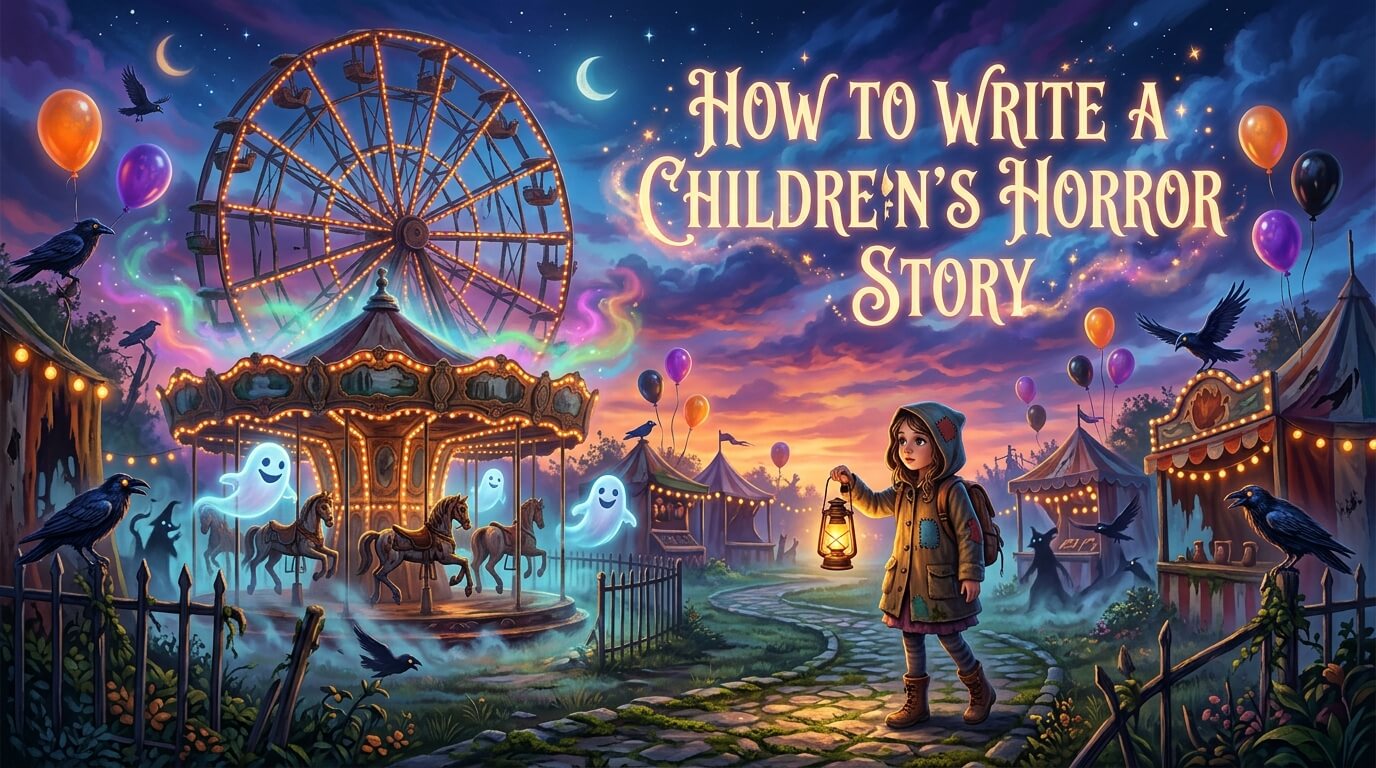
Writing horror for children is not just a softer version of adult horror. It is a completely different storytelling discipline with its own emotional rules, boundaries, and narrative purpose. While adult horror often leans into psychological distress, violence, or existential dread, children’s horror operates in a more imaginative, symbolic, and emotionally guided space.
At its core, children’s horror is about controlled fear. It allows young readers to experience suspense and mild terror in a safe environment where the outcome ultimately restores emotional balance. The purpose is not to disturb but to engage curiosity, strengthen courage, and develop emotional understanding. A well-written children’s horror story helps a child say, consciously or unconsciously, “That was scary, but I handled it.”
This genre also reflects how children naturally experience the world. Childhood is full of unknowns—dark rooms, strange noises, unexplained shadows, and strong imagination. Writers who understand this emotional landscape can transform ordinary experiences into compelling horror narratives that feel both familiar and thrilling.
Understanding the Psychology of Fear in Children
To write effective children’s horror, you must first understand how fear works in young minds. Children do not separate imagination and reality as sharply as adults do. This makes them highly responsive to suggestion, tone, and atmosphere. A single ambiguous sound can create more tension than a detailed description of a monster.
Fear in children is often linked to uncertainty rather than actual danger. They fear what they cannot explain. This is why children’s horror is most effective when it focuses on mystery rather than explicit threats. The unknown is always more powerful than the known.
Children also process fear in waves. They may feel scared one moment and laugh the next. This emotional flexibility allows writers to build tension without overwhelming the reader. It is important to respect this rhythm instead of forcing constant intensity.
Another important psychological factor is resolution. Children need closure. Even if the story is spooky, the emotional journey must end in safety or understanding. Without that, fear can linger in an unhealthy way.
Defining the Core Idea of Your Story
Every strong children’s horror story begins with a simple but powerful idea. This idea is usually rooted in a familiar childhood fear or curiosity. It could be a whisper in an empty classroom, a mirror that reflects something slightly different, or a toy that behaves strangely at night.
The key is not complexity but emotional clarity. The idea should be easy to understand but rich enough to expand into a full narrative. The strongest concepts often come from everyday life because children relate to them instantly.
For example, a story about a haunted playground works because playgrounds are places of joy. Turning them slightly strange creates immediate contrast. Similarly, a talking shadow works because shadows are already mysterious to children.
The core idea should also carry emotional meaning. Behind every spooky element, there should be a deeper theme such as friendship, loneliness, bravery, or curiosity. This emotional layer gives the story depth beyond surface-level scares.
Choosing the Right Setting for Atmosphere
Setting is one of the most powerful tools in children’s horror. Unlike adult horror, which can rely on extreme environments, children’s horror works best in familiar places that slowly become unfamiliar.
Schools, bedrooms, small towns, libraries, parks, and old houses are particularly effective. These environments are part of a child’s everyday life, so even small changes in them feel significant.
The transformation of a normal setting into something eerie is what creates suspense. A hallway that feels slightly longer than usual, a classroom where desks seem rearranged, or a street where streetlights flicker unpredictably can all create unease without explicit danger.
Atmosphere should be built gradually. Instead of introducing horror immediately, allow the environment to shift slowly. This slow transformation gives readers time to adjust emotionally, which makes the eventual tension more effective.
The Role of Atmosphere and Sensory Detail
Atmosphere in children’s horror is not created through fear alone but through sensory immersion. What does the environment sound like? How does it feel? What subtle changes make it unsettling?
Sound is especially important. Children respond strongly to auditory imagination. The creak of a door, distant footsteps, or the absence of sound in a normally noisy place can all be powerful storytelling tools.
Visual detail should be suggestive rather than explicit. Instead of describing something terrifying in full detail, hint at it. A shape in the corner of the room, a reflection that lingers too long, or movement seen only from the corner of the eye can be more effective than a fully described monster.
Temperature and texture also matter. A sudden cold breeze in a warm room, or the feeling that a familiar space “feels different,” can subtly signal that something is wrong.
Building Child-Friendly Fear
One of the most important principles in writing children’s horror is that fear must remain safe. This does not mean removing tension, but rather shaping it so it feels manageable.
Child-friendly fear is often symbolic. The scary element usually represents something deeper. A locked door might represent secrecy. A whispering hallway might represent loneliness. A shadow that follows the protagonist might represent self-doubt or curiosity.
Importantly, the “monster” in children’s horror is rarely purely evil. It is often misunderstood, lost, or incomplete in some way. This allows the story to shift from fear to empathy.
Instead of destruction, children’s horror focuses on discovery. The protagonist does not defeat fear through violence but through understanding. This makes the story emotionally constructive rather than damaging.
Creating Strong and Relatable Characters
Characters are the emotional anchor of children’s horror. The protagonist is typically a child or young teenager because readers need someone they can relate to directly.
A strong protagonist is curious, emotionally open, and imperfect. They may be afraid, hesitant, or unsure, but they are also willing to explore. This combination makes them believable.
Supporting characters serve different narrative roles. A skeptical friend provides contrast by refusing to believe in the supernatural elements. A more imaginative friend may encourage exploration. Adults often represent authority or safety but are usually unaware of the horror elements, which allows children to take the lead.
The antagonist does not always need to be a traditional villain. It could be a mysterious force, an enchanted object, or even a misunderstood presence. The key is that it drives curiosity rather than pure fear.
Structuring a Children’s Horror Story
A well-structured children’s horror story follows a clear emotional progression.
It begins with normal life. This establishes safety and familiarity. The stronger the sense of normality, the more effective the later disruption becomes.
Next comes the introduction of something unusual. This should be subtle at first—something that does not immediately scream “horror.” The goal is curiosity, not panic.
The middle section builds tension through escalation. Strange events become more frequent or more intense. The protagonist begins investigating, trying to understand what is happening.
Finally, the story reaches a resolution. The mystery is solved or partially explained, and emotional balance is restored.
Unlike adult horror, children’s horror must end with emotional closure. Even if some mystery remains, the emotional tone should feel safe.
Table: Essential Elements of Children’s Horror Writing
| Element | Function in Story | Example |
| Familiar Setting | Grounds story in reality | School, bedroom, playground |
| Subtle Disruption | Introduces mystery | Lights flickering, strange sounds |
| Child Protagonist | Emotional connection | Curious student or shy observer |
| Symbolic Fear | Adds emotional depth | Shadow representing loneliness |
| Escalating Suspense | Builds tension gradually | Increasing strange events |
| Emotional Resolution | Restores safety | Mystery explained or softened |
Language Style and Narrative Voice
Language in children’s horror should be simple enough to understand but rich enough to evoke imagination. The best approach is descriptive clarity combined with emotional subtlety.
Instead of directly stating fear, show it through physical reactions. A character’s hesitation before opening a door or their reluctance to enter a dark room communicates fear more effectively than stating “they were scared.”
Metaphors are especially powerful in this genre. A hallway can “stretch longer than it should,” or a shadow can “move like it had thoughts of its own.” These expressions activate imagination without overwhelming the reader.
The tone should remain conversational but slightly atmospheric, as if the story is being told just at the edge of a campfire light.
Managing Tension and Emotional Flow
A successful children’s horror story does not maintain constant fear. Instead, it alternates between tension and relief. This creates emotional rhythm, which keeps readers engaged without exhaustion.
Moments of lightness, curiosity, or humor are essential. A character might joke nervously, or a strange event might turn out to have a harmless explanation before escalating again.
This balance is what makes children’s horror enjoyable rather than overwhelming. It mirrors real emotional processing, where fear and relief often exist together.
Common Mistakes Writers Should Avoid
One major mistake is copying adult horror structure. Children’s horror should never rely on graphic violence, hopeless endings, or extreme psychological distress.
Another mistake is making the story too simple. While language should be accessible, the narrative should still offer mystery, clues, and emotional depth.
A third mistake is poor pacing. If the horror elements appear too quickly, there is no buildup. If they appear too slowly, interest fades. Balance is essential.
Finally, some writers forget the importance of resolution. Leaving too much unresolved can create discomfort instead of curiosity.
The Emotional Purpose of Children’s Horror
Children’s horror serves a deeper purpose than entertainment. It helps children explore fear in a controlled environment. By encountering fictional danger, they learn that fear is something that can be understood and managed.
These stories often become memorable because they reflect real emotional experiences in symbolic form. The haunted house is not just a house—it is uncertainty. The strange shadow is not just a shadow—it is curiosity or doubt.
When children finish such stories, they often feel stronger, more curious, and more aware of their own emotions.
Conclusion: The Art of Safe Fear
Writing a children’s horror story is a careful balance between imagination and emotional responsibility. It requires understanding not only storytelling mechanics but also the psychology of childhood fear. The goal is never to frighten for shock value, but to guide readers through a safe emotional journey where fear becomes curiosity and curiosity becomes understanding.
A successful children’s horror story does not leave children afraid of the dark. Instead, it teaches them that even in the darkest corners of imagination, there is always something to discover—and something to understand.
