
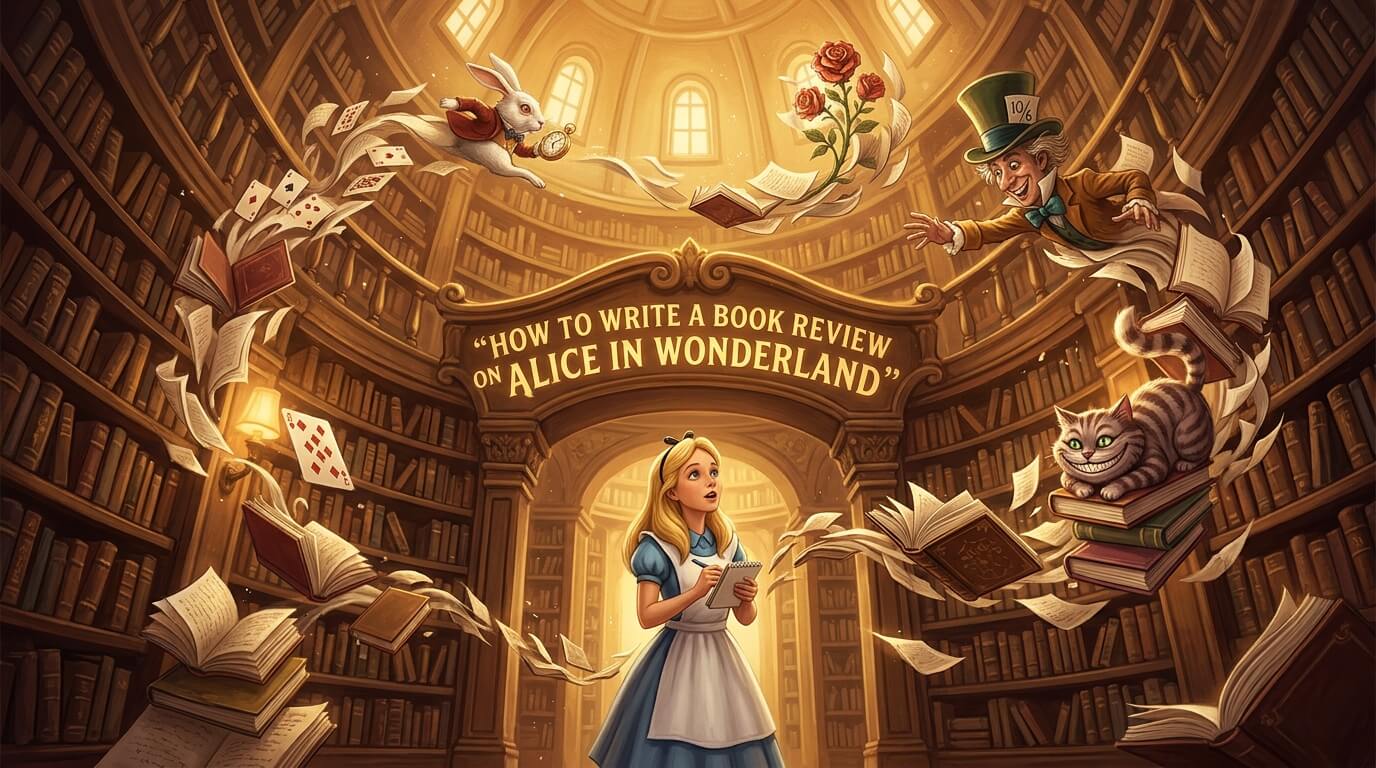
Writing a strong book review is not just about summarizing a story; it is about entering a conversation with the text, understanding its intentions, and offering a thoughtful response that reflects both analysis and interpretation. When the book in question is Alice’s Adventures in Wonderland, the task becomes even more fascinating because it is a literary work filled with symbolism, imagination, and layered meaning that continues to inspire readers across generations. A well-written review of this book does more than retell Alice’s journey; it explores how and why that journey matters, how it reflects its time, and how it still speaks to modern readers.
In this detailed guide, we will explore how to write a complete, insightful, and human-toned book review of Alice in Wonderland, covering structure, interpretation, literary techniques, and critical thinking approaches. The aim is to help you understand not only what to write, but how to think like a reviewer.
The Role of a Book Review in Literary Analysis
A book review is fundamentally an evaluation combined with interpretation. It is not a simple summary, nor is it a personal diary entry about whether you liked a story. Instead, it is a balanced piece of writing that blends description, analysis, and judgment. When writing about Alice’s Adventures in Wonderland, the reviewer must go beyond surface-level storytelling and engage with the deeper layers of meaning.
A strong review answers questions such as what the book is trying to achieve, how effectively it achieves its purpose, and what emotional or intellectual response it creates in the reader. In the case of Alice’s journey, the book challenges logic, language, identity, and reality itself, which makes the review process both creative and analytical.
The purpose is also to guide potential readers. A review helps someone decide whether the book is worth reading or re-reading. Therefore, clarity of thought and depth of insight matter more than personal preference alone.
A Brief Overview of Alice in Wonderland
Before writing a review, it is essential to understand the book’s context and story. Alice’s Adventures in Wonderland, written by Lewis Carroll, follows a young girl named Alice who falls through a rabbit hole into a surreal world called Wonderland. This world is filled with bizarre creatures, illogical events, and shifting realities.
Unlike traditional stories with clear moral lessons or linear plots, this novel is structured as a series of episodic adventures. Alice encounters characters such as the White Rabbit, the Cheshire Cat, the Mad Hatter, and the Queen of Hearts, each representing different aspects of logic, absurdity, and authority.
What makes the book especially significant is its departure from conventional Victorian storytelling. Instead of offering a straightforward moral or realistic narrative, it plays with nonsense, wordplay, and dreamlike logic. This allows readers to interpret it in multiple ways, which is exactly what makes reviewing it so intellectually engaging.
Why Writing a Review of Alice in Wonderland Is Unique
Writing a review of Alice’s Adventures in Wonderland is not like reviewing a standard novel. The book resists simple interpretation. It operates on symbolism, satire, and imagination rather than realistic storytelling.
One of the main challenges is that the book can be understood differently depending on the reader’s perspective. A child may see it as an exciting fantasy adventure, while an adult may interpret it as a critique of Victorian society or a psychological exploration of identity and confusion.
This complexity means your review must acknowledge multiple layers. You are not just evaluating a story; you are interpreting a literary puzzle. This makes your role as a reviewer more analytical and reflective.
Preparing to Write the Review
Before writing the actual review, preparation is essential. A thoughtful review is built on observation, reflection, and structured thinking.
When approaching Alice’s Adventures in Wonderland, begin by carefully reading the text and noting how each chapter contributes to the overall experience. Pay attention to recurring themes such as identity shifts, authority figures, logic versus nonsense, and childhood curiosity.
It is also helpful to consider historical context. The book was written in the 19th century, a time when rigid social structures and educational systems dominated British society. Many critics believe that the absurdity in Wonderland reflects subtle criticism of those structures.
During preparation, think about your personal response as well. Did the story feel confusing, entertaining, symbolic, or humorous? These reflections will help shape your review into something authentic and meaningful.
Structuring a Book Review Effectively
A well-structured review allows readers to follow your thoughts clearly. Even though writing styles may vary, a strong review of Alice’s Adventures in Wonderland usually follows a natural progression from introduction to analysis and conclusion.
The introduction typically presents the book title, author, and general idea of the story. The body explores themes, characters, and literary techniques. The conclusion offers evaluation and final thoughts.
Instead of treating structure as rigid rules, think of it as a flowing conversation. Each section should naturally lead into the next, creating a smooth reading experience.
Analyzing Characters in Alice in Wonderland
Character analysis is a major part of any book review. In Alice’s Adventures in Wonderland, characters are not developed in a traditional psychological sense. Instead, they often represent ideas, behaviors, or symbolic roles.
Alice herself represents curiosity and adaptability. As she navigates the unpredictable world of Wonderland, she constantly questions her surroundings and her own identity. This makes her both a participant and an observer in the narrative.
Characters like the Cheshire Cat and the Mad Hatter embody abstract concepts. The Cheshire Cat often symbolizes ambiguity and philosophical detachment, while the Mad Hatter represents chaos in communication and social norms. The Queen of Hearts, with her constant demand for executions, reflects authoritarian excess and emotional instability.
When writing your review, it is important to interpret these characters not just as fictional personalities but as symbolic tools used to explore deeper meanings.
Exploring Themes and Symbolism
Themes are the foundation of any literary analysis. In Alice’s Adventures in Wonderland, themes are rich and multi-layered.
One of the most prominent themes is the confusion between reality and imagination. Alice’s journey constantly challenges her understanding of what is real, forcing readers to question the stability of their own perceptions.
Another important theme is identity transformation. Alice frequently changes size, perspective, and even mental state, which symbolizes the instability of growing up and self-discovery.
Authority and power are also central themes. Many characters in Wonderland represent irrational authority figures who enforce rules without logic. This can be interpreted as a critique of rigid systems in society.
Symbolism is deeply embedded in the story. Objects like doors, keys, and food that changes size are not just fantasy elements but representations of access, knowledge, and transformation.
Examining Writing Style and Narrative Technique
Lewis Carroll’s writing style is one of the most distinctive aspects of Alice’s Adventures in Wonderland. His use of nonsensical dialogue, playful language, and poetic rhythm creates a dreamlike reading experience.
Wordplay is a major feature, with riddles, puns, and linguistic twists appearing throughout the book. This challenges readers to think beyond literal meaning and engage with language creatively.
The narrative structure is episodic rather than linear. Instead of following a traditional plot progression, the story moves through loosely connected events. This structure reflects the unpredictable nature of dreams and imagination.
When writing your review, analyzing these stylistic choices helps explain why the book feels both confusing and captivating at the same time.
Common Mistakes to Avoid in a Book Review
Many reviewers make the mistake of summarizing the story too much instead of analyzing it. While brief summary is necessary, it should not dominate the review.
Another common issue is ignoring deeper meaning. In the case of Alice’s Adventures in Wonderland, focusing only on plot events overlooks the symbolic richness of the text.
Some reviews also become overly personal, focusing only on whether the reader liked or disliked the book. While personal response is important, it should be supported by reasoning and evidence from the text.
A strong review balances description, interpretation, and evaluation without leaning too heavily on any single aspect.
Comparative Analysis Table for Writing a Book Review
Below is a useful table that helps organize your thoughts when reviewing Alice’s Adventures in Wonderland. This table is designed to guide your analysis rather than replace it.
| Literary Element | What to Observe in the Book | How to Write About It in a Review |
| Plot Structure | Episodic dream-like events | Explain how the non-linear structure affects reader understanding |
| Characters | Symbolic and exaggerated personalities | Interpret characters as ideas rather than realistic individuals |
| Themes | Identity, logic vs nonsense, authority | Discuss how themes are developed through events and dialogue |
| Language Style | Wordplay, puns, nonsense poetry | Analyze how language contributes to tone and meaning |
| Setting | Fantastical and shifting Wonderland | Describe how setting reflects imagination and confusion |
| Tone | Playful yet thought-provoking | Explain how tone influences emotional response |
This table can serve as a mental framework while writing your review, helping you ensure that you cover all major aspects of literary analysis.
How to Develop Your Critical Voice
A strong book review is defined by the reviewer’s voice. When discussing Alice’s Adventures in Wonderland, your voice should reflect both understanding and interpretation.
Developing a critical voice means expressing not just what the book contains but what it means. This requires confidence in your observations and clarity in your writing. Avoid vague statements and focus on explaining why certain elements matter.
For example, instead of saying the story is “confusing,” explain how the confusion is intentionally created to reflect dream logic or philosophical uncertainty. This shift turns simple opinion into meaningful analysis.
Final Evaluation and Conclusion
Writing a book review of Alice’s Adventures in Wonderland is ultimately an exercise in interpretation. The book itself resists fixed meaning, inviting readers to explore imagination, identity, and logic from multiple perspectives.
A well-crafted review does not attempt to solve the book’s mysteries completely. Instead, it highlights its complexity and explains how that complexity affects the reader. It balances summary with analysis, emotion with logic, and personal response with literary understanding.
By approaching the review thoughtfully, you transform it from a simple assignment into a meaningful exploration of literature. Alice’s journey through Wonderland becomes not just a story you read, but a lens through which you examine storytelling itself.
FAQs
Q1. What is the main focus of a book review on Alice in Wonderland?
A book review of Alice’s Adventures in Wonderland should focus on interpretation rather than just summary. It explores themes like imagination, identity, and logic while analyzing how effectively the story communicates its deeper meanings.
Q2. Should I include a summary in my review?
Yes, but only briefly. The summary should give a basic idea of Alice’s journey without dominating the review. The main focus should remain on analysis, character interpretation, and thematic discussion.
Q3. What themes should I discuss in the review?
Key themes in Alice’s Adventures in Wonderland include identity transformation, confusion between reality and dreams, authority and power, and the use of nonsense logic to challenge conventional thinking.
Q4. How do I analyze characters in the book?
Instead of treating characters as real individuals, interpret them symbolically. For example, Alice represents curiosity and growth, while characters like the Queen of Hearts and Cheshire Cat symbolize authority and philosophical ambiguity.
Q5. What makes a book review strong and effective?
A strong review balances summary, analysis, and personal insight. It explains not just what happens in the book, but why it matters, and how it affects the reader’s understanding of imagination and meaning.
