
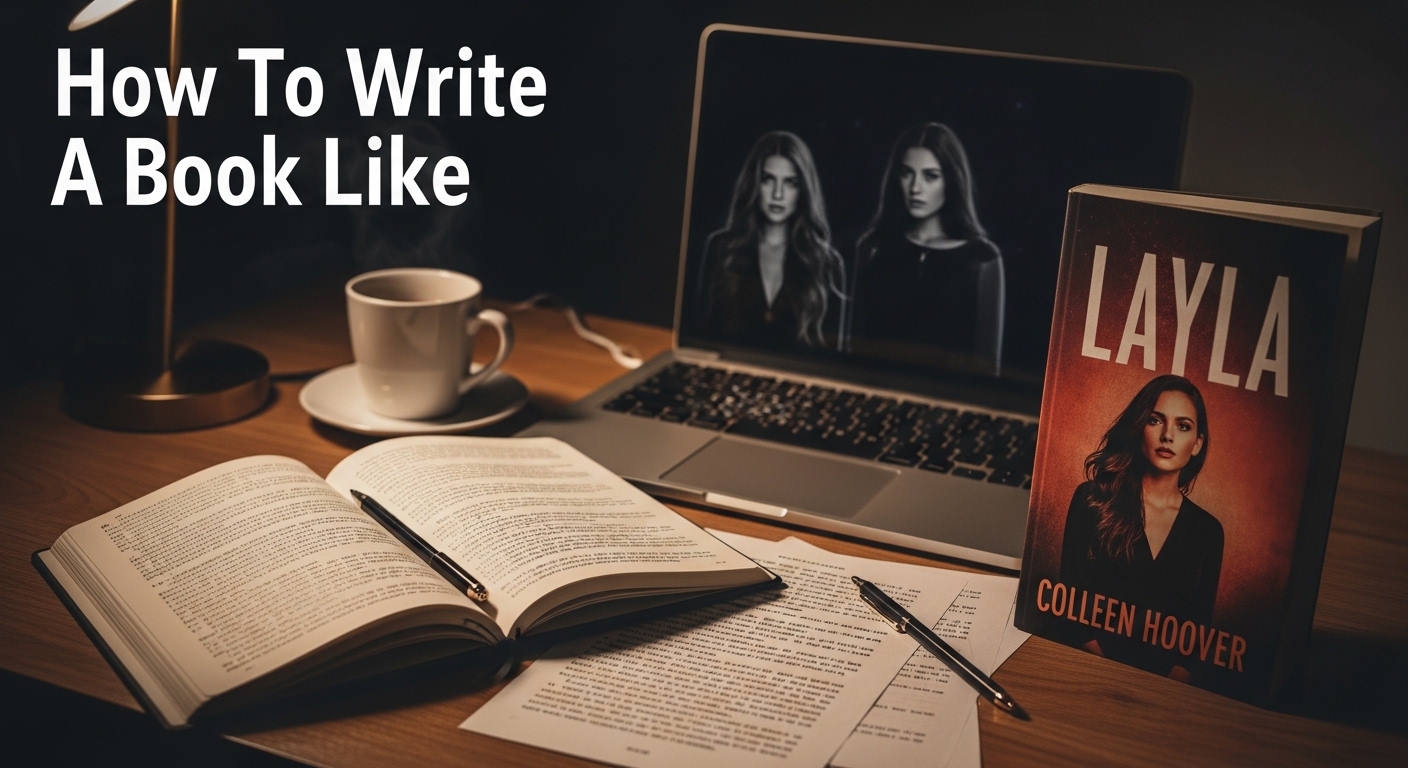
Writing a novel like Layla by Colleen Hoover requires more than simply blending romance with a paranormal twist. It demands a deep understanding of psychological storytelling, emotional tension, and narrative control. Unlike conventional romance novels, Layla operates on multiple layers—emotional, psychological, and metaphysical—creating a reading experience that is both immersive and unsettling.
This guide explores the structural, thematic, and technical elements behind such storytelling. It also integrates key aspects of editing, publishing, and design, helping you move from concept to a polished, market-ready manuscript.
The Narrative Psychology Behind Layla
At its core, Layla is not driven by plot alone—it is driven by perception. The story unfolds through a first-person narrative that deliberately limits the reader’s understanding of reality. This technique, often studied in literary psychology, is known as restricted narration, where the reader experiences events only through the protagonist’s subjective lens.
This approach creates ambiguity. Readers are forced to question whether the events are supernatural or psychological manifestations of trauma and obsession. Research in narrative theory suggests that this form of storytelling increases reader engagement because it activates interpretive participation—readers become analysts, not just observers.
To write like this, you must design a narrative where truth is unstable. Instead of providing answers, you gradually complicate the reader’s understanding.
Structuring Suspense Through Emotional Gradation
Unlike thrillers that rely on fast-paced action, Layla builds suspense through emotional escalation. The tension is not external but internal, growing from discomfort to obsession and finally to moral conflict.
A useful way to understand this structure is through progressive emotional layering:
| Stage of Story | Emotional State of Protagonist | Narrative Function |
| Beginning | Stability mixed with curiosity | Establish baseline reality |
| Early Conflict | Confusion and unease | Introduce disruption |
| Midpoint | Obsession and emotional pull | Deepen psychological stakes |
| Pre-Climax | Moral dilemma | Force difficult choices |
| Climax | Emotional breakdown | Deliver peak tension |
| Resolution | Reflection or ambiguity | Leave lasting impact |
This structure is highly effective because it mirrors real human emotional progression. Instead of abrupt changes, the story evolves gradually, making the experience feel authentic.
Characterization: Writing Flawed and Unreliable Minds
One of the defining elements of Layla is its unreliable protagonist. The narrator is not intentionally deceptive, but his emotional biases distort reality. This aligns with psychological realism, where characters are shaped by trauma, desire, and internal conflict.
To construct such a character, you must focus on internal contradictions. A well-written protagonist in this style often:
- Justifies questionable decisions
- Experiences conflicting emotions simultaneously
- Struggles to distinguish desire from morality
Rather than presenting a hero, you present a mind under pressure. This makes the reader both empathetic and skeptical, which is essential for maintaining tension.
The Interplay of Romance and the Supernatural
What makes Layla particularly compelling is how it merges two seemingly incompatible genres: romance and paranormal suspense. The romance is not merely a subplot—it is the driving force behind the supernatural events.
From a research perspective, this technique works because emotional stakes amplify narrative stakes. When readers are emotionally invested in a relationship, any disruption—especially one that defies logic—feels more intense.
To replicate this, the romantic connection must be deeply established before introducing major twists. The supernatural element should not overshadow the relationship but complicate it.
Language, Tone, and Narrative Voice
The prose in Layla is deceptively simple. It avoids heavy literary ornamentation, focusing instead on clarity and emotional immediacy. This aligns with modern commercial fiction trends, where accessibility often enhances reader immersion.
However, simplicity does not mean lack of depth. The language is carefully calibrated to reflect the protagonist’s mental state. As tension increases, sentences often become shorter and more fragmented, mirroring anxiety and confusion.
This is where editing becomes crucial. During the editing phase, you refine not just grammar but rhythm. Sentence length, word choice, and pacing must align with emotional intensity.
Atmosphere as a Narrative Device
A significant portion of Layla takes place in a confined setting, which contributes to its psychological tension. In literary studies, this is often referred to as spatial compression, where limited environments heighten emotional and narrative pressure.
The setting is not passive—it interacts with the characters. Sounds, silences, and visual details all contribute to a sense of unease.
To achieve this level of immersion, focus on sensory layering. Describe not just what is seen, but what is felt, heard, and implied. Atmosphere should evolve alongside the plot, becoming more intense as the story progresses.
The Role of Editing in Psychological Fiction
Editing is particularly important in novels like Layla because the narrative relies on subtlety. Even minor inconsistencies can break immersion or reveal twists too early.
A research-based editing approach involves multiple layers:
First, structural editing ensures that the pacing aligns with emotional progression. Scenes must be placed strategically to maintain tension.
Second, line editing refines the language, ensuring clarity and consistency in tone.
Finally, proofreading eliminates technical errors, preparing the manuscript for publishing.
Without rigorous editing, the complexity of such a narrative can easily become confusing rather than compelling.
Designing a Book That Reflects Its Narrative
The design of a book like Layla plays a psychological role even before the reader begins the story. Cover design often uses minimalistic visuals combined with symbolic imagery to hint at mystery and emotional conflict.
Typography and layout also matter. Clean formatting ensures that readers remain immersed, while subtle design choices can reinforce the tone of the story.
In the context of modern publishing, design is not just aesthetic—it is strategic. A well-designed book attracts the right audience and sets expectations about genre and mood.
Publishing Strategies
When it comes to publishing, books like Layla perform well in both traditional and self-publishing markets. However, each path requires a different approach.
Traditional publishing offers editorial support and broader distribution, which can be beneficial for complex narratives. Self-publishing, on the other hand, provides creative control, allowing authors to maintain their unique voice and vision.
Regardless of the path, success depends on preparation. A polished manuscript, professional editing, and strong design are non-negotiable elements in today’s competitive publishing landscape.
Key Principles to Follow When Writing Like Layla
To summarize the approach in a concise form:
- Focus on emotional and psychological tension rather than action
- Use a restricted narrative perspective to create ambiguity
- Develop flawed, internally conflicted characters
- Build suspense gradually through emotional escalation
- Integrate romance as a central driving force
- Use editing to refine pacing, tone, and clarity
- Ensure design and publishing strategies align with the story’s genre
Final Reflection
Writing a book like Layla is ultimately about mastering emotional storytelling. It requires patience, precision, and a willingness to explore the complexities of human psychology. Rather than relying on dramatic twists alone, the story draws its power from subtle shifts in perception and emotion.
By combining strong narrative structure, deep characterization, and careful editing, you can create a novel that resonates on multiple levels. When supported by thoughtful design and strategic publishing, your work can stand out in a crowded literary market.
The goal is not imitation but understanding. Once you grasp the principles behind Layla, you can adapt them to your own voice, creating a story that is both original and impactful.
