
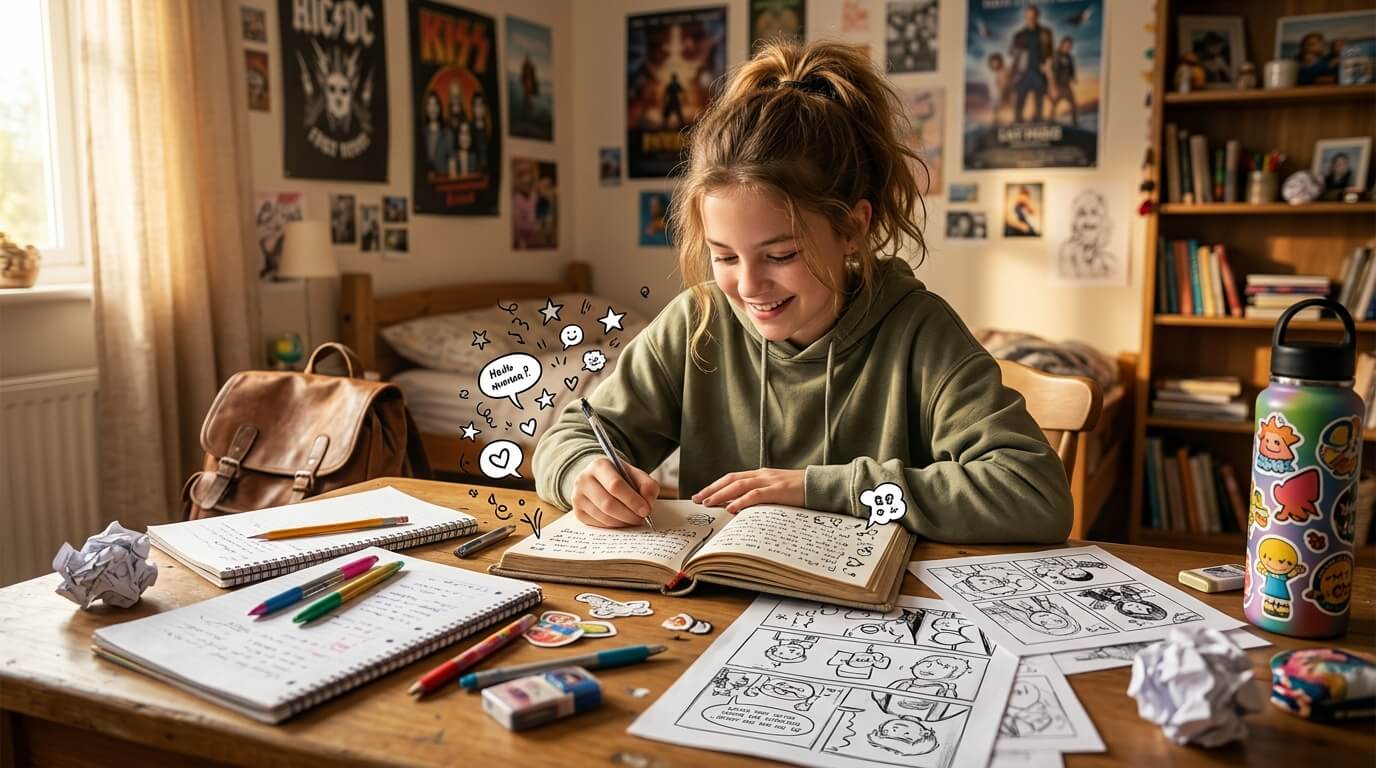
Few children’s books have captured the awkward, funny, and painfully relatable experience of growing up as successfully as Diary of a Wimpy Kid. Since its debut in 2007, Jeff Kinney’s series has sold hundreds of millions of copies worldwide and become a cultural phenomenon. What makes the books so appealing is not just the humor or the cartoon illustrations. The real magic lies in how accurately they reflect the thoughts, fears, embarrassments, and small victories that many kids experience every day.
If you want to write a book that captures a similar feeling, the goal is not to copy Greg Heffley or recreate the same jokes. Instead, you need to understand the storytelling principles that make the series work. The books feel effortless, but they are built on a carefully crafted combination of relatable situations, strong comedic timing, memorable characters, and a narrative voice that sounds authentic rather than polished.
In this guide, you’ll learn how to write a book inspired by the strengths of Diary of a Wimpy Kid while developing your own original style and characters.
What Makes a Wimpy-Kid-Style Book Work?
| Story Element | Purpose |
| First-person diary narration | Makes the story feel personal and immediate |
| Relatable school problems | Helps readers see themselves in the story |
| Short chapters | Keeps the pacing fast and accessible |
| Visual humor and sketches | Adds comedy and breaks up text |
| Flawed main character | Creates humor and realism |
| Running jokes | Builds familiarity and anticipation |
| Everyday conflicts | Makes small events feel important |
| Emotional sincerity | Prevents the story from feeling shallow |
Why Diary of a Wimpy Kid Works So Well
Many writers assume the series succeeds because it is funny. Humor is certainly important, but plenty of funny books never become global bestsellers. Diary of a Wimpy Kid works because it combines humor with emotional truth.
Greg Heffley is not a heroic character. He is often selfish, insecure, lazy, and overly concerned with popularity. Yet readers still like him because his thoughts feel honest. He worries about fitting in, avoiding embarrassment, impressing friends, and surviving school. Those concerns are universal for many children and teenagers.
The series also treats small problems as if they are enormous. A school dance, a class project, a rumor, or a family vacation can feel like the end of the world when you are twelve years old. By taking those everyday experiences seriously, the books create comedy and empathy at the same time.
Understanding the Core Formula Behind the Series
Before writing your own book, it helps to understand the structure behind the apparent simplicity.
A typical Diary of a Wimpy Kid story follows a flawed protagonist who wants something relatively small, such as popularity, success, attention, or freedom from trouble. The protagonist makes questionable decisions while trying to achieve that goal. Those decisions create a chain of increasingly awkward situations. The story builds through misunderstandings, embarrassing moments, and failed plans before ending with a funny or bittersweet realization.
Notice that the stakes are rarely life-and-death. The power of the story comes from emotional stakes. For a middle-school student, sitting alone at lunch can feel catastrophic. Losing a favorite video game can feel devastating. Missing a social event can feel like social ruin.
When writing your own version, focus on problems that matter deeply to kids even if adults would consider them minor.
Creating an Ordinary but Relatable Main Character
One of the smartest things Jeff Kinney did was make Greg feel ordinary. He is not exceptionally talented, brave, or special. He sits in the uncomfortable middle of the social hierarchy, which allows many readers to identify with him.
When designing your protagonist, avoid making them perfect. Give them strengths, but also give them flaws that create humor and conflict.
A good Wimpy-Kid-style protagonist might be clever but lazy. They might have big dreams but little discipline. They might want popularity while constantly making socially awkward choices.
The key is self-awareness. The character does not need to understand all their flaws, but readers should be able to see the gap between how the character views themselves and how the world actually sees them.
Building a Funny Everyday World
The setting in Diary of a Wimpy Kid is not magical or extraordinary. Most scenes take place in school, at home, in the neighborhood, or during family activities. This familiarity is essential.
Readers laugh because they recognize the situations. The weird teacher, the annoying sibling, the embarrassing parent, the school assembly, the group project, and the awkward birthday party all feel real.
To build a similar world, observe everyday life closely. Think about the strange rules schools have, the misunderstandings families create, and the tiny social dramas that seem huge to children. The more specific your observations, the funnier the story becomes.
For example, instead of writing “school was annoying,” describe a situation where students must carry a ridiculous object for a class project, or where a teacher invents a confusing reward system that nobody understands.
Writing Humor That Feels Natural
Humor in children’s fiction often fails because the writer tries too hard to be funny. Diary of a Wimpy Kid succeeds because the humor grows naturally from character and situation.
Greg’s bad decisions are funny because they make sense from his perspective. He is not trying to be a comedian; he is trying to avoid embarrassment, gain status, or make life easier. The comedy comes from the consequences.
One useful technique is to let your protagonist justify questionable choices. The more reasonable the character thinks they are being, the funnier the outcome can become.
Imagine a character who decides to fake being sick to avoid a school presentation. Everything goes smoothly until the principal announces that the school nurse wants to send them home with their parent, creating a much bigger problem than the presentation ever was.
That kind of escalating complication is at the heart of Wimpy-Kid-style comedy.
Using the Diary Format Effectively
Although the diary format looks simple, it creates several storytelling advantages.
First, it allows a strong personal voice. Readers feel as though the protagonist is talking directly to them. Second, it lets the narrator exaggerate, complain, and misinterpret events in entertaining ways. Third, it naturally breaks the story into short, digestible entries.
If you use a diary format, remember that the narrator is not completely objective. Their version of events should reflect their personality. A dramatic character may describe a minor inconvenience as a disaster, while a confident character may ignore obvious problems.
That gap between reality and narration is often where the humor lives.
The Importance of Short Chapters
One reason reluctant readers enjoy Diary of a Wimpy Kid is that the chapters feel manageable. The story moves quickly, and each section delivers a joke, a problem, or a new complication.
Long chapters can slow down comedic momentum. Short chapters create the feeling that readers are constantly turning pages.
Think of each chapter as a mini-story with a setup, a complication, and a punchline or twist. Even serious moments benefit from this rhythm because the narrative never feels stuck.
Creating Supporting Characters Readers Remember
Great comedic stories need strong supporting characters. In Diary of a Wimpy Kid, characters like Rowley, Rodrick, and Greg’s parents each have distinct personalities and predictable behaviors.
Your supporting cast should not all sound the same. Give each character a clear role in the protagonist’s life. One friend might be overly optimistic, another might be competitive, and a sibling might constantly create trouble.
The best supporting characters challenge the protagonist in different ways. They should create opportunities for jokes, conflicts, and unexpected situations.
A useful test is this: if you removed the character’s name from a line of dialogue, could readers still guess who said it? If the answer is yes, the character probably has a strong voice.
Balancing Comedy with Genuine Emotion
One of the biggest reasons Diary of a Wimpy Kid has remained popular for so many years is that it never relies on jokes alone. Beneath the embarrassing moments and humorous misunderstandings are real emotions that children recognize immediately. Greg may complain constantly, make selfish decisions, or exaggerate his problems, but he still experiences loneliness, disappointment, jealousy, guilt, and insecurity. Those emotions give the comedy weight and make readers care about what happens next.
When writing your own story, remember that humor becomes more effective when readers are emotionally invested. A funny scene is entertaining, but a funny scene involving a character readers genuinely understand is memorable. If your protagonist is embarrassed after making a mistake, allow that embarrassment to feel real before moving on to the next joke. If a friendship begins to crack because of misunderstandings, spend time exploring how that affects both characters. Young readers appreciate stories that acknowledge difficult feelings without becoming overly dramatic.
The emotional moments in this type of story should never feel like separate lessons. Instead, they should naturally grow out of the events already taking place. A failed science project, a forgotten birthday, or an argument with a best friend can all become opportunities for meaningful character development while still maintaining the lighthearted tone that readers expect.
Structuring the Story Like a Real Diary
The diary format offers much more than a unique presentation style. It influences the pacing, voice, and overall reading experience. Rather than dividing the novel into long traditional chapters, diary entries allow the story to move through days or weeks while focusing only on the moments that matter most.
Each entry should feel like something the main character genuinely wanted to record. Some days might feature a major event, while others simply highlight an awkward conversation, a strange classroom assignment, or an unexpected family disaster. Together, these entries gradually build a larger narrative without making the structure feel forced.
A successful diary-style novel usually includes an ongoing problem that stretches across the entire book. Smaller incidents occur from one entry to the next, but they all connect to the central conflict. Perhaps the protagonist desperately wants to win a school competition, survive an upcoming family vacation, earn a leadership position, or impress a certain group of classmates. Every diary entry should either complicate that goal or reveal something new about the character.
Because each entry is relatively short, pacing becomes easier to control. Readers constantly encounter fresh situations, new jokes, and changing circumstances, which keeps them turning pages.
Let Everyday Conflicts Drive the Plot
Unlike fantasy adventures or mystery novels, books inspired by Diary of a Wimpy Kid rarely depend on extraordinary events. Instead, they transform ordinary experiences into compelling stories by viewing them through the eyes of a child.
School remains one of the richest settings because it naturally creates social challenges. Group projects pair incompatible classmates together. School assemblies interrupt everyone’s routine. Sports days expose insecurities. Classroom presentations test confidence. Lunch breaks become opportunities for social victories or humiliating defeats. Every ordinary school activity contains potential for both comedy and emotional growth.
Home life offers another endless source of material. Parents create rules that seem unfair, siblings become rivals over the smallest issues, and family traditions often produce chaos despite everyone’s best intentions. Even something as simple as cleaning a bedroom or preparing for a holiday can evolve into an entertaining storyline when viewed from the protagonist’s perspective.
The secret is treating these ordinary situations as though they are enormously important. Children naturally experience many everyday events with heightened emotions, and your narration should reflect that viewpoint without mocking it.
Creating Running Gags That Readers Look Forward To
One hallmark of memorable comedy is repetition with variation. Diary of a Wimpy Kid frequently introduces jokes that return throughout the book in slightly different forms. Rather than repeating the exact same punchline, each appearance builds upon previous ones, making the joke increasingly satisfying.
A running gag might involve a teacher who constantly mispronounces the protagonist’s name, a younger sibling who accidentally ruins important moments, or a neighborhood pet that always appears at the worst possible time. Each recurrence reminds readers of earlier scenes while introducing a fresh twist.
Running jokes also strengthen character development. Readers begin anticipating how certain personalities will react in familiar situations. A chronically overconfident friend continues making ridiculous predictions. An overly dramatic classmate always assumes the worst. A strict parent consistently misunderstands harmless situations.
Because readers recognize these patterns, even simple interactions become funnier over time.
Writing Dialogue That Sounds Like Real Kids
Dialogue in middle-grade fiction should feel natural rather than overly polished. Children rarely deliver perfect speeches or explain every emotion they experience. Instead, conversations tend to be short, spontaneous, and occasionally awkward.
Listen to how children actually communicate. They interrupt one another, exaggerate stories, jump between topics, and often avoid expressing their feelings directly. Capturing that rhythm makes conversations believable without relying on slang that may quickly become outdated.
Humor frequently emerges from misunderstandings rather than carefully written jokes. Two characters may interpret the same situation completely differently, creating confusion that escalates naturally. Likewise, children often overreact to small problems while completely ignoring larger ones, creating opportunities for both comedy and insight.
The narrator’s internal thoughts are equally important. Since diary-style stories are deeply personal, readers should hear the protagonist’s opinions alongside conversations. Those private reactions often become funnier than the dialogue itself because they reveal how differently the character interprets events compared to everyone else.
Developing Your Own Unique Narrative Voice
Many aspiring writers mistakenly imitate Greg Heffley’s exact personality when trying to write a similar book. This approach usually results in a story that feels like a copy instead of an original work.
Instead, focus on creating a distinctive narrative voice. Ask yourself how your protagonist sees the world differently. Perhaps they are overly optimistic, endlessly curious, unusually dramatic, quietly sarcastic, or fascinated by strange hobbies. Their perspective should shape every observation they record.
Voice influences word choice, sentence length, humor, and emotional reactions. Two characters experiencing the exact same event should describe it in completely different ways because their personalities affect what they notice.
Developing a unique narrator ensures your story stands on its own while still embracing the qualities that make diary-style fiction enjoyable.
Finding the Right Balance Between Text and Illustrations
Although illustrations play an important role in books like Diary of a Wimpy Kid, they work because they support the storytelling rather than replace it. The drawings emphasize visual jokes, clarify funny situations, or exaggerate facial expressions that enhance the narration.
If you plan to include illustrations in your own book, think about how they interact with the text. A picture should add something readers cannot fully experience through words alone. Sometimes an awkward expression communicates more humor than several descriptive sentences. Other times, a simple sketch can reveal details that make the narrator seem unreliable or overly dramatic.
Even if you are not illustrating the book yourself, leaving room for visual storytelling during the writing process can improve pacing and comedic timing.
Common Mistakes to Avoid
Many writers misunderstand what makes this style successful because they focus only on surface elements. Simply writing in diary format or including cartoon illustrations will not automatically capture the charm of Diary of a Wimpy Kid. The foundation is always character, voice, and authentic observation.
Another frequent mistake is forcing jokes into every paragraph. Constant comedy eventually becomes exhausting if characters never experience genuine emotions. Readers need occasional quieter moments where relationships deepen and personalities develop.
Some stories also rely too heavily on random events instead of connected storytelling. While each diary entry should be entertaining on its own, the novel as a whole still requires direction. Every event should contribute to the protagonist’s larger journey, even if that journey revolves around something relatively small.
Finally, avoid copying familiar characters or situations too closely. Inspiration is valuable, but originality is what allows your book to build its own identity and connect with readers in a fresh way.
Making Your Story Memorable Long After the Last Page
The books readers remember are rarely those with the biggest adventures. More often, they are stories that capture familiar experiences in surprising ways. The awkward school presentation, the disastrous family trip, the embarrassing misunderstanding, or the impossible homework assignment all become unforgettable because the narration transforms ordinary moments into meaningful memories.
To achieve that effect, pay close attention to observation. Notice how children interpret adult behavior, how friendships change over time, and how confidence can disappear in seconds after one embarrassing mistake. These small details create authenticity, and authenticity builds lasting connections with readers.
Humor may attract readers initially, but relatable experiences encourage them to return for every new installment.
Conclusion
Writing a book like Diary of a Wimpy Kid is not about copying its format, characters, or illustrations. It is about understanding why millions of readers connect with its storytelling. The series succeeds because it respects children’s perspectives, finds comedy in everyday life, embraces flawed yet lovable characters, and balances laughter with emotional honesty.
As you develop your own story, focus on creating a narrator with a unique voice, believable relationships, and relatable challenges. Build your humor from personality rather than random jokes, allow everyday conflicts to drive the narrative, and remember that even the smallest problems can feel enormous through the eyes of a young protagonist.
When readers recognize themselves in your characters and laugh at situations that feel familiar, your story will capture the same spirit of authenticity that has made diary-style fiction one of the most beloved forms of middle-grade storytelling.
FAQs
Q1. Do I have to use a diary format to write a book like Diary of a Wimpy Kid?
No. While the diary format enhances the personal voice, you can achieve a similar tone using first-person narration if the storytelling feels authentic and conversational.
Q2. What age group should this style target?
Most diary-style middle-grade books appeal to readers between 8 and 12 years old, though older readers often enjoy them because of their humor and nostalgia.
Q3. Should my main character be likable?
Not necessarily. They should be relatable and believable. Flaws often make characters more entertaining and realistic.
Q4. Are illustrations necessary?
No, but they can enhance the reading experience if they support the story instead of replacing strong writing.
Q5. How can I make my book original while taking inspiration from Diary of a Wimpy Kid?
Create unique characters, settings, relationships, and conflicts while focusing on your own narrative voice. Let the storytelling principles inspire you rather than copying specific plotlines or personalities.
