
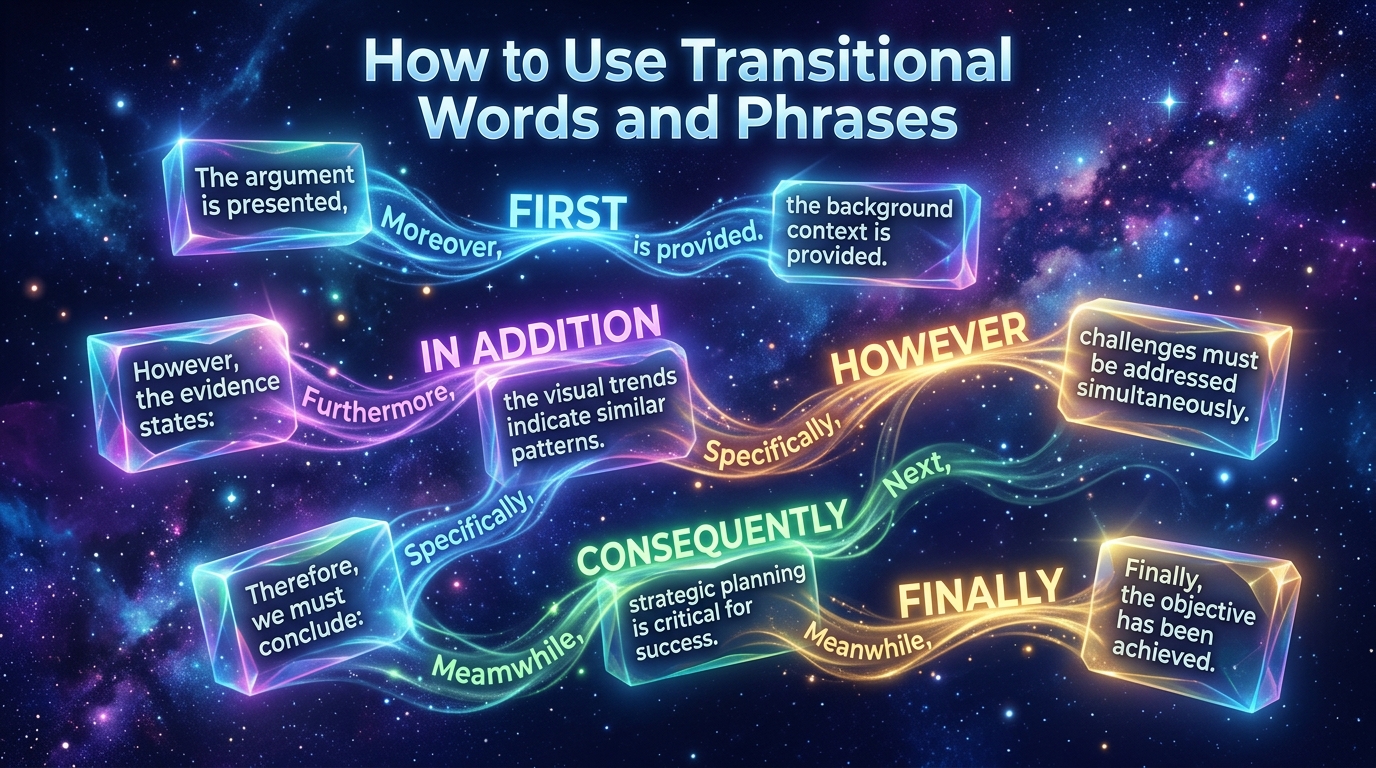
Writing that flows smoothly rarely happens by accident. It is carefully shaped with words that guide the reader from one idea to the next without confusion or abrupt jumps. These guiding words are known as transitional words and phrases, and they play a far more important role in writing than most people realize. Whether you are writing an essay, a blog post, a report, or even a story, transitions are what make your ideas feel connected rather than scattered. They act like invisible bridges between thoughts, helping readers understand not just what you are saying, but how each idea relates to the next.
In strong writing, transitions are not decoration. They are structure. Without them, even well-researched ideas can feel disorganized or incomplete. With them, even complex arguments become readable and engaging. Understanding how to use transitional words effectively can transform average writing into clear, professional communication.
Understanding Transitional Words and Their Role in Writing
Transitional words and phrases are expressions that connect ideas, sentences, and paragraphs. They show relationships such as contrast, cause and effect, addition, sequence, and emphasis. When used correctly, they guide readers through a logical progression of thought, making writing easier to follow.
At a basic level, transitions answer questions like “What is coming next?”, “How is this related?”, or “Is this different from what was said before?” For example, if a writer says, “The weather was cold. We decided to go for a walk anyway,” the word “anyway” signals contrast. Without it, the connection between the two sentences feels weaker and less intentional.
Transitions also improve readability by reducing cognitive load. Readers do not have to guess how ideas connect because the writer has already made the relationship clear. This is especially important in academic writing, professional communication, and long-form content where clarity determines effectiveness.
Types of Transitional Words and Phrases
Transitional words are not all the same. They serve different functions depending on the relationship between ideas. Understanding these categories helps writers choose the right transition for the right context.
Addition Transitions
Addition transitions are used when you want to add information that supports or expands the previous idea. These transitions help build arguments or elaborate on a topic without breaking flow. Words like “furthermore,” “in addition,” “also,” and “moreover” are commonly used.
For instance, if a writer states that reading improves vocabulary, they might continue by saying it also enhances comprehension skills. The transition signals that the second idea strengthens the first rather than shifting away from it.
Contrast Transitions
Contrast transitions highlight differences between ideas. They are essential when showing opposing viewpoints, exceptions, or alternative perspectives. Words like “however,” “on the other hand,” “although,” and “nevertheless” fall into this category.
These transitions help prevent confusion when a writer introduces a conflicting idea. Instead of appearing random, the contrast is clearly signposted, allowing readers to adjust their understanding accordingly.
Cause and Effect Transitions
Cause and effect transitions explain why something happens or what results from an action. These include words such as “therefore,” “as a result,” “because,” and “consequently.”
They are particularly useful in analytical and persuasive writing. When a writer explains a situation and its outcome, these transitions ensure that the logical relationship is obvious rather than implied.
Sequence and Order Transitions
Sequence transitions organize ideas in a step-by-step order. They are commonly used in instructions, storytelling, and process explanations. Words like “first,” “next,” “then,” and “finally” help structure information chronologically or logically.
Without these transitions, instructions can become confusing and difficult to follow. With them, readers can easily track progression from one step to the next.
Emphasis Transitions
Emphasis transitions highlight important points or reinforce a message. Words like “indeed,” “above all,” and “in fact” are used to draw attention to key ideas.
These transitions help writers guide readers toward what matters most in a paragraph or argument. They are subtle but powerful tools for shaping focus.
How Transitional Words Improve Writing Flow
Good writing feels natural, almost effortless to read. This sense of flow is created largely through transitions. When ideas are connected smoothly, readers can move through the text without stopping to reorient themselves.
Transitions reduce abrupt shifts between sentences. Instead of jumping from one idea to another, they create continuity. This is especially important in long paragraphs where multiple ideas are developed. Without transitions, such writing feels fragmented.
Transitions also help control pacing. For example, short sentences with minimal transitions can create a fast, urgent tone, while well-connected sentences slow the reading experience, allowing for deeper understanding. Skilled writers use this control deliberately to shape how readers experience the text.
Common Mistakes When Using Transitional Words
While transitional words are extremely useful, they are often misused. One common mistake is overuse. When every sentence begins with a transition, writing can feel mechanical and repetitive. Instead of improving flow, it can actually disrupt it.
Another mistake is using the wrong type of transition. For example, using a contrast word like “however” when adding information creates confusion. The relationship between ideas must match the transition used.
Writers also sometimes insert transitions where they are not needed. Not every sentence requires a linking word. Overloading text with unnecessary transitions can make writing feel forced rather than natural.
Finally, many writers rely on basic transitions repeatedly, such as “and,” “but,” or “so,” without exploring more varied options. While these are useful, overdependence on them can make writing appear simplistic.
Practical Examples of Transitional Words in Use
To understand transitions more clearly, it helps to see them in context. The following table shows how different types of transitional words function within sentences.
| Type of Transition | Example Sentence | Function |
| Addition | The book was informative; furthermore, it was easy to read. | Adds supporting information |
| Contrast | The experiment was successful; however, the results were unexpected. | Shows difference or contradiction |
| Cause and Effect | The road was closed; therefore, we took a different route. | Shows result |
| Sequence | First, gather your materials; then, begin the experiment. | Shows order |
| Emphasis | In fact, this is the most important step in the process. | Highlights importance |
These examples demonstrate how transitions shape meaning and guide interpretation. Without them, sentences would still make sense individually, but the relationships between ideas would be unclear.
How to Choose the Right Transitional Word
Choosing the correct transition depends on the relationship between your ideas. The first step is identifying what you want to express. If you are adding information, addition transitions are appropriate. If you are showing contrast, you need a word that signals opposition.
Context also matters. Formal writing often uses transitions like “moreover” and “consequently,” while informal writing might prefer “also” or “so.” Matching tone with context ensures consistency and professionalism.
Another important factor is sentence structure. Some transitions work better at the beginning of a sentence, while others fit naturally between clauses. Reading your writing aloud can help you identify where transitions feel natural or forced.
Building Stronger Paragraphs with Transitions
Transitions are especially important at the paragraph level. Each paragraph in a well-structured text should connect smoothly to the one before it. This creates unity across the entire piece rather than isolated sections.
A strong paragraph often begins with a topic sentence, followed by supporting ideas connected with transitions. At the end of the paragraph, a transition may lead into the next idea, ensuring continuity.
For example, after discussing the benefits of exercise, a paragraph might end with a sentence that naturally leads into nutrition. The transition ensures that readers do not feel a sudden shift in topic but rather a logical progression of thought.
The Role of Transitions in Academic and Professional Writing
In academic writing, transitions are essential for building logical arguments. They help connect evidence to conclusions and ensure that ideas are presented in a structured manner. Without transitions, academic work can appear disjointed or difficult to follow.
In professional writing, transitions improve clarity and persuasion. Reports, proposals, and business communications rely on smooth information flow to maintain reader attention. A well-placed transition can make complex information easier to understand and more convincing.
Even in digital content such as blogs and articles, transitions play a crucial role in keeping readers engaged. Online readers often scan content quickly, and clear transitions help guide them through the material without confusion.
Conclusion
Transitional words and phrases are small but powerful tools that shape the clarity and flow of writing. They connect ideas, guide readers, and create structure within sentences and paragraphs. When used correctly, they transform disconnected thoughts into coherent communication that is easy to read and understand.
Mastering transitions is not about memorizing lists of words but about understanding relationships between ideas. Once you learn to recognize these relationships, choosing the right transition becomes natural. Over time, your writing develops a rhythm that feels smooth, logical, and intentional.
Strong writing is not just about what you say, but how you connect what you say. Transitional words make those connections possible, turning simple sentences into meaningful, flowing communication that holds a reader’s attention from beginning to end.
