
When people hear the term self-publishing, they often think about aspiring authors trying to sell books through online retailers or land on bestseller lists. While that is certainly one side of the publishing world, there is another growing reason people choose to publish books: personal use. Every year, thousands of individuals transform their memories, experiences, family histories, recipes, journals, photographs, poems, and personal stories into professionally printed books that are never intended for commercial sale.
A book created for personal use carries a different kind of value. It is not measured by sales numbers, rankings, or reviews. Instead, its worth comes from preserving memories, documenting important moments, celebrating milestones, and creating something tangible that can be shared with loved ones. A self-published book can become a treasured family heirloom, a meaningful gift, or simply a personal accomplishment that brings years of satisfaction.
The good news is that self-publishing for personal use has never been easier. Modern technology allows anyone to create a professional-quality book without securing a literary agent, finding a traditional publisher, or investing thousands of dollars. Whether you want a single copy for yourself or a small collection of books for family members and friends, the tools and resources available today make the process accessible to everyone.
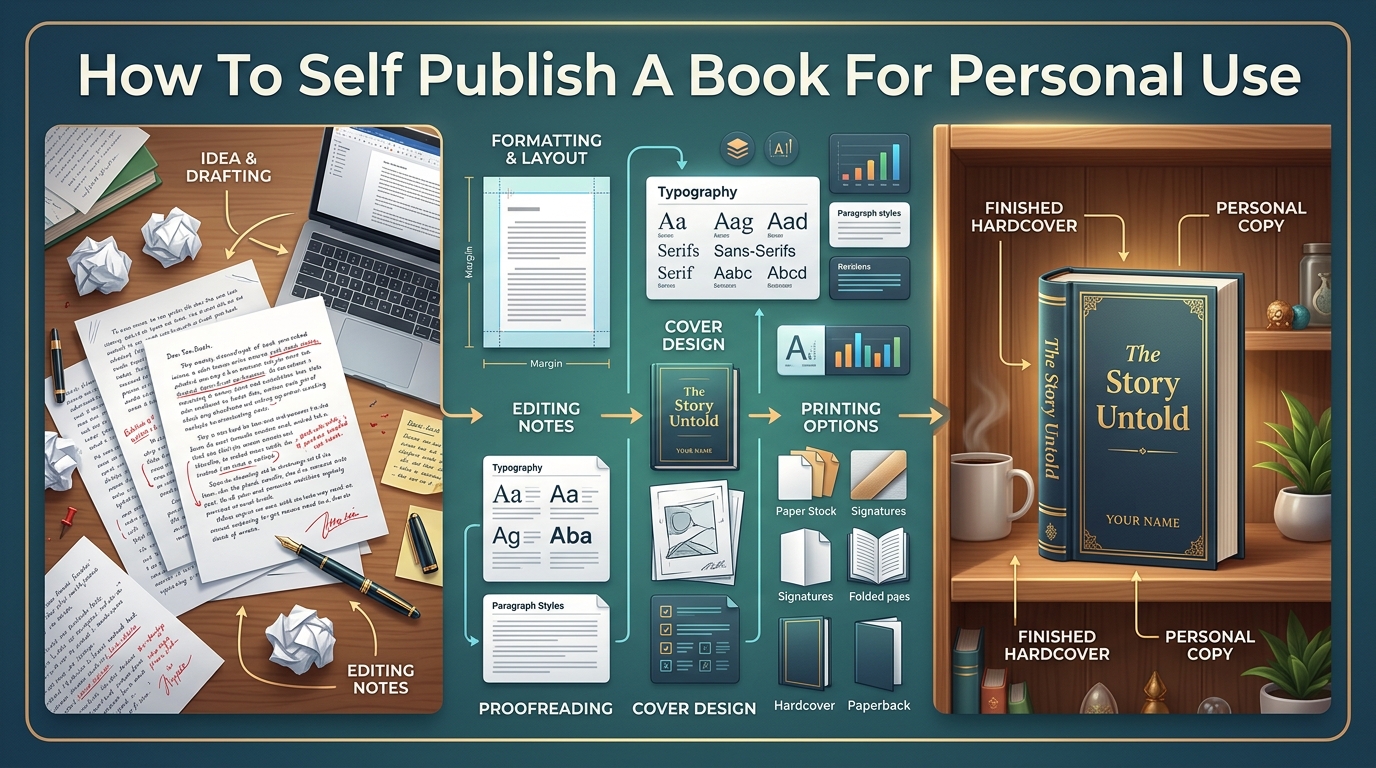
Understanding how to self-publish a book for personal use involves much more than uploading a document and ordering a printed copy. The process includes planning, writing, editing, formatting, designing, printing, and preserving your work in a way that reflects its personal significance. By approaching each stage thoughtfully, you can create a book that looks professional, tells your story effectively, and remains meaningful for years to come.
The Creative Purpose Behind Personal-Use Books
Before beginning the publishing process, it is important to understand why you want to create the book. Unlike commercial publishing, where success is often measured by audience reach and revenue, personal publishing focuses on preserving something meaningful.
For some individuals, the goal is to document a lifetime of experiences. Memoirs and autobiographies allow people to capture stories that might otherwise be forgotten. Family history books preserve generations of knowledge and traditions that can be passed to children and grandchildren.
Others create books to celebrate special occasions. Weddings, anniversaries, retirements, graduations, and milestone birthdays often inspire personalized publications that commemorate important moments. Some people even produce travel books filled with photographs and reflections from memorable journeys.
The beauty of personal-use publishing lies in its flexibility. There are no market expectations to satisfy, no publishing trends to follow, and no commercial pressures influencing your decisions. The book can be entirely tailored to your vision and purpose.
Why Self-Publishing Has Become Popular for Personal Projects
Over the last decade, self-publishing technology has transformed the publishing industry. What once required large print runs and significant financial investment can now be accomplished with a laptop and internet connection.
The growing popularity of personal publishing reflects a broader desire to preserve stories and experiences in a lasting format. While digital storage provides convenience, many people recognize that physical books offer a permanence that digital files cannot match.
A printed book creates a unique emotional connection. Holding a bound volume filled with your own words, photographs, and memories feels different from viewing those same materials on a screen. Books can be displayed on shelves, gifted to family members, and passed down through generations.
In a world where so much information exists digitally, creating a physical book has become a meaningful way to preserve personal history.
Choosing the Right Type of Personal Book
Memoirs and Life Stories
One of the most popular forms of personal publishing is the memoir. Many people realize that their experiences contain valuable lessons, fascinating stories, and family history worth preserving.
Memoirs do not have to cover an entire lifetime. Some focus on a specific period, such as military service, parenthood, career achievements, immigration experiences, or overcoming significant challenges. Concentrating on a particular chapter of life often creates a more focused and engaging narrative.
Family History Books
Family history books combine storytelling, genealogy, photographs, letters, and historical records. These projects often require research and interviews with relatives, but the result can become an invaluable family resource.
Future generations frequently appreciate having access to stories and details that might otherwise disappear over time.
Recipe Collections
Family recipes often carry emotional significance beyond the food itself. Publishing a cookbook filled with treasured recipes allows traditions to survive across generations.
Adding stories behind the recipes can make the book even more meaningful. Readers gain insight into family gatherings, cultural traditions, and cherished memories associated with each dish.
Photo Books and Travel Journals
Photographs tell stories in ways words sometimes cannot. Combining images with written reflections creates visually rich books that preserve important experiences and adventures.
Travel books, in particular, allow individuals to capture both the sights they encountered and the emotions they experienced during their journeys.
Planning Your Book Before You Start Writing
Many first-time authors underestimate the importance of planning. While it may be tempting to jump directly into writing, a thoughtful plan creates a stronger final product.
Start by identifying the central purpose of the book. Ask yourself what you want readers to remember after finishing it. Even if the audience consists only of family members, having a clear focus helps guide the writing process.
Creating an outline is often beneficial. Rather than approaching the manuscript as one massive project, divide it into manageable chapters or sections. This structure makes writing less intimidating and helps maintain logical flow.
For memoirs, chronological organization often works well. Family histories may be organized by generations, while travel books might follow destinations or experiences. The organizational structure should support the overall purpose of the project.
Writing with Authenticity and Personal Voice
One of the greatest advantages of personal publishing is the freedom to write authentically. Unlike commercial books that must appeal to broad audiences, personal books can reflect your natural voice and perspective.
Readers often connect most strongly with genuine storytelling. Honest reflections, vivid details, and personal insights make a narrative more engaging and memorable.
When writing about experiences, focus on sensory details and emotions. Instead of simply describing what happened, explain how events felt and why they mattered. These details help bring stories to life.
Many people worry that their lives are not interesting enough to fill a book. However, what makes personal books valuable is not extraordinary events but authentic experiences. Everyday moments often become the stories future generations treasure most.
Researching and Gathering Supporting Materials
Using Family Archives
For memoirs and family history projects, supporting materials can significantly enrich the content. Old photographs, journals, letters, newspaper clippings, certificates, and personal documents provide valuable context.
Reviewing these materials often triggers forgotten memories and reveals details that enhance storytelling.
Conducting Interviews
Family members can be excellent sources of information. Interviewing relatives may uncover stories, perspectives, and historical details that would otherwise remain unknown.
Recording conversations allows you to revisit information later and incorporate accurate details into the manuscript.
Organizing Your Research
As information accumulates, organization becomes increasingly important. Creating folders for photographs, documents, interviews, and chapter materials can streamline the writing process and prevent confusion.
Editing: The Step That Separates Good Books from Great Ones
Many self-published authors consider writing the most important stage, but editing is equally crucial. Even books intended solely for personal use benefit from careful revision.
The first stage of editing involves evaluating the overall structure. Review whether chapters flow logically and whether the narrative remains engaging throughout.
The second stage focuses on sentence-level improvements. Removing repetition, clarifying ideas, and refining language can significantly improve readability.
Finally, proofreading addresses grammar, punctuation, and spelling errors. Small mistakes may seem minor, but they can distract readers and diminish the professional appearance of the book.
Taking time to edit thoroughly demonstrates respect for both your work and your future readers.
Designing a Professional Interior Layout
A well-designed interior enhances the reading experience and elevates the perceived quality of the book.
Typography plays a significant role in readability. Traditional book fonts remain popular because they are comfortable to read over extended periods. Consistent spacing, margins, and chapter formatting contribute to a polished appearance.
For books containing images, thoughtful placement is essential. Photographs should support the narrative rather than interrupt it. Maintaining consistent image styles and caption formatting creates a cohesive design.
Professional design does not require elaborate graphics or complex layouts. Simplicity often produces the most elegant results.
Choosing the Best Book Size and Format
The physical format of your book influences both appearance and usability.
| Book Type | Recommended Format | Common Use |
| Memoir | 6 x 9 inches Paperback or Hardcover | Personal stories and life experiences |
| Family History | Hardcover | Archival and legacy projects |
| Recipe Book | Spiral Bound or Paperback | Easy kitchen use |
| Travel Journal | Large Paperback | Photos and storytelling |
| Poetry Collection | Small Paperback | Creative projects |
| Photo Book | Premium Hardcover | Visual preservation |
Selecting the appropriate format depends on how the book will be used and preserved.
Creating a Cover That Reflects Your Story
The cover serves as the visual identity of the book. Even if the book is intended only for personal use, a professionally designed cover adds significance and emotional impact.
A memoir might feature a meaningful photograph from the author’s life. A family history book could incorporate vintage images or heritage-inspired design elements. Travel books often showcase memorable destinations.
Typography should remain clear and balanced. The title should be easy to read while complementing the overall design.
An attractive cover immediately communicates the book’s purpose and creates a strong first impression.
Understanding Print-on-Demand Publishing
Print-on-demand technology has transformed self-publishing by allowing books to be printed individually rather than in large batches.
This approach offers several advantages for personal-use projects. Authors can order a single copy, make revisions if necessary, and print additional copies later. There is no need to store boxes of books or invest heavily upfront.
The flexibility of print-on-demand makes it ideal for memoirs, family histories, and limited-distribution projects.
Because books are produced only when ordered, costs remain manageable while maintaining professional quality.
Evaluating Printing Quality
Not all printing options are equal. The quality of paper, binding, and image reproduction can significantly affect the final product.
Premium paper often enhances photographs and creates a more luxurious reading experience. Hardcover binding typically offers greater durability, making it suitable for books intended as keepsakes.
Ordering a proof copy before final production is highly recommended. Viewing the physical book allows you to evaluate image clarity, typography, spacing, and overall presentation.
Many authors discover small adjustments they wish to make after reviewing a printed proof.
Preserving Your Book for the Future
Publishing a personal book often involves preserving memories for future generations. Therefore, long-term preservation should be part of the planning process.
Store digital copies of all files in multiple locations, including cloud storage and external drives. Maintaining backup copies protects against accidental data loss.
Physical books should be stored in dry, climate-controlled environments to prevent deterioration. Hardcover editions printed on quality paper often remain in excellent condition for decades.
Some families choose to distribute copies widely to ensure preservation across multiple households.
Sharing Your Book with Family and Friends
One of the most rewarding aspects of personal publishing is sharing the finished product with others.
Receiving a professionally printed book containing family stories, memories, recipes, or photographs often creates a powerful emotional response. These books become more than reading materials; they become family treasures.
Many authors present their books during reunions, anniversaries, birthdays, and holiday gatherings. Such occasions provide opportunities to celebrate the stories and experiences preserved within the pages.
Even a small print run can create lasting memories and strengthen family connections.
Common Challenges and How to Overcome Them
Many first-time self-publishers face similar challenges. Some struggle with writer’s block, while others feel overwhelmed by editing or design decisions.
The key is approaching the project one step at a time. Focus first on writing, then editing, then formatting, and finally printing. Attempting to manage every aspect simultaneously often creates unnecessary stress.
Perfectionism can also become a barrier. While quality matters, remember that personal books exist to preserve memories and experiences. Authenticity is often more valuable than flawless prose.
Completing the project is ultimately more important than endlessly revising it.
The Lasting Impact of Publishing a Personal Book
Years from now, the true value of your book may become even more apparent. Stories that seem ordinary today may become invaluable historical records for future generations. Family recipes may preserve cultural traditions. Photographs may document lives and relationships that would otherwise fade from memory.
A personal book serves as a bridge between generations, allowing experiences, lessons, and stories to continue long after they were originally lived.
Few projects offer such a unique combination of creativity, preservation, and legacy.
Conclusion
Learning how to self-publish a book for personal use is about far more than printing pages. It is a process of preserving memories, documenting experiences, celebrating milestones, and creating something meaningful that can endure for years. Whether you are writing a memoir, compiling family recipes, documenting a journey, preserving photographs, or recording your family’s history, self-publishing gives you complete control over how your story is told.
Modern publishing technology has removed many traditional barriers, making it possible for anyone to create a professional-quality book regardless of publishing experience. Through careful planning, thoughtful writing, thorough editing, attractive design, and quality printing, you can transform personal memories into a lasting publication that reflects your vision.
The greatest reward of self-publishing for personal use is not commercial success or public recognition. It is knowing that your stories, experiences, and memories have been preserved in a tangible form that can be revisited, shared, and cherished for generations. In a world where so much information is temporary and digital, a printed book remains one of the most meaningful ways to ensure that the moments that matter most are never forgotten.
