
Introduction
In the modern publishing landscape, where thousands of books are uploaded to digital storefronts daily, the barrier to entry has never been lower. However, the barrier to success remains incredibly high. Readers have zero tolerance for poorly paced plots, thin character development, and typographical errors. Whether you are aiming for a traditional publishing contract or planning to self-publish on Amazon Kindle Direct Publishing (KDP), the quality of your manuscript is your ultimate currency. This reality brings every author to a critical, defining question: How Many Drafts Does a Book Need Before Publishing?
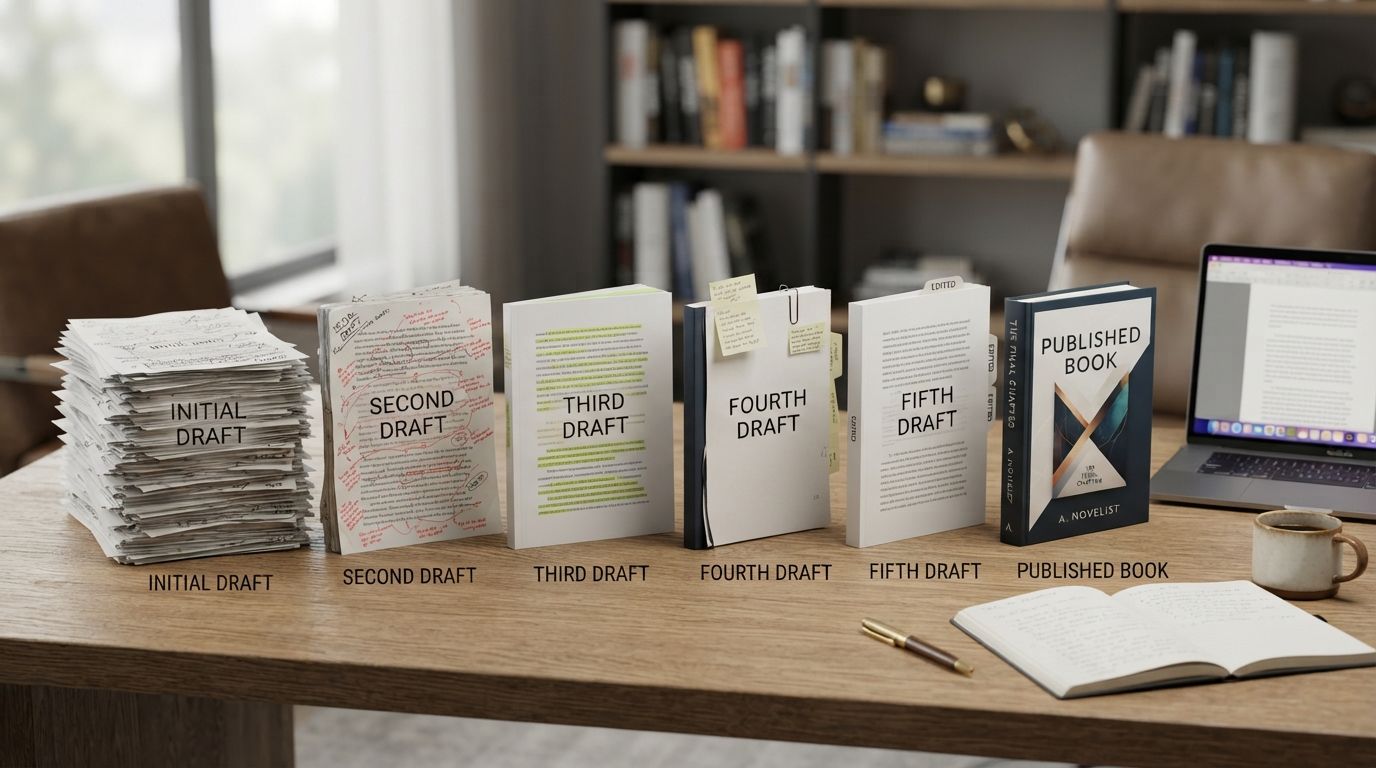
The short answer is that there is no single, universally mandated number. Some legendary authors boast of publishing works after only two passes, while others painstakingly revise their manuscripts dozens of times. However, for the vast majority of successful authors, a book requires between four and eight drafts before it is ready for public consumption. This range is not arbitrary; it represents a systematic, multi-layered refining process that transforms a raw, chaotic concept into a polished, market-ready masterpiece. Understanding the purpose of each drafting stage is crucial for managing your time, preserving your creative energy, and producing a book that resonates with your target audience.
In this comprehensive, industry-grade guide, we will dissect the drafting process from the initial “brain dump” to the final proofreading pass. We will analyze the factors that influence your specific drafting timeline, examine historical data from bestselling authors, and provide you with actionable frameworks to determine when your manuscript is officially ready to meet the world.
The Anatomy of Book Drafting: Stage by Stage
Writing a book is not a linear task of writing from page one to page three hundred and then hitting “publish.” It is an iterative process of construction, demolition, and reconstruction. To understand How Many Drafts Does a Book Need Before Publishing?, we must first break down the distinct phases of drafting that a manuscript must undergo to reach commercial viability.
Draft 1: The Zero Draft (The Discovery Phase)
Often referred to as the “rough draft” or the “shitty first draft” (a term popularized by author Anne Lamott), the Zero Draft is written entirely for the author. At this stage, your sole objective is to transfer the story from your imagination onto the blank page. You should not worry about grammar, plot holes, repetitive vocabulary, or pacing.
- Primary Focus: Narrative momentum, basic plot progression, and character introduction.
- Common Pitfalls: Editing while writing. This is the fastest way to kill your momentum and abandon your manuscript.
- The Goal: To reach the words “The End” for the very first time.
Draft 2: The Structural Draft (The Developmental Phase)
Once the Zero Draft is complete, it is highly recommended to let it sit untouched for at least two to four weeks. This cooling-off period gives you the emotional distance required to evaluate your work objectively. When you return, you begin Draft 2, which focuses on macro-level developmental editing.
During this draft, you are acting as an architect. You will look at the structural integrity of your book. Do the plot points align with a satisfying three-act structure? Are there massive plot holes that make no logical sense? Do characters disappear for chapters at a time without explanation? This is the phase where you make sweeping changes: cutting entire chapters, merging characters, shifting the point of view, or rewriting the ending.
Draft 3: The Line Editing Draft (The Stylistic Phase)
With the structural foundation of your book securely in place, you can shift your focus to the micro-level. Draft 3 is about voice, flow, cadence, and clarity. You are no longer moving massive blocks of text; instead, you are polishing individual paragraphs and sentences.
In this phase, you should look for passive voice, repetitive sentence structures, and weak verbs (e.g., changing “he walked slowly” to “he lingered” or “he trudged”). You will also refine your dialogue to ensure that each character has a distinct, recognizable voice and that the subtext is sharp and engaging.
Draft 4: The Feedback Integration Draft (The Beta Reader Phase)
At this point, you have taken the manuscript as far as you can on your own. It is time to introduce external eyes. This draft involves sending your polished manuscript to beta readers, critique partners, or sensitivity readers who represent your target demographic.
Once you collect their feedback, you will inevitably find areas where readers became confused, bored, or emotionally detached. Draft 4 is dedicated to synthesizing this feedback, identifying common consensus points, and making targeted revisions to enhance reader engagement and emotional resonance.
Draft 5: The Copyediting & Proofreading Draft (The Final Polish)
The final draft is dedicated to technical perfection. This is where you (and ideally a professional copyeditor) hunt down grammatical errors, spelling mistakes, punctuation inconsistencies, and formatting issues. This draft does not alter the story, characters, or style; it simply ensures that the reading experience is seamless and free of distractions.
Factors That Determine Your Magic Number
While the four-to-five-draft model outlined above is standard, the exact answer to How Many Drafts Does a Book Need Before Publishing? depends on several unique variables. No two authors write the same way, and no two genres have the same structural demands.
1. Plotters vs. Pantsers
Your writing methodology plays a massive role in how many revision passes you will require:
- Plotters (Outliners): Writers who extensively outline their books before writing often require fewer drafts (typically 3 to 5). Because they resolved major structural issues, pacing problems, and character arcs during the pre-writing phase, their first draft is structurally sounder.
- Pantsers (Discovery Writers): Writers who write “by the seat of their pants” without an outline usually require more drafts (typically 6 to 10). Their first draft is essentially a prolonged brainstorming session, meaning Draft 2 and Draft 3 must be used to find the actual story hidden within the prose.
2. Genre Complexity
The genre of your book heavily influences the drafting workload. A highly complex Epic Fantasy featuring an original magic system, multiple viewpoint characters, and intricate world-building will naturally require more drafting cycles than a contemporary romance or a short self-help guide. Thrillers and murder mysteries also require extra revision passes to ensure that clues, red herrings, and foreshadowing are perfectly calibrated without giving away the ending too early.
3. Author Experience
Debut authors almost always need more drafts than seasoned professionals. Writing is a craft that is honed over millions of words. A debut novelist is learning how to structure a narrative, develop a theme, and manage pacing in real-time. Conversely, a veteran author who has published twenty books has internalized these structural rules, allowing them to produce a much cleaner first and second draft.
The Industry Standard: How Many Drafts Do Bestselling Authors Write?
To demystify the drafting process, it is helpful to look at the habits of world-renowned, bestselling authors. This data demonstrates that even the most celebrated minds in literature do not produce perfection on their first attempt.
| Author | Famous Work / Genre | Average Number of Drafts | Core Revision Strategy |
|---|---|---|---|
| Stephen King | On Writing / Horror & Thriller | 3 Drafts | Draft 1 is written with the door closed (for the author). Draft 2 is written with the door open (incorporating reader feedback and cutting 10% of the fluff). Draft 3 is a final polish for the publisher. |
| Ernest Hemingway | A Farewell to Arms / Literary Fiction | 30+ Drafts | Hemingway famously rewrote the ending to A Farewell to Arms 39 times, focusing on extreme word economy and rhythmic simplicity. |
| Brandon Sanderson | Mistborn / Epic Fantasy | 4 – 5 Drafts | Sanderson uses a highly structured approach: Draft 1 for plot, Draft 2 for character depth, Draft 3 for world-building details, Draft 4 for beta reader feedback, and Draft 5 for copyediting. |
| John Green | The Fault in Our Stars / YA Fiction | 10+ Drafts | Green is known for throwing away entire drafts (sometimes up to 100,000 words) and starting over from scratch to find the true emotional core of his novels. |
As this table illustrates, there is a vast spectrum of drafting methodologies. However, the common denominator among all these literary icons is a commitment to relentless revision. No professional author publishes their first draft.
The Role of Professional Editors in the Drafting Process
Many self-publishing authors believe they can skip multiple drafts if they simply hire a professional editor to fix their work. This is a costly misconception. If you send a structurally flawed, unpolished second draft to a professional editor, you will end up paying premium rates for developmental changes that you could have identified and resolved yourself.
To maximize your financial investment and ensure your book is of the highest quality, you should align your self-drafting process with professional editorial intervention. The graphic below illustrates the ideal sequence of professional editing within your drafting workflow:
Step 1: Self-Revision (Drafts 1 to 3)
Before you show your manuscript to any professional, you must take it as far as your current skill level allows. Fix the obvious plot holes, polish the dialogue, and tighten the pacing yourself.
Step 2: Professional Developmental Editing (Between Drafts 3 and 4)
A developmental editor evaluates your book’s high-level elements: story structure, character arcs, thematic depth, and pacing. They provide a comprehensive editorial letter detailing what is working and what needs to be overhauled. You will use this feedback to write Draft 4.
Step 3: Professional Line Editing & Copyediting (Between Drafts 4 and 5)
Once the story structure is locked in, a copyeditor reviews your manuscript at the sentence level. They correct grammatical errors, fix awkward syntax, ensure stylistic consistency (using style guides like the Chicago Manual of Style), and eliminate factual errors.
Step 4: Professional Proofreading (The Final Pass)
After your manuscript has been formatted for print and digital layout, a proofreader performs a final quality control check. They look for lingering typos, formatting anomalies, bad line breaks, and minor punctuation mistakes. This is the final gatekeeper before your book is published.
Key Takeaways: A Checklist for Your Drafting Journey
If you are currently working on a manuscript and trying to determine if it is ready for the public, use this comprehensive checklist to guide your progress:
- Have you completed a dedicated Structural Draft? Ensure you have addressed major plot holes, pacing lulls, and character consistency issues before editing individual sentences.
- Have you read your manuscript aloud? Reading your work aloud (or using text-to-speech software) is the most effective way to identify awkward dialogue, clunky syntax, and repetitive phrasing.
- Have you utilized external readers? Never publish a book that has only been read by you. Utilize beta readers, critique partners, or professional editors to get objective feedback.
- Have you cut the fluff? Most first drafts contain 10% to 15% unnecessary filler. Ensure every scene, character, and line of dialogue serves to either advance the plot or develop a character.
- Is your formatting up to industry standards? Confirm that your manuscript conforms to standard publishing layouts (proper margins, standard fonts like Times New Roman or Garamond, and clean paragraph styling).
Frequently Asked Questions
Is it possible to write too many drafts of a book?
Yes. This is a common phenomenon known as “over-editing” or “the revision trap.” While revising is essential, there comes a point of diminishing returns where you are no longer making the book better; you are simply making it different. If you find yourself endlessly swapping synonyms, changing minor details back and forth, or refusing to let anyone read your work out of fear, you have likely entered the over-editing stage. Trust your process, rely on external feedback, and set a firm deadline to release the manuscript.
How long should I wait between writing my first draft and starting my second?
Industry experts recommend waiting at least two to four weeks before diving into your second draft. This period of separation is crucial. When you finish a draft, you are too close to the project; your brain will automatically read what you *intended* to write rather than what is actually on the page. Time provides the emotional detachment needed to view your manuscript with the critical, objective eye of an editor.
Do self-published books require more drafts than traditionally published books?
The drafting requirements are identical, but the personal responsibility is different. In traditional publishing, you have a built-in team of editors, copyeditors, and proofreaders provided by the publisher to guide you through multiple drafts. If you self-publish, you act as the project manager. You must have the discipline to execute multiple drafts and the financial willingness to hire independent, professional editors to match the quality control of traditional houses.
Can I combine the developmental draft and the line editing draft?
It is highly discouraged to combine these phases. Trying to fix individual sentence structures while simultaneously trying to fix a broken plot structure is mentally exhausting and highly inefficient. If you spend hours polishing a beautiful paragraph only to realize in the next draft that the entire chapter needs to be cut for pacing reasons, you have wasted valuable creative energy. Always fix the macro-structural issues before focusing on micro-stylistic details.
How do I know when my manuscript is officially finished?
Your manuscript is finished when you have resolved all structural issues, integrated feedback from trusted beta readers, corrected all grammatical and technical errors, and when further changes cease to improve the overall narrative flow. Ultimately, a book is never truly “perfect,” but it is complete when it effectively delivers the emotional and intellectual experience you intended for your target audience.
Conclusion
Determining How Many Drafts Does a Book Need Before Publishing? is not about hitting a magical, arbitrary number. It is about committing to a structured, disciplined process of refinement. A book is an investment of your time, your creative energy, and your professional brand. Rushing a premature draft to publication is a disservice to your talent and to your future readers.
By embracing the journey from the chaotic discovery of the Zero Draft to the meticulous precision of the Final Polish, you ensure that your book stands out in a crowded marketplace. Remember, the difference between an amateur writer and a professional author lies not in the brilliance of their first draft, but in the dedication of their revisions. Give your manuscript the time, care, and drafting cycles it deserves, and your readers will reward you with their loyalty, their reviews, and their advocacy.
