
Stories have always been one of the strongest ways humans communicate ideas, emotions, history, and imagination. From ancient myths told around fires to modern novels and documentaries consumed online, storytelling continues to shape culture and personal understanding. Yet not all stories are created in the same way. Some emerge entirely from imagination, while others are grounded in reality and factual truth. These two major literary categories are known as fiction and nonfiction.
Although most people are familiar with the terms, many readers still confuse the distinction between them. A fantasy novel may emotionally feel real despite being invented, while a memoir may read like a dramatic story even though every event actually happened. Because modern literature often blends storytelling techniques across genres, understanding the true difference between fiction and nonfiction has become more important than ever.
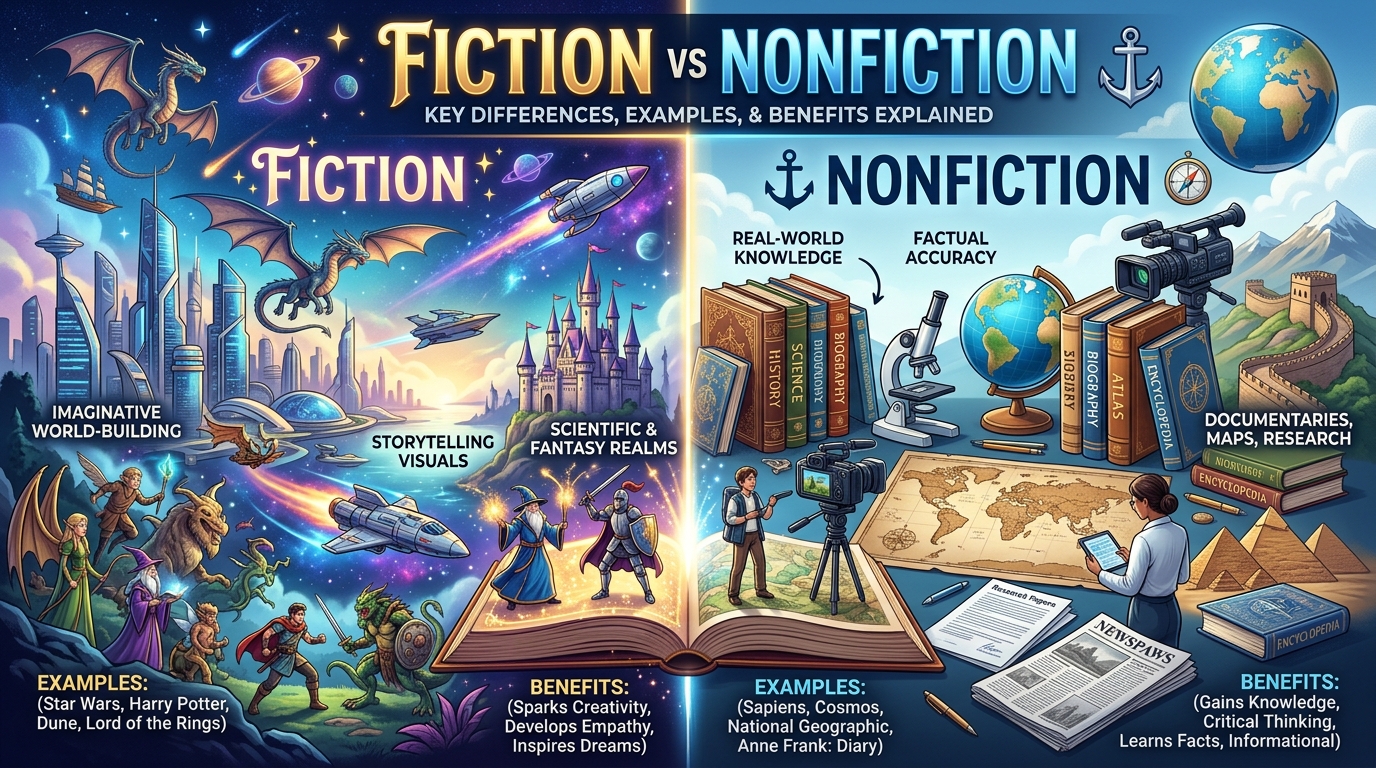
Both forms of writing serve valuable purposes. Fiction entertains, inspires creativity, and allows readers to explore imagined worlds and emotional experiences. Nonfiction educates, informs, and helps readers better understand reality, history, science, and human experiences. Together, they shape the literary world and influence how people think, learn, and connect.
This guide explores the major differences between fiction and nonfiction, their characteristics, examples, benefits, educational value, and why both continue to play such an important role in modern reading culture.
Understanding Fiction and Nonfiction
At the most basic level, fiction refers to literature created from imagination. The events, characters, dialogue, and settings are invented by the writer, even if they are inspired by real-life experiences. Fiction does not need to follow factual accuracy because its purpose is usually centered around storytelling, emotional engagement, and creativity.
Nonfiction, on the other hand, is based on real events, factual information, and truthful accounts. The purpose of nonfiction is often to educate, explain, document, inform, or persuade readers using reality as its foundation. Readers expect nonfiction content to remain accurate and credible.
Despite their differences, both fiction and nonfiction rely on effective communication, strong writing, and meaningful storytelling. A great fictional story can emotionally move readers just as deeply as a powerful nonfiction memoir or historical account.
The Main Difference Between Fiction and Nonfiction
The clearest difference between fiction and nonfiction lies in imagination versus factual truth.
Fiction gives writers complete creative freedom. Authors can invent worlds, create fictional characters, manipulate timelines, and imagine impossible situations. A fantasy novel featuring magical creatures or a science fiction story set on another planet is not expected to be real. Readers understand that the story exists primarily for entertainment, emotional experience, or symbolic meaning.
Nonfiction depends on truth and accuracy. Readers expect nonfiction authors to present reliable information based on research, evidence, observation, or personal experience. A biography, history book, or scientific article must remain rooted in reality. If facts are fabricated, the credibility of the work is damaged.
This core distinction influences writing style, structure, reader expectations, and even publishing categories.
Quick Comparison Table
| Aspect | Fiction | Nonfiction |
| Definition | Imagined stories | Fact-based writing |
| Purpose | Entertainment and creativity | Education and information |
| Characters | Usually fictional | Real people |
| Events | Invented or dramatized | Real events |
| Writing Style | Descriptive and creative | Informative and factual |
| Reader Expectation | Emotional engagement | Accuracy and reliability |
| Examples | Novels, fantasy, thrillers | Biographies, essays, journalism |
| Freedom | Unlimited imagination | Must stay truthful |
The Origins of Fiction and Nonfiction
The roots of fiction and nonfiction stretch back thousands of years. Early civilizations used storytelling to preserve traditions, explain natural mysteries, and communicate cultural values. Myths, legends, and folktales became some of the earliest examples of fiction. These stories were not intended to be scientifically accurate. Instead, they reflected imagination, spirituality, morality, and cultural identity.
Nonfiction developed alongside humanity’s desire to document real events and preserve knowledge. Ancient historians recorded wars, political developments, and societal structures. Philosophers and scholars wrote about science, mathematics, ethics, and human behavior. These writings laid the foundation for educational and factual literature.
As literacy expanded and printing technology evolved, fiction and nonfiction became major pillars of publishing. Today, they dominate bookstores, libraries, online media, film adaptations, and educational systems worldwide.
Characteristics of Fiction
Fiction thrives on creativity and emotional storytelling. Writers build narratives designed to immerse readers into fictional experiences.
One of the strongest characteristics of fiction is character development. Fictional characters often experience emotional struggles, transformation, internal conflict, and personal growth. Readers connect with these characters because they feel emotionally authentic, even when they exist in imaginary worlds.
Plot structure is another essential component. Most fiction follows a narrative arc involving introduction, rising conflict, climax, and resolution. This structure helps maintain suspense and emotional engagement.
Setting also plays a major role. Fiction authors often create detailed environments that shape the atmosphere and mood of the story. Whether the setting is a medieval kingdom, a futuristic city, or a quiet village, the environment becomes part of the reader’s experience.
Dialogue is equally important in fiction. Through conversations between characters, writers reveal personality, emotion, tension, and relationships. Strong dialogue makes stories feel alive and immersive.
Themes add deeper meaning to fictional works. Fiction often explores universal human experiences such as love, identity, fear, ambition, power, and survival. Even though the stories are invented, the emotions behind them often reflect real human truths.
Characteristics of Nonfiction
Nonfiction focuses on factual communication, clarity, and credibility. Instead of inventing stories, nonfiction writers aim to explain real information in an engaging and understandable way.
Research is one of the defining features of nonfiction. Writers often rely on interviews, historical records, scientific studies, firsthand experiences, or verified evidence to support their work. This research strengthens trust between the writer and reader.
Organization is another important element. Nonfiction typically follows a logical structure that helps readers understand information step by step. Educational books, essays, and journalism all rely on clarity and structure.
Tone can vary significantly across nonfiction genres. Academic writing may sound formal and analytical, while memoirs can feel deeply personal and emotional. Regardless of tone, nonfiction remains grounded in reality.
Many nonfiction works also include citations, references, statistics, or documented evidence. These details help confirm the accuracy of the information being presented.
Popular Fiction Genres
Fiction includes countless genres designed to satisfy different reader interests and emotions.
Fantasy Fiction
Fantasy fiction transports readers into magical worlds filled with mythical creatures, supernatural powers, and imaginative adventures. These stories often focus on themes of destiny, courage, and conflict between good and evil.
Science Fiction
Science fiction explores futuristic technologies, artificial intelligence, space exploration, and alternate realities. It frequently examines how scientific advancement may shape society and humanity.
Mystery and Thriller Fiction
Mystery and thriller fiction rely on suspense, secrets, crime, and psychological tension. These stories keep readers engaged through twists and dramatic reveals.
Romance Fiction
Romance fiction centers on emotional relationships and human connection. It remains one of the most commercially successful literary genres worldwide because readers strongly connect with emotional storytelling.
Historical Fiction
Historical fiction combines fictional narratives with real historical settings or events. Writers recreate past eras while adding imagined characters and dramatic situations.
Literary Fiction
Literary fiction often emphasizes character psychology, symbolism, and deeper philosophical themes rather than fast-paced action.
Popular Nonfiction Genres
Nonfiction is equally diverse and covers a wide range of educational and informative categories.
Biographies and Autobiographies
Biographies and autobiographies tell the stories of real individuals and their life experiences. These works provide insight into historical figures, leaders, artists, entrepreneurs, and influential personalities.
Memoirs
Memoirs focus on specific personal experiences or emotional journeys rather than documenting an entire life story. Memoirs are often reflective and emotionally intimate.
Self-Help Books
Self-help books aim to guide readers toward personal growth, productivity, emotional health, or career improvement. These books remain extremely popular because readers seek practical advice and transformation.
Journalism and Investigative Nonfiction
Journalism and investigative nonfiction examine politics, social issues, current events, and global developments. Accuracy and evidence are critical in these forms.
Educational Nonfiction
Educational nonfiction includes textbooks, scientific studies, instructional guides, and academic writing designed to teach readers about specific subjects.
Travel Nonfiction
Travel nonfiction documents real journeys, cultures, and observations from around the world while combining factual experiences with engaging storytelling.
Why Fiction Matters
Fiction offers emotional experiences that few other forms of communication can replicate. Readers often become deeply connected to fictional characters and worlds.
One major benefit of fiction is escapism. A compelling story allows readers to temporarily leave behind stress and immerse themselves in another reality. This emotional escape can provide comfort, relaxation, and inspiration.
Fiction also strengthens empathy. By experiencing life through the perspectives of fictional characters, readers develop greater emotional understanding and compassion for others.
Creativity is another important benefit. Fiction stimulates imagination and encourages readers to think beyond ordinary limitations. Fantasy and speculative fiction, in particular, inspire innovation and curiosity.
Many fictional stories also reflect real social issues and human struggles. Even though the events may be invented, the emotional truths often feel deeply authentic.
Why Nonfiction Matters
Nonfiction provides intellectual, educational, and practical value. Readers often choose nonfiction because they want to learn, improve themselves, or better understand reality.
One major advantage of nonfiction is knowledge acquisition. Readers can explore history, science, psychology, business, politics, and countless other subjects through factual writing.
Nonfiction also strengthens critical thinking skills. Readers learn to analyze evidence, evaluate arguments, and distinguish accurate information from misinformation.
Self-help nonfiction can motivate personal growth and behavioral change. Many readers turn to nonfiction for guidance on productivity, relationships, health, and career development.
Historical nonfiction preserves important cultural and societal knowledge. Without nonfiction documentation, much of human history and scientific discovery would be lost.
Real-life stories can also feel incredibly powerful because readers know the events actually happened. Memoirs of survival, achievement, and resilience often create strong emotional impact.
Can Fiction and Nonfiction Overlap?
Modern literature frequently blurs the line between fiction and nonfiction.
Creative nonfiction is one example. In this style, writers use storytelling techniques commonly found in fiction while still presenting factual information. Memoirs and narrative journalism often fall into this category.
Historical fiction also combines truth with imagination. Writers place fictional characters within real historical events to create emotionally engaging narratives.
Autobiographical novels, docudramas, and fictionalized biographies further demonstrate how storytelling can merge factual foundations with creative interpretation.
This overlap shows that storytelling itself is highly flexible. Writers often use emotional narrative techniques to make factual information more engaging and relatable.
Fiction vs Nonfiction in Education
Both fiction and nonfiction play important roles in education and intellectual development.
Fiction improves imagination, vocabulary, emotional intelligence, and literary analysis skills. Students learn how to interpret symbolism, themes, and character psychology through fictional literature.
Nonfiction strengthens research skills, analytical reasoning, factual understanding, and information literacy. Students learn how to evaluate evidence and process complex information logically.
Educational systems increasingly encourage balanced reading because both genres develop different but equally important abilities.
A student who only reads fiction may struggle with analytical research, while a student who only reads nonfiction may miss opportunities for creative thinking and emotional exploration.
Together, fiction and nonfiction help create well-rounded readers.
Writing Fiction vs Writing Nonfiction
The writing process differs significantly between fiction and nonfiction authors.
Fiction writers focus heavily on storytelling, pacing, emotional arcs, dialogue, and world-building. They spend time developing characters and constructing compelling narratives designed to emotionally engage readers.
Nonfiction writers prioritize research, organization, factual accuracy, and clarity. Their work often involves interviews, data collection, evidence verification, and structured explanation.
Fiction offers greater creative freedom because writers are not limited by factual constraints. Nonfiction requires stronger accountability because readers expect truthful information.
Despite these differences, both forms require strong communication skills and audience awareness.
The Influence of Digital Media
Technology has dramatically transformed how fiction and nonfiction are created and consumed.
eBooks, audiobooks, self-publishing platforms, and online libraries have made literature more accessible than ever before. Readers can instantly explore stories and educational resources from anywhere in the world.
Social media has also influenced reading culture. Fiction readers participate in online book communities, fan discussions, and review platforms. Nonfiction creators share educational content through podcasts, blogs, and digital journalism.
Streaming platforms have further blurred the boundaries between fiction and nonfiction through documentaries, dramatized historical series, and true crime storytelling.
Artificial intelligence and digital tools are also changing how authors research, edit, and market their work.
Despite technological evolution, the human desire for stories and knowledge remains constant.
Which Is Better: Fiction or Nonfiction?
The debate over whether fiction or nonfiction is better ultimately depends on individual goals and preferences.
Readers seeking entertainment, emotional immersion, and imaginative experiences may naturally prefer fiction. Those focused on learning, self-improvement, or factual understanding may lean toward nonfiction.
In reality, both genres provide valuable benefits. Fiction nurtures emotional and creative intelligence, while nonfiction strengthens practical knowledge and critical thinking.
Many of the most engaged readers enjoy both forms because each satisfies different intellectual and emotional needs.
Rather than competing against each other, fiction and nonfiction complement one another.
Conclusion
Fiction and nonfiction are two powerful forms of literature that shape how people understand both imagination and reality. Fiction invites readers into invented worlds filled with emotional depth, creativity, and limitless storytelling possibilities. Nonfiction grounds readers in factual truth, offering knowledge, insight, education, and real-world understanding.
The primary difference between fiction and nonfiction lies in imagination versus factual accuracy, yet both genres share the ability to inspire, influence, and transform readers. Fiction encourages empathy, creativity, and emotional exploration, while nonfiction develops critical thinking, awareness, and intellectual growth.
Modern literature increasingly blends elements of both forms, proving that storytelling itself is highly adaptable. Whether readers enjoy fantasy novels, historical biographies, investigative journalism, or personal memoirs, both fiction and nonfiction continue to hold immense cultural and educational value.
Understanding the differences between fiction and nonfiction ultimately helps readers make better literary choices while appreciating the unique strengths each genre brings to the world of storytelling.
