
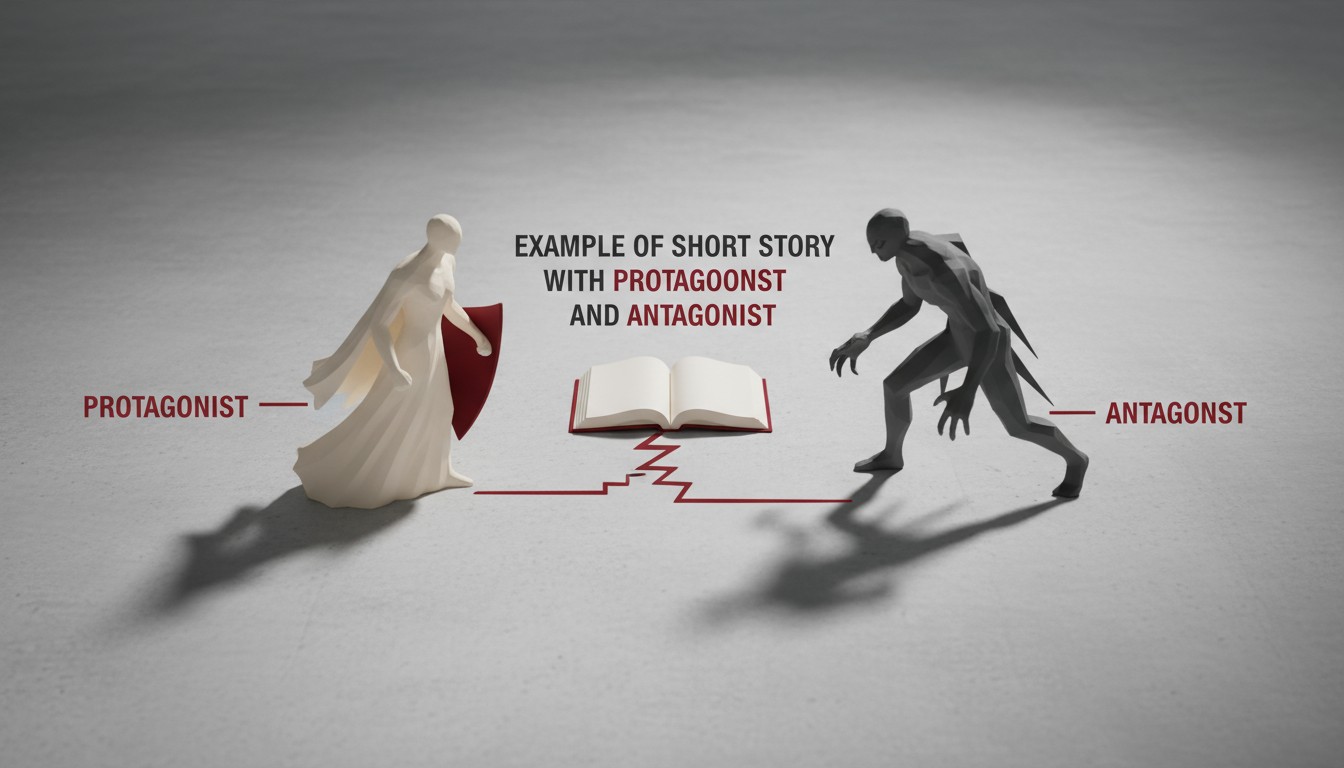
At The Legacy Ghostwriters, we recognize that the foundation of every compelling narrative lies in the dynamic friction between opposing forces. Whether you are crafting a novel or a piece of flash fiction, understanding the interplay between characters is paramount. A clear example of short story with protagonist and antagonist serves as the most effective tool for mastering this balance. In the realm of professional publishing, the ability to construct these roles with nuance is what separates amateur drafts from literary masterpieces.
This comprehensive guide will explore the theoretical definitions of these roles, provide a complete, original short story example, and offer a rigorous analysis of the mechanics at play. By dissecting the conflict, motivation, and resolution, we aim to provide authors with a blueprint for high-level storytelling.
Defining the Roles: Beyond Good and Evil
Before examining a specific example of short story with protagonist and antagonist, it is crucial to strip away the common misconceptions regarding these literary terms. In the publishing industry, we often see manuscripts that mistake “protagonist” for “hero” and “antagonist” for “villain.” While these overlaps frequently occur, they are not synonymous.
The Protagonist: The Carrier of Action
The protagonist is the central character whose decisions drive the plot forward. They are defined not by their morality, but by their agency. In literary theory, the protagonist is the character whose fate matters most to the narrative arc. They must possess a specific goal or desire—be it survival, love, revenge, or understanding.
The Antagonist: The Force of Resistance
The antagonist is the person, force, or institution that opposes the protagonist’s goal. The antagonist exists to create conflict. Without an antagonist, there is no struggle; without struggle, there is no story. An effective antagonist is often a reflection of the protagonist’s internal flaws or a challenge to their worldview.
Original Example of Short Story With Protagonist and Antagonist
To illustrate these concepts effectively, we have crafted an original piece of short fiction. This story, titled “The Silence of the Watchmaker,” provides a concise yet dense example of how character dynamics fuel a narrative.
The Silence of the Watchmaker
Elias Thorne did not simply repair clocks; he healed time. In his cramped workshop, smelling of brass and cedar, the rhythmic ticking of a thousand gears was the only music he required. His goal was simple: to restore the Grand Town Clock, a mechanism that had not chimed in fifty years, before the Centennial Festival.
Enter Councilor Vane. Vane was a man of digital precision, wearing suits that seemed to repel dust and a smile that never reached his eyes. He represented the “New Era” initiative.
“It is obsolete, Elias,” Vane said, standing in the doorway of the workshop, blocking the morning light. “The town council has voted. We are replacing the Grand Clock with a digital interface. It is efficient. It is silent. It is the future.”
Elias tightened his grip on his screwdriver. “It is soulless. The Grand Clock is the heartbeat of this district. You cannot simply tear out history because it requires maintenance.”
“Efficiency requires sacrifice,” Vane countered, stepping inside. He placed a demolition order on the workbench. “You have until noon tomorrow to vacate the tower. The dismantling crew arrives at one.”
The conflict was set. Elias possessed the skill to fix the clock, but Vane possessed the legal authority to destroy it. Throughout the night, Elias worked with feverish desperation. He wasn’t fighting a monster; he was fighting bureaucracy and the indifference of progress. His antagonist was not just Vane, but the concept of “efficiency” that Vane embodied.
At 11:55 AM the next day, Vane arrived with the crew. The town square was silent. “Time is up, old man,” Vane declared, checking his digital watch.
Elias stood on the balcony of the tower, grease-stained and trembling. He didn’t speak. Instead, he pulled the final lever.
At exactly 12:00 PM, a deep, resonant boom shook the square. Then another. The gears ground against fifty years of rust and roared to life. The chime was not perfect—it was raspy and loud—but it was undeniable. The crowd below cheered, the sound vibrating through the pavement. Vane’s digital watch beeped unnoticed.
Vane looked at the crowd, then at the demolition order in his hand. He saw the tears in the eyes of the elders and the wonder in the eyes of the children. The political cost of silencing the clock now outweighed the efficiency of removing it.
“Leave it,” Vane muttered to the crew, turning his back on the tower. “For now.”
Deep-Dive Analysis of the Example
The story above serves as a textbook example of short story with protagonist and antagonist. At The Legacy Ghostwriters, we analyze manuscripts by breaking down these exact components to ensure the narrative engine is functioning correctly.
1. The Protagonist: Elias Thorne
Elias is the protagonist because his desire drives the action.
Goal: Restore the Grand Town Clock.
Motivation: Preservation of history, artistry, and tradition.
Agency: He stays up all night working; he pulls the lever.
2. The Antagonist: Councilor Vane
Vane is the antagonist because he directly opposes Elias’s goal.
Goal: Install a digital interface (Modernization).
Motivation: Efficiency, cost-reduction, and political progress.
Opposition: He brings legal orders and a demolition crew.
3. The Nature of the Conflict
This example demonstrates that conflict does not require violence. The friction here is ideological: Tradition vs. Modernity. Elias and Vane are proxies for these larger themes. The protagonist represents the human touch, while the antagonist represents sterile efficiency. This elevates the story from a simple argument to a thematic exploration.
Types of Antagonistic Forces in Short Fiction
While the example above utilizes a “Person vs. Person” dynamic, an elite writer must understand that an example of short story with protagonist and antagonist can manifest in various forms. The antagonist is not always a human being.
- Person vs. Self: The protagonist battles their own psychology, fear, or addiction. In this case, the “antagonist” is a facet of the protagonist’s own mind.
- Person vs. Nature: The protagonist faces a storm, a wild animal, or a disease. The antagonist is the indifference of the natural world.
- Person vs. Society: The protagonist fights against a dystopian government, a social norm, or systemic injustice.
- Person vs. Supernatural: The protagonist opposes ghosts, gods, or technological singularities.
Regardless of the type, the function remains the same: the antagonist provides the resistance necessary for the protagonist to undergo change.
Classic Literary Examples Analyzed
To further solidify your understanding, it is helpful to look at established literary canons. Analyzing a classic example of short story with protagonist and antagonist reveals how masters of the craft handle this dynamic.
“The Most Dangerous Game” by Richard Connell
Protagonist: Rainsford. His goal is survival.
Antagonist: General Zaroff. His goal is to hunt Rainsford for sport.
Analysis: This is a literal, physical conflict. The antagonist is a dark mirror of the protagonist; both are hunters, but Zaroff has lost his humanity. The story works because the antagonist is more powerful and knowledgeable than the protagonist, raising the stakes.
“The Tell-Tale Heart” by Edgar Allan Poe
Protagonist: The Narrator. His goal is to prove his sanity while concealing his crime.
Antagonist: The “Vulture Eye” (initially) and the Police (externally), but ultimately, the Narrator’s own Guilt (Internal).
Analysis: This is a complex example where the antagonist shifts. The police are merely a catalyst; the true antagonist is the narrator’s fracturing psyche, represented by the sound of the beating heart.
Constructing the Dynamic: Tips for Writers
When you are outlining your own example of short story with protagonist and antagonist, follow these guidelines to ensure depth and resonance.
1. Give the Antagonist a Valid Point
In our original story, Councilor Vane was not “evil.” He wanted efficiency. A digital clock is more accurate than a mechanical one. When the antagonist has a logical motivation, the conflict becomes morally complex and far more engaging for the reader.
2. The “Unity of Effect”
Edgar Allan Poe famously argued for the “unity of effect” in short stories. Every sentence should contribute to a single emotional impact. Ensure that the interaction between your protagonist and antagonist serves this single effect. If the story is about fear, the antagonist must be terrifying. If the story is about nostalgia (like The Silence of the Watchmaker), the antagonist must represent the cold march of time.
3. Raise the Stakes
In a short story, you have limited space to capture attention. The consequences of the protagonist failing must be established early. In our example, the consequence was the permanent destruction of history. If the stakes are low, the conflict feels trivial.
Common Mistakes to Avoid
Through our work at The Legacy Ghostwriters, we frequently encounter manuscripts that fail to maximize the potential of the protagonist-antagonist relationship. Avoid these pitfalls:
- The Passive Protagonist: Things should not just “happen” to the protagonist. They must make choices that provoke the antagonist.
- The “Straw Man” Antagonist: Do not create an antagonist who is weak or easily defeated. The antagonist should be stronger than the protagonist at the beginning of the story.
- Lack of Direct Confrontation: Even in subtle stories, the two forces must meet. This is the climax. In our example, the confrontation occurred on the balcony as the clock struck noon.
Frequently Asked Questions (FAQ)
Can a short story have no antagonist?
Technically, no. While there may not be a “villain,” there must be a force of antagonism. Without resistance, there is no plot. Even in “slice of life” stories, the antagonist might be time, grief, or a difficult decision.
Can the protagonist be a bad person?
Absolutely. This is known as an anti-hero. The protagonist is simply the main character driving the plot. In The Cask of Amontillado, Montresor is a murderer, yet he is the protagonist because the story follows his pursuit of revenge.
How early should the antagonist be introduced?
In a short story, space is limited. The antagonistic force should be introduced or alluded to within the first 25% of the narrative. In The Silence of the Watchmaker, the conflict is established in the second paragraph.
Does the protagonist always have to win?
No. In many literary short stories, the protagonist fails to achieve their goal. However, they usually achieve a realization or internal change. This is often referred to as a tragic ending or a pyrrhic victory.
Expert Summary
Writing a compelling narrative requires more than just an interesting idea; it requires a structural understanding of conflict. As demonstrated in this guide, a strong example of short story with protagonist and antagonist relies on two opposing forces with diametrically opposed goals colliding within a confined narrative space.
The protagonist provides the vehicle for the reader’s empathy, while the antagonist provides the fuel for the plot’s momentum. Whether you are writing high fantasy or literary fiction, the mechanics remain the same: Goal, Opposition, Struggle, and Resolution. By mastering this dynamic, you elevate your writing from a simple sequence of events to a resonant, professional story.
At The Legacy Ghostwriters, we encourage authors to view the antagonist not as an enemy to be destroyed, but as the necessary pressure that turns the coal of a character into a diamond.
Disclaimer: The Legacy Ghostwriters shares publisher information for educational purposes only. We are not affiliated with or endorsed by any of the publishers listed, and we do not guarantee anything related to submissions, acceptance, or publication. Our team provides professional writing, editing, and marketing support to help authors prepare and present their work effectively.
