
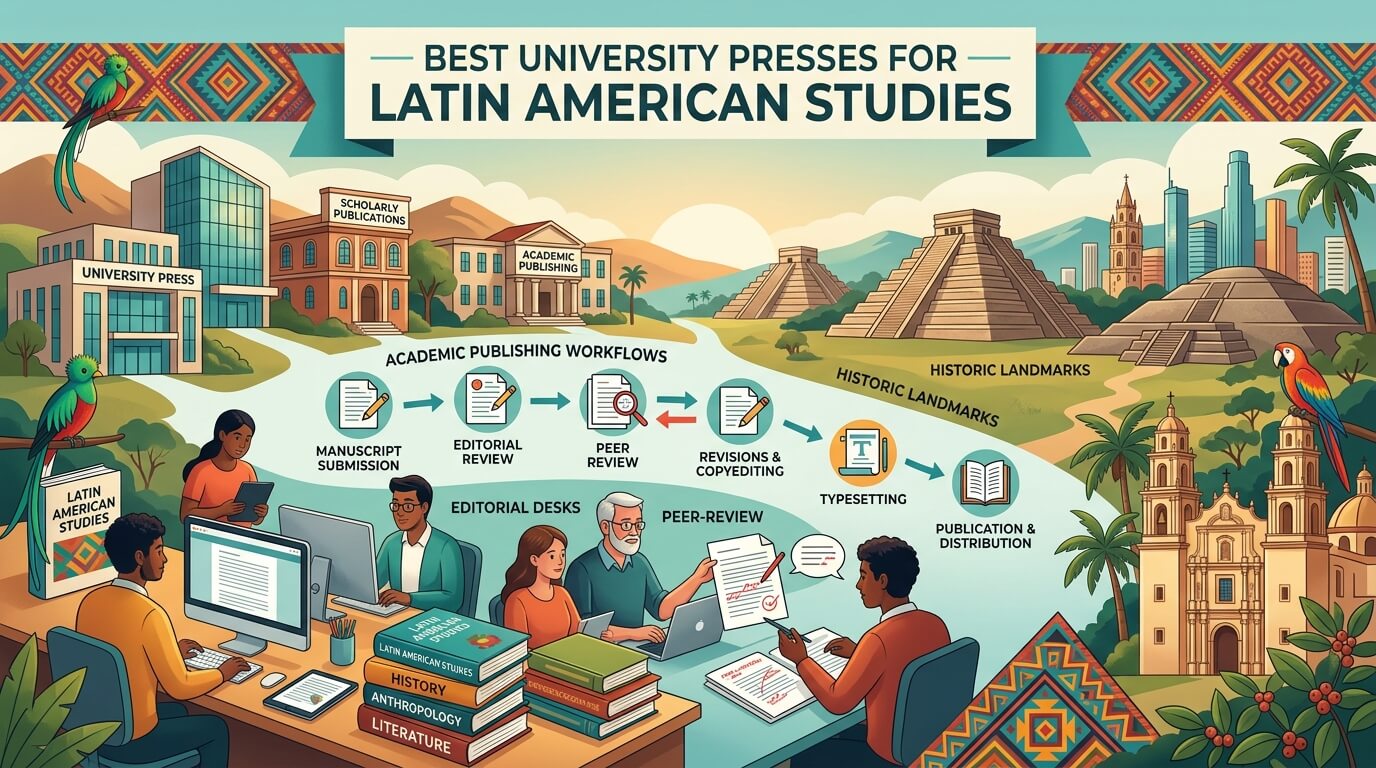
Latin American Studies is one of the most dynamic and interdisciplinary fields in academia. It brings together history, politics, literature, anthropology, sociology, economics, cultural studies, and environmental research to explore the diverse societies and experiences of Latin America and the Caribbean. As interest in the region continues to grow, scholars, students, and researchers increasingly rely on university presses to access credible, peer-reviewed, and groundbreaking scholarship.
University presses play a vital role in shaping the field. They publish original research, preserve historical narratives, introduce emerging voices, and encourage critical conversations about colonialism, migration, democracy, identity, globalization, and social change. For academics seeking reputable publishing opportunities or readers searching for authoritative works, choosing the right university press is essential.
This guide explores some of the best university presses for Latin American Studies, highlighting their strengths, publishing focus, and contributions to the discipline.
The Importance of University Presses in Latin American Studies
University presses occupy a unique position within academic publishing. Unlike commercial publishers that often prioritize market demand, university presses focus on advancing knowledge and supporting scholarly inquiry. Their rigorous peer-review processes ensure the quality and credibility of published research.
For Latin American Studies, this role is particularly important. The region’s history is deeply intertwined with issues of colonialism, political transformation, indigenous resistance, economic development, environmental challenges, and cultural innovation. University presses provide a platform for nuanced analyses that might not find space in mainstream publishing.
The best presses help scholars engage with both regional and global audiences. They publish works in history, political science, anthropology, literature, and interdisciplinary studies that contribute significantly to understanding Latin America’s past, present, and future.
What Makes a University Press Outstanding for Latin American Studies?
Not all university presses have the same level of commitment to Latin American scholarship. The strongest presses typically demonstrate a long history of publishing influential books in the field, maintain dedicated editorial programs focused on Latin America, and collaborate with leading scholars and academic institutions.
These presses often support diverse methodological approaches, including archival research, ethnographic studies, literary criticism, comparative politics, and cultural analysis. They also invest in translating important works and making scholarship accessible to wider audiences.
A great university press not only publishes books but also helps define the intellectual direction of the discipline.
Leading University Presses for Latin American Studies
The following university presses have earned strong reputations for publishing influential scholarship on Latin America and the Caribbean.
Comparative Overview of Top University Presses
| University Press | Strengths in Latin American Studies | Notable Areas |
| Duke University Press | Critical theory and cultural studies | Race, identity, migration |
| University of Texas Press | Deep regional specialization | History, culture, anthropology |
| University of California Press | Interdisciplinary scholarship | Politics, environment, society |
| Stanford University Press | Innovative research | Political science and history |
| University of North Carolina Press | Historical studies | Colonial and modern Latin America |
| Cambridge University Press | Global academic reach | Political economy and history |
| Oxford University Press | Broad scholarly coverage | Literature, politics, social sciences |
| University of Pittsburgh Press | Latin American literary studies | Literature and cultural analysis |
| Vanderbilt University Press | Regional studies focus | Politics and society |
| University of New Mexico Press | Borderlands and indigenous studies | Native communities and history |
Duke University Press
A Leader in Critical and Cultural Scholarship
Duke University Press has become one of the most influential publishers in Latin American Studies, particularly in cultural studies, postcolonial theory, and critical social research. Its publications frequently challenge conventional narratives and encourage scholars to examine issues through innovative theoretical frameworks.
The press has gained recognition for works addressing race, gender, sexuality, migration, and transnational identities across Latin America. Many influential books in cultural studies and anthropology have emerged from Duke’s editorial programs, making it a preferred destination for scholars pursuing interdisciplinary research.
Contributions to Contemporary Debates
One of Duke University Press’s greatest strengths is its ability to engage with contemporary social and political debates. Its publications often examine how globalization, neoliberalism, and social movements shape everyday life throughout the region.
Researchers interested in critical perspectives on Latin American societies frequently turn to Duke’s catalog for innovative and thought-provoking scholarship.
University of Texas Press
A Historic Commitment to Latin American Scholarship
The University of Texas Press is widely regarded as one of the premier publishers in Latin American Studies. Its geographic proximity to Latin America has contributed to decades of engagement with the region’s cultures, histories, and communities.
The press publishes works covering Mexico, Central America, South America, and the Caribbean. Its extensive catalog includes studies in anthropology, history, literature, art, archaeology, and cultural studies.
Strength in Regional Expertise
What distinguishes the University of Texas Press is its deep regional expertise. Many of its publications focus on local experiences and community-based research, providing detailed insights into specific countries, regions, and populations.
Its commitment to diverse voices and interdisciplinary approaches has made it a trusted resource for scholars worldwide.
University of California Press
Interdisciplinary Excellence
The University of California Press has consistently published influential works that bridge multiple academic disciplines. Scholars studying Latin America often find valuable resources across the press’s extensive catalog.
Research published by the press frequently explores environmental challenges, social inequality, political transitions, and economic development. These themes are particularly relevant in understanding contemporary Latin America.
Expanding Global Perspectives
The press encourages scholarship that places Latin America within broader global contexts. Rather than treating the region in isolation, many publications examine international connections, transnational movements, and comparative frameworks.
This approach helps readers understand Latin America as a critical participant in global historical and political processes.
Stanford University Press
Innovation in Political and Historical Research
Stanford University Press has built a strong reputation for publishing sophisticated research in political science, history, and social theory. Its Latin American Studies publications often address state formation, democratization, political violence, and institutional development.
The press is known for supporting rigorous scholarship that combines theoretical depth with empirical evidence.
Advancing New Methodologies
Many Stanford publications introduce innovative research methodologies and comparative perspectives. These works frequently influence broader debates beyond Latin American Studies, contributing to political science, sociology, and international relations.
For scholars seeking intellectually ambitious and methodologically robust research, Stanford remains a leading choice.
University of North Carolina Press
Excellence in Historical Scholarship
The University of North Carolina Press has long been recognized for its contributions to historical studies. Its publications on Latin America often focus on colonial societies, independence movements, slavery, labor systems, and nation-building processes.
The press’s commitment to archival research has resulted in numerous landmark studies that continue to shape scholarly conversations.
Understanding Long-Term Historical Change
Many books published by the press explore long-term transformations in Latin American societies. By examining historical continuity and change, these works provide valuable context for contemporary issues.
This emphasis on historical depth makes the press especially valuable for historians and social scientists alike.
Cambridge University Press
Global Academic Influence
Cambridge University Press is among the world’s most respected academic publishers, and its Latin American Studies program reflects this reputation. The press publishes research across multiple disciplines, including economics, politics, history, and sociology.
Its books often become essential reading in university courses and research programs around the world.
Strong Political and Economic Research
Cambridge is particularly influential in political economy and comparative politics. Scholars studying democratic institutions, economic reforms, public policy, and governance frequently publish their work through the press.
The combination of global visibility and rigorous peer review makes Cambridge an attractive option for academic authors.
Oxford University Press
Breadth and Diversity
Oxford University Press maintains one of the most comprehensive publishing programs in academia. Its Latin American Studies offerings cover literature, history, politics, anthropology, economics, and cultural studies.
This breadth allows the press to support both specialized research and broader interdisciplinary projects.
Supporting International Scholarship
Oxford’s global network enables scholars from different regions and academic traditions to engage in meaningful dialogue. Many of its publications bring together international perspectives, enriching understanding of Latin America’s diverse realities.
The press’s reputation ensures that published works receive substantial academic attention.
University of Pittsburgh Press
A Strong Focus on Literature
The University of Pittsburgh Press is especially respected for its contributions to Latin American literary studies. It publishes research on novels, poetry, cultural movements, translation studies, and literary criticism.
Its catalog includes works that explore both canonical authors and emerging literary voices from across the region.
Promoting Cultural Understanding
Through literature and cultural analysis, the press helps readers understand broader social and political dynamics. Literary texts often provide unique insights into identity, memory, migration, and resistance.
This cultural emphasis has made Pittsburgh an important contributor to the field.
Vanderbilt University Press
Emerging Influence in Latin American Studies
Vanderbilt University Press has steadily expanded its presence in Latin American scholarship. The press publishes works examining politics, society, culture, and regional development.
Its growing catalog reflects the increasing importance of interdisciplinary approaches within the field.
Addressing Contemporary Challenges
Many Vanderbilt publications focus on current issues such as migration, democratic governance, social inequality, and public policy. These topics resonate strongly with scholars and policymakers interested in understanding modern Latin America.
The press’s commitment to contemporary relevance has enhanced its reputation among researchers.
University of New Mexico Press
Expertise in Borderlands Studies
The University of New Mexico Press occupies a distinctive position within Latin American Studies because of its focus on borderlands research. Its publications frequently examine the cultural, political, and historical interactions between Latin America and the United States.
These studies provide important perspectives on migration, identity formation, and transnational relationships.
Indigenous and Community Perspectives
The press is also known for its commitment to indigenous scholarship and community-centered research. Many of its publications highlight voices and experiences that have historically been marginalized within mainstream narratives.
This focus contributes to a more inclusive understanding of Latin America’s diverse societies.
The Growing Importance of Interdisciplinary Publishing
Latin American Studies has evolved significantly over the past several decades. Scholars increasingly recognize that complex social issues cannot be fully understood through a single disciplinary lens.
University presses have responded by encouraging interdisciplinary scholarship that combines history, anthropology, sociology, political science, environmental studies, and literary analysis. This trend has produced richer and more comprehensive understandings of the region.
Interdisciplinary publishing also helps researchers connect local experiences to broader global processes, fostering deeper insights into contemporary challenges.
Digital Publishing and the Future of Latin American Studies
Academic publishing is undergoing significant transformation as digital technologies reshape how research is produced and consumed. University presses are increasingly adopting digital platforms, open-access initiatives, and innovative publishing models.
For Latin American Studies, these developments are particularly important. Digital access enables scholars, students, and institutions throughout Latin America to engage with academic research more easily than ever before.
Expanded accessibility promotes international collaboration and encourages the exchange of ideas across geographic and institutional boundaries.
As digital publishing continues to evolve, university presses will play a critical role in ensuring that high-quality scholarship remains widely available.
How Scholars Can Choose the Right University Press
Selecting the right university press requires careful consideration. Scholars should evaluate a press’s existing catalog, editorial focus, target audience, and reputation within the discipline.
A press that specializes in political science may be ideal for research on governance and public policy, while another with strengths in cultural studies may be better suited for work on identity and representation.
Authors should also consider the press’s commitment to marketing, distribution, and international visibility. A well-positioned press can significantly increase the impact and reach of scholarly work.
Ultimately, the best choice depends on how closely a press’s mission aligns with the goals and subject matter of the manuscript.
Why University Presses Continue to Matter
Despite rapid changes in the publishing landscape, university presses remain essential institutions within academia. They preserve scholarly standards, support intellectual diversity, and provide platforms for innovative research.
In Latin American Studies, their contributions extend beyond publishing books. They help shape scholarly debates, amplify underrepresented voices, and foster greater understanding of one of the world’s most diverse and complex regions.
Their commitment to rigorous scholarship ensures that researchers, students, policymakers, and general readers have access to trustworthy and meaningful knowledge.
Conclusion
The field of Latin American Studies depends heavily on the work of distinguished university presses that publish rigorous, impactful, and interdisciplinary scholarship. Institutions such as Duke University Press, University of Texas Press, University of California Press, Stanford University Press, University of North Carolina Press, Cambridge University Press, Oxford University Press, University of Pittsburgh Press, Vanderbilt University Press, and University of New Mexico Press have made lasting contributions to the discipline.
Each press brings unique strengths, whether in cultural studies, political science, history, literature, borderlands research, or interdisciplinary inquiry. Together, they create a vibrant intellectual ecosystem that advances understanding of Latin America’s rich histories, cultures, and contemporary realities.
For scholars seeking publication opportunities and readers searching for authoritative research, these university presses represent some of the most respected and influential sources of knowledge in Latin American Studies. As the field continues to evolve, their role in shaping future scholarship will remain as important as ever.
