
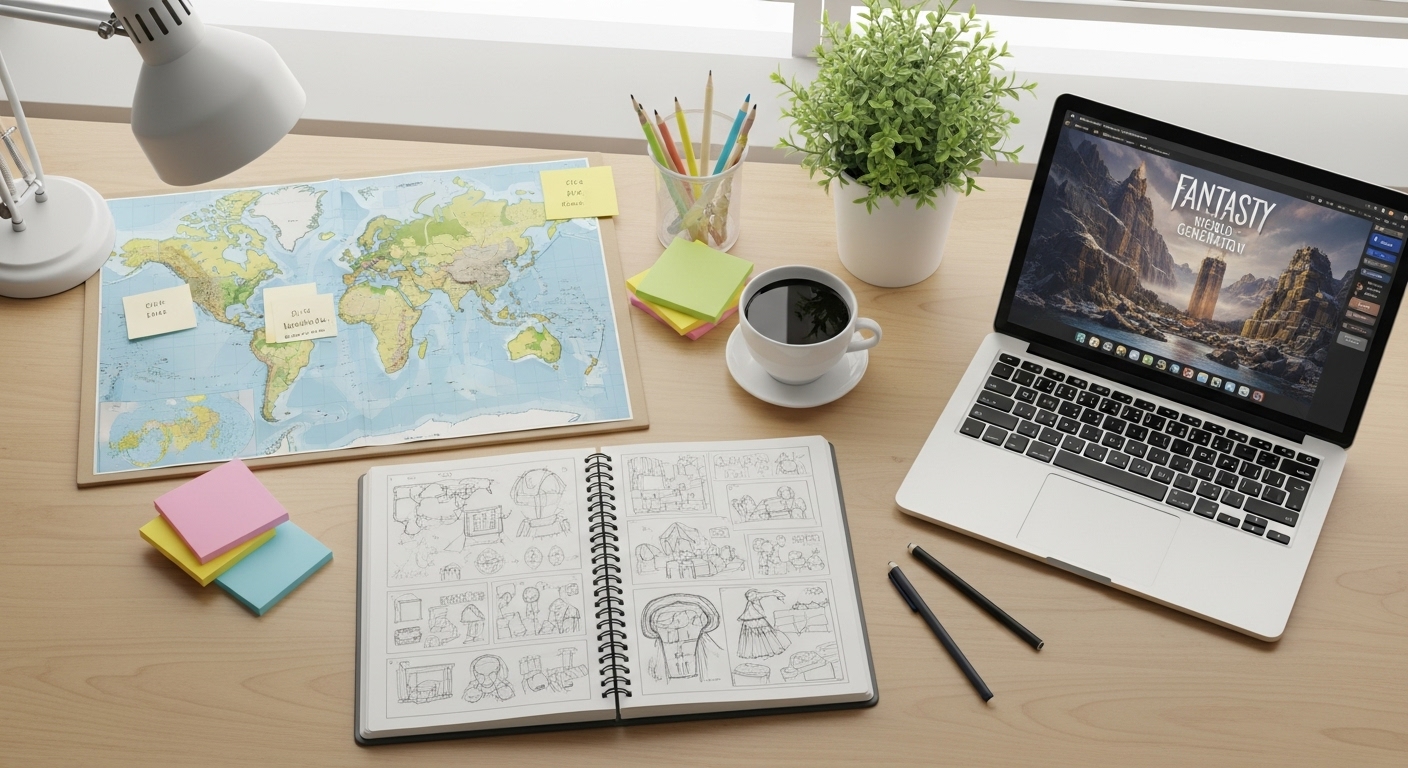
Imagine crafting a world so vivid, readers forget it’s fiction. But where do you start?
Whether you’re building a galaxy full of alien civilizations or a quaint town with a mysterious past, world-building is one of the most important parts of storytelling. It gives your readers something to hold on to—a sense of place, time, and rules that make the fiction feel real.
But let’s be honest. World-building can also feel overwhelming. It’s easy to get lost in the details or forget a key element that makes your setting believable. That’s why having the right tools can help you stay organized, creative, and consistent.
In this guide, we’ll explore everything from digital platforms to simple notebooks, from fantasy kingdoms to realistic cityscapes. Let’s dive into the tools that make world-building less stressful and way more fun.
1. What is World-Building? (And Why It’s Not Just for Fantasy/Sci-Fi)
At its core, world-building is about creating a believable setting. This includes geography, politics, culture, history, technology, and even laws of magic or science.
It’s a myth that only fantasy or sci-fi writers need it. Here’s how world-building shows up in different genres:
- Fantasy: Magical systems, legendary histories, mythical races, and diverse kingdoms.
- Sci-fi: Advanced tech, alien societies, new worlds, or altered Earths.
- Historical fiction: Accurate details about periods, events, and customs.
- Contemporary fiction: Subcultures, communities, or realistic towns that feel alive.
Common World-Building Pitfalls
- Info-dumping: Sharing too much backstory too soon.
- Inconsistent rules: Magic that works differently every time? Readers notice.
- Convenient world gaps: Leaving things vague just to avoid plot issues.
The key is balance. Enough detail to feel immersive, but not so much that it slows the story.
2. Digital Tools for World-Building
Digital tools are a game-changer for modern writers. They can help you organize vast amounts of information, sketch out cities or continents, track timelines, and even randomly generate names or cultures when inspiration is low.
Whether you’re a plotter or a pantser, having structured tools can save you from major headaches down the line.
Let’s look at some of the best options, broken down by function.
A. Writing Software with World-Building Features
1. Scrivener:
Offers a “binder” system where you can separate your manuscript from research, character profiles, and setting details. It’s great for big projects.
2. Campfire Pro:
Designed specifically for world-building. Build relationship charts, species, languages, religions—whatever your world needs.
3. Notion:
Super flexible. You can make custom templates for anything from city profiles to economic systems. Works great as a digital wiki.
These apps let you keep everything in one place. So if you’re halfway through a chapter and forget how your teleportation rules work, the answer is just a tab away.
B. Map-Making Tools
4. Inkarnate:
One of the most popular visual tools for fantasy maps. Great for beginners and pros alike.
5. Wonderdraft:
More detailed and ideal for creating regional maps or zoomed-in areas with towns and trade routes.
6. Azgaar’s Fantasy Map Generator:
Perfect if you want to generate entire continents with political borders, biomes, and languages. Auto-generated, but still customizable.
Maps make your world feel real—not just to readers but to you. When you know where everything is, your characters move more naturally, and your plot flows better.
C. Organization & Wiki-Style Tools
7. World Anvil:
This is like having your own private Wikipedia. You can organize timelines, track interlinked pages, and even publish some sections for fans.
8. LegendKeeper:
Clean and efficient. Especially useful if you have a map and want to link articles directly to locations.
9. Obsidian:
If you love markdown and linked notes, this tool turns your world into a network of connected ideas—kind of like your brain.
The great thing about wiki-style tools is that they keep your world consistent. You can easily reference past events, update characters, and avoid contradictions as your world grows.
D. Random Generators (For Inspiration)
10. Chaotic Shiny:
Want to create random cultures or tavern names? This quirky tool offers generators for all kinds of fun world details.
11. Donjon:
Particularly helpful for fantasy and TTRPG-style writing. Generate NPCs, quests, or even star systems.
12. Fantasy Name Generators:
When you’re stuck on naming a kingdom or a forest, this site has a generator for almost everything imaginable.
Even if you don’t use the results directly, these generators can spark ideas you wouldn’t have had otherwise. They’re especially helpful during brainstorming sessions or creative slumps.
3. Analog World-Building Methods
Not everyone likes building worlds on screens. For some writers, there’s something magical about scribbling notes in a journal, sketching a city layout on graph paper, or pinning index cards to a corkboard. Analog methods are tactile, flexible, and often a lot more intuitive when you’re just trying to figure things out.
Let’s go through some of the most helpful non-digital world-building approaches.
A. The Notebook System
- Bullet journals can act like personal world bibles, helping you track culture, character quirks, and magical rules.
- Index cards are perfect for shuffling events or people around without rewriting anything.
- Sketches are underrated. You don’t have to be a good artist. Even a basic floor plan or map layout can help you understand spatial relationships better.
Sometimes, the act of physically organizing your thoughts gives you clarity in ways apps can’t.
B. The “Big 5” World-Building Questions
You don’t need to answer a hundred questions to create a believable world. These five categories cover most of what you need:
- Geography: What does the land look like? What resources are abundant? Are there natural borders?
- Culture: How do people live, worship, love, and mourn? What’s considered rude or sacred?
- History: Who won past wars? What inventions changed everything? Are there legends that shape the present?
- Politics: Is there a monarchy? A council? Rebels trying to overthrow it all?
- Magic/Tech: What rules govern it? Is it rare, expensive, or accessible to all?
Answering these will give you a solid foundation without needing to overbuild.
C. Sensory Details Checklist
This step breathes life into your world. Go beyond sight—think about:
- Smells: The spice of street food, the metallic tang of a spaceship.
- Sounds: Do birds sing? Is there always wind howling? What does the market sound like?
- Textures: Are roads smooth stone or dusty gravel? Is magic tingly, warm, or cold?
- Taste: What’s the national dish? What’s comfort food here?
The more senses you involve, the more immersive your world becomes for readers.
4. Genre-Specific World-Building Tips
World-building isn’t one-size-fits-all. The genre you write in often determines how deep and wide you need to go. A cozy romance might just need a well-described small town, while an epic fantasy needs a detailed religion, political history, and unique flora.
The key is to align your world-building with your genre’s expectations. Readers of historical fiction expect accuracy; sci-fi fans expect logical futures. By understanding what your audience is looking for, you can shape your world accordingly—without getting lost in unnecessary detail.
Here are a few specific tips based on genre.
A. Fantasy
- Magic systems should have consistent rules. Decide early: Is it soft (mysterious, undefined) or hard (with laws and consequences)?
- Non-human races should be more than stereotypes. Give them cultures, flaws, and diversity.
- Myths and religions help explain the worldview. They don’t need to be true in-story, but they shape how characters behave.
The richer the internal logic of your fantasy world, the more readers will buy into it.
B. Sci-Fi
- Technology should be futuristic but plausible. Ask how it changes daily life—not just warfare or travel.
- Aliens or future humans should have biologically and socially consistent traits. Avoid making them just “humans in masks.”
- Language and communication are often overlooked. Does everyone use universal translators, or do barriers still exist?
The best sci-fi worlds feel like logical evolutions of our own—not just wild guesses.
C. Historical/Alternate History
- Primary sources (letters, diaries, laws) give you a direct view into the mindset of a past time.
- Use “What if” logic sparingly and purposefully. If a major event changed, make sure the ripple effects feel believable.
- Respect the era, even when bending it. Don’t impose modern values without showing the tension that would cause.
Readers of historical fiction are savvy. They’ll notice—and appreciate—your attention to detail.
5. Pro Tips for Efficient World-Building
You don’t need to build everything. Here’s how to focus.
1. The Iceberg Method
Only show 10% of what you build. The rest supports your story quietly in the background.
2. Consistency Checks
Use timelines and maps to avoid contradictions.
3. Collaboration
Share your world with trusted beta readers or writing groups. They’ll help you spot holes.
4. Avoid Overbuilding
Don’t get stuck designing 12 types of tree bark. Build what you need for your plot.
6. Free World-Building Resources
World-building doesn’t have to be expensive. There’s a treasure trove of free resources online that can help you go deeper, stay organized, and get inspired without spending a dime.
From templates to YouTube channels, these tools are excellent for both beginners and experienced writers. You can pick and choose what suits your workflow, and combine them with your own creative instincts.
A. Pre-Made Templates
Try using downloadable Google Docs or Sheets for:
- Culture questionnaires: covering food, fashion, values, and education.
- Magic systems: defining costs, consequences, and rarity.
- City profiles: governance, population, crime, history, and trade.
Many writer forums and blogs offer these as free downloads.
B. YouTube Deep Dives
· Hello Future Me
Offers deep dives into world-building elements in popular media.
· Terrible Writing Advice
Uses humor to point out what not to do—but also teaches you how to do it right.
These are fun, binge-worthy, and surprisingly educational.
C. Podcasts for Writers
- Writing Excuses: 15-minute episodes packed with practical advice.
- Worldbuilding for Masochists: Long-form discussions with guest authors, full of insights and laughs.
Play them while walking, commuting, or cleaning—you’ll pick up gems along the way.
Conclusion
World-building isn’t just background work—it’s what breathes life into your story. With the right tools and a bit of strategy, you can create a world your readers won’t want to leave.
Whether you’re using high-tech apps or scribbling in a worn-out journal, what matters most is staying consistent, inspired, and focused on what serves the story.
Start small, build smart, and most importantly: have fun.
FAQs
1. Do I need to build my entire world before writing the story?
No, start with what you need. You can expand your world as the story grows.
2. What’s the difference between hard and soft magic?
Hard magic has clear rules and limits (like in Mistborn). Soft magic is more mysterious (like in The Lord of the Rings).
3. How do I avoid info-dumping in my story?
Reveal your world naturally—through dialogue, setting, or action—instead of giving long exposition.
4. Can I use multiple world-building tools at once?
Absolutely. Many writers use Notion for organizing, Scrivener for writing, and Inkarnate for maps.
5. What if my world-building doesn’t feel original?
Every idea has been done—but not by you. Your voice and spin make it fresh. Focus on what excites you most.
