
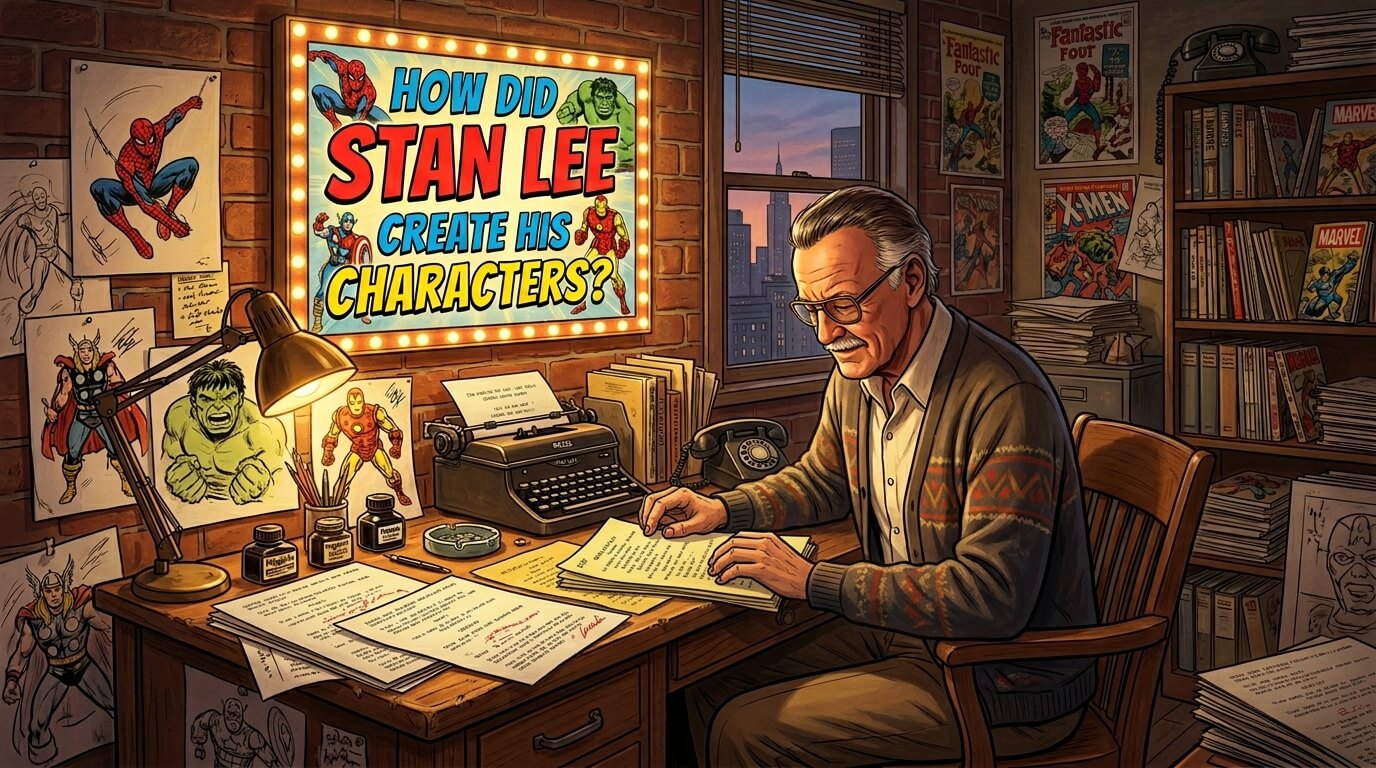
Stan Lee is often described as one of the most influential creative minds in modern pop culture, but the way he actually created his characters was far less mystical and far more grounded in collaboration, timing, and a deep understanding of human emotion. Instead of simply inventing superheroes as perfect, godlike beings, he reshaped the entire idea of what a comic book hero could be. His characters were not just powerful figures in costumes; they were flawed, emotional, conflicted people who also happened to have extraordinary abilities. That shift in perspective became the foundation of the Marvel Universe and permanently changed how superhero stories were told.
What makes Stan Lee’s creative process especially fascinating is that it was never a single-person operation in the traditional sense. He worked within a system that encouraged collaboration between writers, artists, and editors, and he often built characters from shared ideas that evolved through constant revision. His creativity was less about sudden invention and more about refining concepts until they felt alive, relatable, and culturally relevant.
The Early Comic Book Environment That Shaped His Creativity
To understand how Stan Lee created his characters, it is important to look at the era he was working in. During the early and mid-20th century, comic books were still developing as a storytelling medium. Many superheroes of the time were written as nearly flawless figures who represented absolute justice and moral clarity. Characters like Superman and Batman had depth, but they were still largely idealized symbols rather than deeply human personalities.
Stan Lee entered the comic book industry during a time when the medium was transitioning. Readers were beginning to want more complex stories, especially teenagers and young adults who were growing up with comics but wanted them to reflect real emotional struggles. Lee, along with his collaborators at Marvel Comics, recognized this shift. He saw that superheroes could be more compelling if they felt like real people living real lives beneath their costumes.
This environment pushed him to experiment with storytelling approaches that broke away from tradition. Instead of focusing only on external conflict, he began to emphasize internal conflict, personality flaws, and moral ambiguity. This was the seed of what would later become the Marvel style of character creation.
The Marvel Method and Collaborative Storytelling
One of the most important elements in understanding Stan Lee’s character creation process is the Marvel Method. Unlike traditional comic book writing, where a writer scripts everything in detail before the artist draws, the Marvel Method was far more flexible and collaborative.
In this system, Stan Lee would typically begin by discussing a rough story idea with an artist. He might suggest a concept like a scientist who transforms into a monster when angry or a teenager who gains spider-like abilities after a strange accident. From there, the artist would often take the lead in visually plotting the story, deciding pacing, action sequences, and even some character behavior through illustrations.
Once the artwork was completed, Stan Lee would return to the pages and write dialogue, captions, and narrative structure based on what had already been drawn. This meant that characters were shaped not only by Lee’s imagination but also by the visual interpretation of artists like Jack Kirby and Steve Ditko.
This method created characters who felt organic because they were literally built in layers. Instead of being locked into a rigid script from the beginning, they evolved through visual storytelling and narrative refinement. It also allowed for unexpected creative directions that sometimes led to entirely new character traits or emotional dimensions.
The Shift Toward Humanized Superheroes
Before Stan Lee’s influence, superheroes often represented ideals rather than personalities. One of his most revolutionary ideas was to make superheroes emotionally complex. He believed that readers would connect more deeply with characters who struggled with everyday problems alongside their extraordinary responsibilities.
This is why many of his characters experience issues like financial stress, social rejection, self-doubt, or romantic complications. These elements were not accidental; they were intentional design choices that made the characters relatable.
For example, instead of creating a hero who was always confident and in control, he might design a character who doubts themselves constantly, even after gaining incredible powers. This humanization allowed readers to see themselves in superheroes, which dramatically increased emotional engagement.
Stan Lee often emphasized that superpowers alone were not enough to sustain interest. What mattered was how those powers affected a character’s life, relationships, and identity. This philosophy became a cornerstone of Marvel storytelling.
Case Study Table: How Stan Lee’s Characters Were Conceptually Built
| Character | Core Idea | Human Problem | Creative Collaboration | Resulting Impact |
| Spider-Man | Teenager gains spider abilities | Responsibility, guilt, growing up | Developed with Steve Ditko’s visual storytelling | Became the symbol of relatable superheroes |
| Iron Man | Wealthy industrialist builds armored suit | Alcoholism, ego, morality of war | Expanded through Jack Kirby and Don Heck’s designs | Reflected Cold War-era industrial anxiety |
| The X-Men | Mutants born with powers | Social discrimination and identity | Built through ensemble storytelling | Became metaphor for civil rights struggles |
| Fantastic Four | Family of explorers gain powers | Family conflict, teamwork | Jack Kirby’s cosmic imagination shaped visuals | First Marvel family-style superhero team |
| Hulk | Scientist transforms under emotional stress | Rage, identity loss, inner conflict | Collaboration with Jack Kirby | Embodied psychological struggle and duality |
This table shows that Stan Lee’s characters were never created in isolation. Each one emerged from a blend of conceptual thinking, emotional grounding, and artistic interpretation. The human problem at the center of each character was often more important than the superpower itself.
Emotional Truth as the Foundation of Character Creation
A major reason Stan Lee’s characters remain popular is that they are built on emotional truth rather than pure fantasy. He often started with a simple question: what kind of emotional struggle would make a character interesting even without superpowers?
From that starting point, he would layer in extraordinary abilities. This approach meant that the powers were not the focus of the character but rather a complication added to an already compelling human situation.
For example, the idea behind Spider-Man is not just “a boy with spider powers,” but “a teenager trying to balance responsibility, guilt, and growing up while dealing with powers he did not ask for.” That emotional foundation is what makes the character timeless.
Stan Lee understood that readers connect more deeply with emotional struggle than with perfection. By embedding vulnerability into his characters, he made them feel alive and unpredictable.
Influence of Real Life and Social Context
Stan Lee also drew heavily from the world around him. Many of his characters reflect social, political, and cultural issues of the time. The X-Men, for instance, are often interpreted as a metaphor for discrimination and civil rights struggles. Their stories explore what it means to be feared or rejected because of something intrinsic to who you are.
Similarly, Iron Man reflects themes of war, technology, and corporate responsibility, especially during a time when the military-industrial complex was a growing concern in society. These real-world influences gave his characters depth beyond entertainment.
Stan Lee did not always explicitly design these metaphors from the beginning. Often, they emerged naturally as stories developed and as readers interpreted the characters through the lens of their own experiences. This openness to interpretation added longevity to his creations.
The Role of Dialogue and Personality Building
Another key aspect of Stan Lee’s creative process was his attention to dialogue. Even when characters were visually designed and plotted by artists, their personalities were often defined through speech patterns, humor, and emotional expression.
Stan Lee had a distinctive writing style that blended dramatic narration with witty, conversational dialogue. He often gave characters unique voices that reflected their personalities. Spider-Man, for example, is known for his humorous, self-aware remarks even during intense battles, which contrasts with more serious heroes.
This emphasis on voice helped differentiate characters in a crowded superhero landscape. Even when multiple characters had similar powers or backgrounds, their dialogue made them feel distinct.
Why His Creative Approach Still Matters Today
Stan Lee’s method of character creation continues to influence modern storytelling far beyond comic books. Today’s superhero films, television shows, and graphic novels still rely on the principles he helped establish: emotional depth, collaboration, and human relatability.
Modern audiences expect characters to have flaws, motivations, and internal struggles. This expectation can be traced directly back to the foundation Stan Lee helped build. His characters proved that superheroes could be both powerful and deeply human at the same time.
Even outside of comics, writers in film, television, and literature often use similar techniques: starting with emotional conflict first, then building external circumstances around it.
Conclusion
The process behind how Stan Lee created his characters was not a single formula but a dynamic blend of collaboration, emotional insight, cultural awareness, and storytelling innovation. He transformed superheroes from distant ideals into relatable human beings by focusing on their struggles rather than just their powers. Working closely with artists and editors, he helped shape a storytelling system that allowed characters to evolve organically.
What made his approach revolutionary was not just the characters themselves, but the idea that anyone—even someone with extraordinary abilities—could still feel doubt, fear, humor, and vulnerability. That simple shift is what made his creations timeless and continues to define the superhero genre today.
