
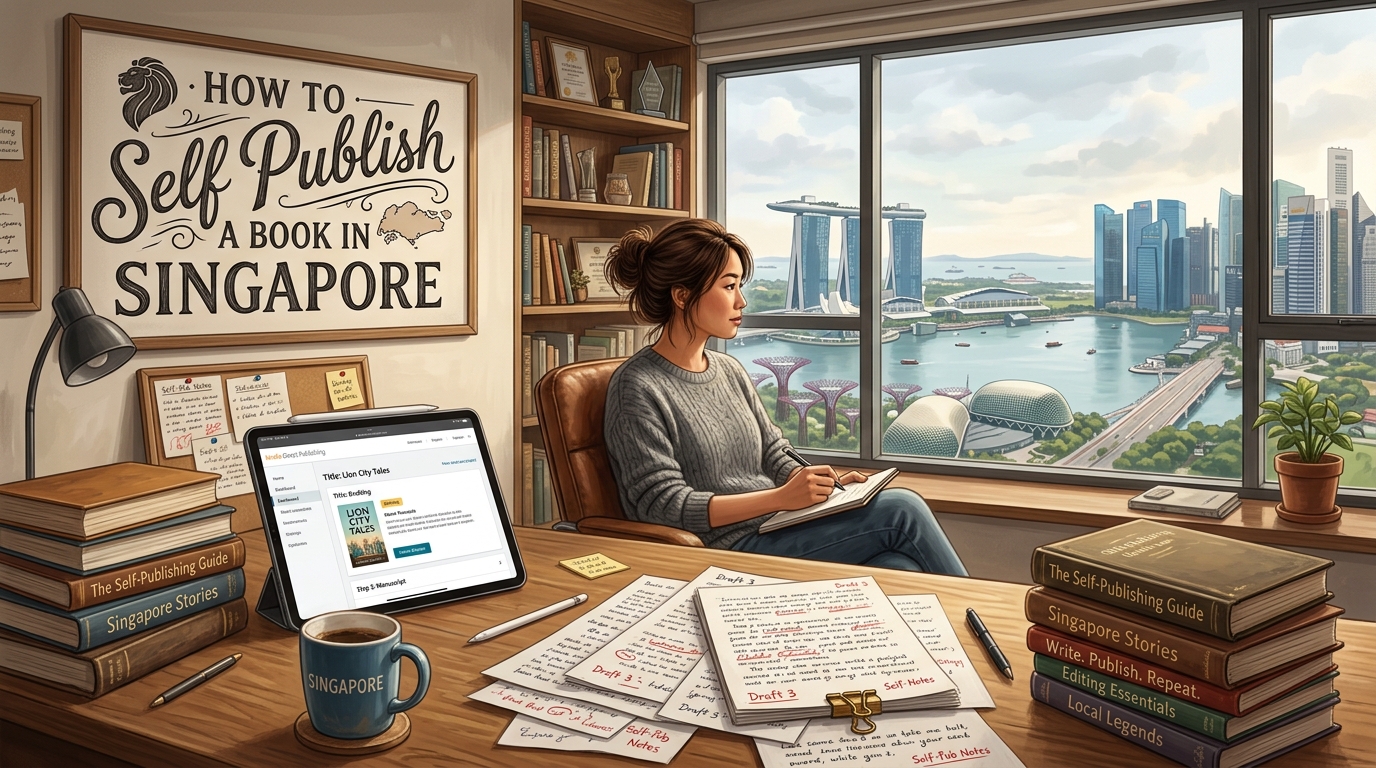
Self-publishing in Singapore has evolved from a niche path into a serious and respected publishing route for writers, entrepreneurs, educators, and storytellers. Over the last decade, digital technology, global marketplaces, and the growing acceptance of independent publishing have transformed the way books are produced and distributed. Writers in Singapore are no longer limited to traditional publishing houses or dependent on literary gatekeepers to share their work with readers. Today, an author with a strong manuscript, a clear publishing strategy, and a willingness to learn the process can successfully publish a professional-quality book independently.
Singapore’s multicultural literary landscape makes self-publishing especially appealing. Writers can publish in English, Mandarin, Malay, Tamil, or bilingual formats while reaching local and international readers at the same time. Whether the goal is to publish fiction, memoirs, poetry, business books, children’s books, educational guides, or personal stories, self-publishing provides authors with creative control and ownership over every aspect of the project.
The process, however, involves much more than uploading a document online. Professional self-publishing requires editing, formatting, cover design, pricing strategies, distribution planning, and marketing preparation. Authors who understand the publishing journey from start to finish are more likely to create books that stand out in a competitive marketplace.
This guide explores how to self-publish a book in Singapore step by step, including planning, editing, design, printing, digital publishing, marketing, legal considerations, and distribution opportunities available to Singaporean authors.
Understanding the Self-Publishing Landscape in Singapore
Singapore has a unique publishing environment shaped by its strong education sector, multilingual culture, and digitally connected population. Readers in Singapore consume both local and international content, which creates opportunities for independent authors to enter different genres and categories.
The rise of global publishing platforms has also reduced many of the traditional barriers to entry. Singaporean authors can now publish through international marketplaces such as Amazon Kindle Direct Publishing, Apple Books, Kobo, and IngramSpark while also working with local printing companies and bookstores. This means a self-published author in Singapore can reach readers in the United States, the United Kingdom, Australia, India, and Southeast Asia without needing a traditional publisher.
At the same time, the Singapore book market values professionalism. Readers expect books to have strong editing, quality cover designs, and polished formatting. Because of this, successful self-publishing in Singapore often involves investing in professional services rather than rushing the process.
Another important factor is the growing number of entrepreneurs, coaches, educators, and business professionals using books to build authority. Many professionals in Singapore publish books not only for sales but also for branding, speaking engagements, workshops, and online business growth.
Deciding Why You Want To Publish Your Book
Before beginning the publishing journey, authors should understand the purpose behind their book. A clear publishing goal shapes every decision afterward, from editing and design to pricing and marketing.
Some writers publish to establish themselves as experts in a field. Others publish to tell personal stories, preserve family history, or share creative ideas. Fiction writers may want to build a long-term readership and eventually create a series, while entrepreneurs might use books to strengthen business credibility.
Understanding the purpose of the book also helps define the audience. A children’s picture book for Singaporean families requires a different publishing strategy than a finance guide for professionals or a science-fiction novel aimed at international readers.
When authors skip this stage, the book often lacks direction. Successful self-published books are usually created with a strong understanding of who the readers are and why the book matters to them.
Preparing Your Manuscript for Publication
The manuscript is the foundation of the entire publishing process. No amount of marketing or cover design can compensate for weak writing or poor structure. Authors should spend time revising the manuscript thoroughly before moving into production.
In Singapore’s competitive publishing environment, readers expect books that feel professionally written. This means authors should focus on clarity, pacing, readability, and consistency.
Revising the First Draft
The first draft is rarely ready for publication. Most books require several rounds of revisions before they reach a publishable standard. Writers should revisit character development, sentence flow, chapter organization, dialogue quality, and overall readability.
Many authors benefit from stepping away from the manuscript for a few weeks before revising it. Distance helps writers identify weaknesses more objectively.
For nonfiction books, revision often includes improving structure, strengthening arguments, and ensuring information is accurate and relevant. For fiction, revisions usually focus on plot coherence, emotional depth, and pacing.
Hiring Professional Editors
Editing is one of the most important investments in self-publishing. Readers quickly notice grammar mistakes, awkward phrasing, and inconsistent formatting. A professionally edited book builds trust and improves the reading experience.
There are different types of editing involved in publishing.
| Editing Type | Purpose | Best Time To Use |
| Developmental Editing | Improves structure, storytelling, and organization | Early revision stage |
| Line Editing | Enhances clarity, tone, and sentence flow | After structural revisions |
| Copy Editing | Corrects grammar, punctuation, and consistency | Before formatting |
| Proofreading | Identifies final errors before publishing | Final production stage |
Singaporean authors can hire freelance editors locally or work remotely with international professionals. The key is choosing editors experienced in the book’s genre.
Receiving Beta Reader Feedback
Beta readers provide valuable insight into how general readers may react to the manuscript. They can highlight confusing sections, pacing problems, or emotional gaps the author may not notice.
For Singaporean authors writing culturally specific stories, beta readers from the target audience can be especially helpful. They help determine whether the language, references, and themes resonate naturally.
Choosing Between Print and Digital Publishing
One of the biggest decisions in self-publishing is selecting the book format. Most modern authors publish both print and digital editions because each serves different reader preferences.
Print books remain highly valued in Singapore, especially for children’s books, educational materials, memoirs, and business publications. Physical books are also useful for events, signings, workshops, and bookstores.
Ebooks, however, provide global reach and lower production costs. They are especially effective for fiction genres, self-help books, and niche nonfiction categories.
Many successful self-published authors use a hybrid strategy by launching ebooks first and later expanding into print editions.
Designing a Professional Book Cover
Book covers heavily influence purchasing decisions. In both online marketplaces and physical bookstores, the cover creates the first impression.
A common mistake among new self-publishers is trying to design the cover themselves without design experience. While free tools exist, professional covers usually perform far better because they are designed according to genre expectations and reader psychology.
Singapore’s publishing market includes diverse genres and audiences, which means cover trends vary significantly. A romance novel requires different typography and imagery than a business guide or literary memoir.
Understanding Genre Expectations
Readers often judge a book’s genre within seconds based on visual presentation. Professional cover designers understand how to align colors, typography, and layout with reader expectations.
For example, thriller novels often use darker tones and bold typography, while self-help books tend to feature clean designs with strong title visibility.
Ignoring genre conventions can make books appear unprofessional or confusing to potential readers.
Creating Covers for Digital Platforms
Online bookstores display covers as small thumbnails. This means titles must remain readable even at reduced sizes.
Strong ebook covers usually feature high contrast, clean typography, and uncluttered designs. Overly complex visuals can become difficult to recognize on mobile devices.
Cover Design for Print Books
Print covers require additional elements such as spine design, back cover text, ISBN barcodes, and print dimensions. Authors publishing paperbacks or hardcovers in Singapore should work with designers familiar with print specifications.
Formatting Your Book for Publication
Formatting transforms a manuscript into a readable book layout. Poor formatting immediately signals amateur publishing.
Different formats require different layout standards. Print books need margins, page numbering, trim sizes, and typography adjustments, while ebooks require responsive formatting compatible with multiple devices.
Print Formatting
Print formatting focuses on visual balance and readability. Elements such as chapter headings, spacing, indentation, and font selection contribute to the reading experience.
Singaporean authors often choose common trim sizes such as 5” x 8”, 5.5” x 8.5”, or 6” x 9” depending on genre and page count.
Ebook Formatting
Ebook formatting involves creating files compatible with Kindle, EPUB, and other digital reading systems. Unlike print books, ebooks must adapt to different screen sizes.
Professional ebook formatting ensures proper chapter navigation, clickable tables of contents, and consistent spacing across devices.
Obtaining an ISBN in Singapore
An ISBN, or International Standard Book Number, is a unique identifier assigned to books. In Singapore, ISBNs are issued through the National Library Board.
ISBNs help bookstores, distributors, and libraries catalog books properly. Authors planning to sell print books through retailers or libraries should obtain an ISBN.
Different editions require separate ISBNs. For example, paperback, hardcover, and ebook editions each need unique identifiers.
Although some publishing platforms provide free ISBNs, many authors prefer owning their own ISBNs for greater publishing control and branding consistency.
Choosing a Self-Publishing Platform
Self-publishing platforms determine where and how books are distributed. Singaporean authors have access to both global and local publishing services.
Amazon Kindle Direct Publishing
Amazon KDP is one of the most widely used self-publishing platforms globally. It allows authors to publish ebooks and paperbacks with worldwide distribution.
The platform is especially attractive because it requires no upfront publishing fees. Authors earn royalties based on sales while maintaining ownership of their work.
IngramSpark
IngramSpark provides broader print distribution to bookstores, libraries, and retailers worldwide. Many professional authors use it for high-quality print publishing.
Apple Books and Kobo
Apple Books and Kobo are additional ebook distribution platforms that help authors diversify their reach beyond Amazon.
Publishing on multiple platforms can increase visibility and reduce dependence on a single marketplace.
Understanding Printing Options in Singapore
Authors planning physical books must decide between print-on-demand and offset printing.
Print-on-demand allows books to be printed only when orders are placed. This reduces upfront costs and inventory risks.
Offset printing involves printing large quantities at once. While it requires higher upfront investment, the per-unit cost becomes cheaper for bulk orders.
| Printing Method | Advantages | Limitations |
| Print-On-Demand | Low upfront cost, no inventory needed | Higher per-book printing cost |
| Offset Printing | Better for large orders, premium quality | Requires bulk investment |
Marketing Your Self-Published Book in Singapore
Publishing a book is only part of the journey. Marketing determines whether readers discover it.
One of the biggest misconceptions about self-publishing is that books automatically gain attention after release. In reality, successful authors actively market their work before and after publication.
Building an Author Platform
An author platform refers to the audience and online presence surrounding the writer. This includes websites, email newsletters, social media accounts, podcasts, blogs, and speaking opportunities.
Singaporean authors benefit from building visibility early rather than waiting until launch day.
Using Social Media Strategically
Social media plays a major role in modern publishing marketing. Platforms such as Instagram, TikTok, Facebook, LinkedIn, and YouTube allow authors to engage readers directly.
Different genres perform better on different platforms. Fiction authors often find success through BookTok and Bookstagram communities, while business authors may benefit more from LinkedIn.
Organizing Book Launch Campaigns
A strong launch creates momentum during the early release period. Launch campaigns often include preorder announcements, cover reveals, interviews, reviews, giveaways, and virtual events.
In Singapore, authors can also host launch events at bookstores, libraries, cafes, or creative spaces.
Selling Your Book in Singapore Bookstores
Getting self-published books into bookstores can be challenging but possible with professional preparation.
Independent bookstores are often more open to local authors than large chain retailers. Singapore has several bookstores that support local literary communities and independent publishing.
Bookstores usually consider factors such as cover quality, editing standards, marketability, and distribution reliability before accepting books.
Professional presentation matters greatly. Authors approaching bookstores should prepare a sell sheet, ISBN details, pricing information, and professionally printed copies.
Publishing Audiobooks in Singapore
Audiobooks are becoming increasingly popular worldwide, including in Singapore. Many readers now consume books while commuting, exercising, or multitasking.
Independent authors who publish audiobooks can reach entirely new audiences and increase revenue opportunities.
Producing an audiobook involves narration, audio editing, mastering, and distribution. Authors can narrate their own books or hire professional voice actors.
Audiobook platforms such as Audible, Apple Books, and Kobo allow Singaporean authors to distribute audio editions internationally.
Translating Books for Multilingual Audiences
Singapore’s multilingual environment creates opportunities for translated editions.
Authors who publish in English may later translate books into Mandarin, Malay, or Tamil to expand their audience reach. Likewise, writers originally publishing in regional languages may consider English translations for international markets.
Translation involves much more than direct language conversion. Skilled translators preserve tone, emotion, and cultural meaning while adapting the text naturally for readers.
Managing Self-Publishing Costs
Self-publishing costs vary depending on production quality, genre, and marketing strategy.
The overall budget may include editing, formatting, illustrations, ISBN registration, website creation, printing, advertising, and promotional services.
While self-publishing can be affordable compared to traditional publishing routes that require literary representation, professional-quality publishing still requires thoughtful investment.
Authors should avoid viewing publishing costs as unnecessary expenses. High-quality editing and design directly influence reader trust and long-term reputation.
Understanding Royalties and Revenue
One of the advantages of self-publishing is higher royalty potential compared to traditional publishing.
Traditional publishers often pay authors a smaller percentage because they handle production, printing, and distribution. Self-publishing platforms generally offer higher royalty percentages, especially for ebooks.
However, self-published authors are also responsible for managing expenses and marketing efforts themselves. Success often depends on balancing quality production with strategic promotion.
Some authors generate income not only through book sales but also through workshops, consulting, speaking engagements, coaching programs, and digital courses connected to their books.
Common Mistakes New Self-Publishers Make
Many self-published authors rush into publishing before the manuscript is truly ready. This often leads to weak reviews and disappointing sales.
Another common mistake is neglecting editing and cover design. Readers immediately associate production quality with credibility.
Some authors also underestimate marketing. Even excellent books require visibility and promotion to reach readers.
Others publish without understanding their audience. Successful books are usually positioned clearly for specific readers rather than trying to appeal to everyone.
Pricing errors, poor formatting, and inconsistent branding can also hurt a book’s long-term performance.
Building a Long-Term Author Career
Self-publishing should not always be viewed as a one-time project. Many successful authors in Singapore treat publishing as a long-term creative and business journey.
Authors who consistently publish quality books often build loyal readerships over time. Each new release strengthens visibility and expands audience reach.
Long-term success usually comes from combining strong storytelling with strategic marketing and professional presentation.
Some writers expand into speaking opportunities, workshops, consulting, teaching, or adaptation rights. Others build online communities around their books.
The modern publishing industry rewards consistency, authenticity, and reader engagement.
The Future of Self-Publishing in Singapore
Self-publishing in Singapore continues to grow as technology becomes more accessible and readers increasingly embrace independent authors.
Digital publishing tools, artificial intelligence, online bookstores, and social media marketing have reshaped how books are created and distributed. This has opened opportunities for writers who previously struggled to access traditional publishing systems.
At the same time, reader expectations continue to rise. Successful self-published books are becoming nearly indistinguishable from traditionally published titles in terms of editing, design, and production quality.
Singapore’s international connectivity and multilingual culture position local authors well for both regional and global publishing success.
Conclusion
Learning how to self-publish a book in Singapore involves much more than simply uploading a manuscript online. It is a creative, technical, and strategic process that requires planning, professionalism, and patience. From editing and design to marketing and distribution, every stage contributes to how readers experience the final book.
Singapore offers a strong environment for independent authors because of its global connectivity, educated readership, and growing creative economy. Writers today have more opportunities than ever before to publish stories, share expertise, and build audiences without relying solely on traditional publishers.
The most successful self-published authors are usually the ones who treat publishing seriously. They invest in quality, understand their audience, and commit to long-term growth rather than expecting overnight success.
Whether you are publishing your first novel, a children’s picture book, a memoir, or a business guide, self-publishing in Singapore can become a powerful way to turn ideas into lasting work that reaches readers around the world.
