
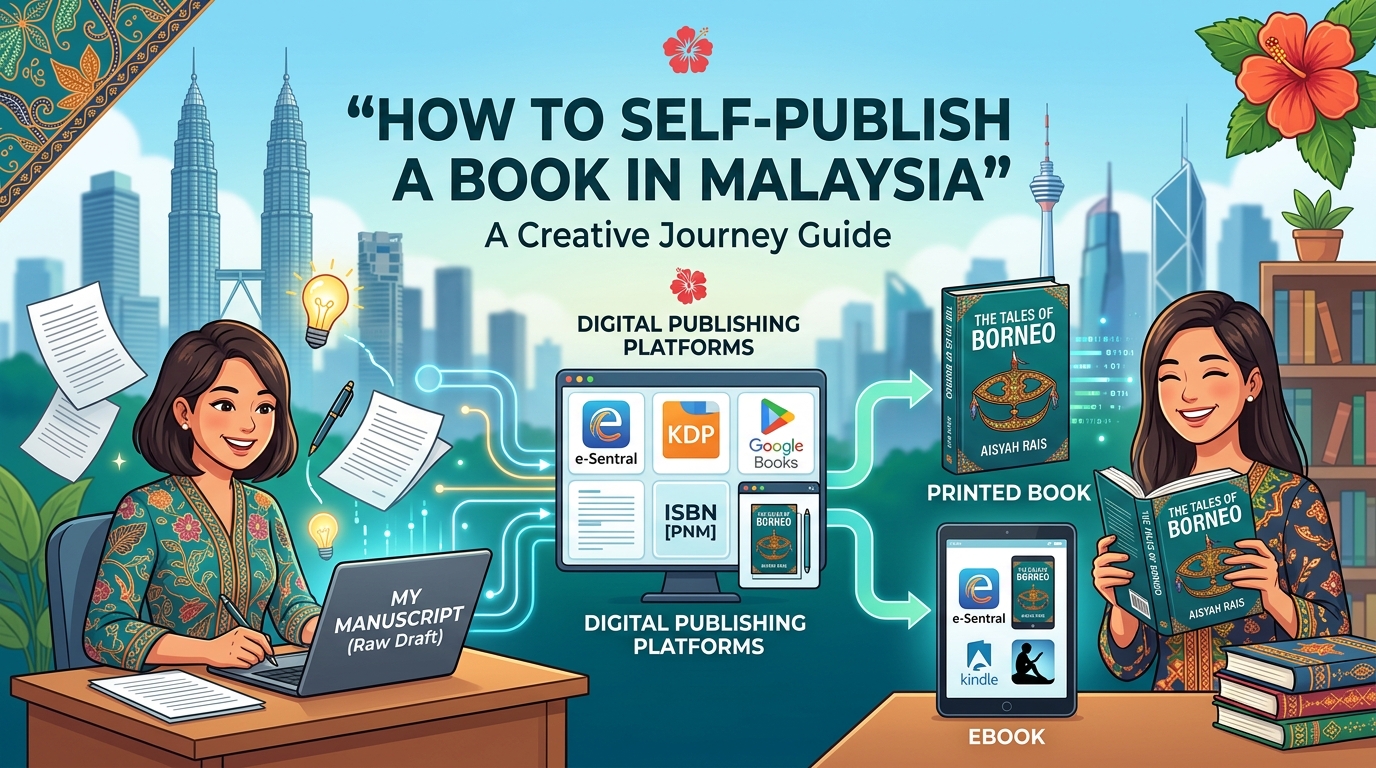
The publishing industry has changed dramatically over the last decade, giving aspiring authors more control over their work than ever before. In the past, writers in Malaysia had to rely heavily on traditional publishing houses to get their books into bookstores and reach readers. Today, self-publishing has created a new path that allows authors to maintain creative ownership, publish faster, and earn a larger share of royalties.
Whether you are writing a novel, a memoir, a business guide, a poetry collection, an academic book, or a children’s story, self-publishing in Malaysia has become a practical and accessible option. Digital publishing platforms, print-on-demand services, and online bookstores have removed many of the barriers that once prevented independent authors from sharing their work with the world.
However, successful self-publishing involves much more than simply writing a manuscript and uploading it online. Authors must understand editing, formatting, cover design, ISBN registration, printing options, distribution channels, marketing strategies, and legal considerations. The process can seem overwhelming at first, but with the right knowledge and preparation, it becomes manageable and rewarding.
This guide explores everything you need to know about self-publishing a book in Malaysia, from the initial manuscript to selling copies locally and internationally.
Exploring Self-Publishing Opportunities in Malaysia
Self-publishing refers to the process where an author independently manages the publication of their book without relying on a traditional publishing company. Instead of submitting manuscripts to publishers and waiting for approval, writers take responsibility for every stage of production and distribution.
In Malaysia, self-publishing has grown rapidly thanks to the rise of digital technology and online retail platforms. Independent authors now have access to tools that were once available only to established publishing houses. They can publish ebooks, print physical copies, distribute globally, and connect directly with readers.
One of the biggest advantages of self-publishing is creative freedom. Authors control the content, title, cover design, pricing, and publication timeline. There is no need to make significant changes to satisfy a publisher’s editorial requirements.
Financially, self-publishing can also be attractive because authors retain ownership of their intellectual property and often receive higher royalty percentages than they would through traditional publishing agreements.
Why More Malaysian Authors Are Choosing Self-Publishing
The increasing popularity of self-publishing in Malaysia is driven by several factors. Traditional publishing often involves lengthy submission processes, limited acceptance rates, and extended production schedules. Many talented writers struggle to secure publishing contracts despite producing quality work.
Self-publishing removes these obstacles by allowing authors to publish whenever they are ready. This flexibility is especially appealing to first-time writers, entrepreneurs, educators, and professionals who want to share their expertise without waiting for industry approval.
Malaysia’s growing digital literacy and internet penetration have also expanded opportunities for independent authors. Readers increasingly purchase books online, making it easier for self-published writers to reach audiences beyond local bookstores.
Additionally, social media platforms have become powerful marketing tools. Authors can build personal brands, engage directly with readers, and promote their books without relying on large advertising budgets.
Preparing Your Manuscript Before Publication
Writing the first draft is only the beginning of the publishing journey. Before releasing a book to the public, authors must ensure the manuscript meets professional standards.
Many writers make the mistake of rushing to publication after completing their draft. While enthusiasm is understandable, publishing an unpolished manuscript can negatively impact reviews, credibility, and future sales.
The editing phase is where a manuscript truly becomes a book. Authors should spend time revising structure, improving clarity, correcting inconsistencies, and strengthening the overall reading experience.
Developmental Editing
Developmental editing focuses on the book’s overall content and structure. For fiction, this may involve plot development, pacing, characterization, and narrative flow. For nonfiction, it involves organization, clarity, and logical progression of ideas.
A developmental editor helps identify weaknesses that authors may overlook because they are too close to the material.
Copy Editing
Copy editing examines grammar, punctuation, sentence structure, style consistency, and language usage. This stage ensures the writing reads smoothly and professionally.
Proofreading
Proofreading is the final review before publication. It catches spelling mistakes, formatting issues, and minor errors that may have survived earlier editing rounds.
Professional editing significantly improves the quality and credibility of a self-published book.
ISBN Requirements in Malaysia
An ISBN, or International Standard Book Number, serves as a unique identifier for published books. While some digital platforms provide alternative identification systems, obtaining an ISBN remains an important step for authors who want professional distribution.
In Malaysia, ISBNs are managed through the national agency responsible for bibliographic records and publishing registration. An ISBN allows books to be cataloged, sold through bookstores, tracked by libraries, and recognized within the global publishing ecosystem.
For authors planning to publish both print and ebook editions, separate ISBNs may be required for each format.
Having an ISBN increases the professionalism of a publication and expands distribution opportunities.
Choosing Between Print Books and Ebooks
One of the first decisions self-publishing authors face is selecting the format of their book.
Both print and digital publishing offer distinct advantages, and many successful authors choose to publish in both formats.
| Publishing Format | Advantages | Challenges |
| Ebook | Lower production costs, global reach, instant delivery | High competition |
| Paperback | Tangible product, preferred by many readers | Printing expenses |
| Hardcover | Premium appearance, higher perceived value | Higher production cost |
| Print-on-Demand | No inventory required | Lower profit margins |
| Offset Printing | Lower cost per unit for large quantities | Upfront investment |
Ebooks are often ideal for first-time authors because they require minimal financial investment. Physical books, however, continue to hold strong appeal among readers who enjoy collecting and reading printed copies.
Formatting Your Book Professionally
Book formatting plays a critical role in reader satisfaction. A poorly formatted book can appear amateurish regardless of how strong the content may be.
Formatting involves arranging text, chapter headings, page numbers, margins, spacing, fonts, and images according to publishing standards.
Formatting for Print
Print books require careful attention to page dimensions, margins, bleed settings, and typography. Authors must ensure the layout remains consistent throughout the manuscript.
Professional formatting creates a polished reading experience and reduces printing errors.
Formatting for Ebooks
Ebooks require a different approach because readers access them on devices with varying screen sizes. Flexible formatting ensures compatibility across e-readers, tablets, and smartphones.
Authors should test their ebook files before publication to confirm proper functionality.
Designing a Cover That Attracts Readers
Book covers remain one of the most influential factors in purchasing decisions. Readers often form immediate impressions based on visual presentation.
A professional cover communicates genre, tone, and quality before a reader examines the book description.
For example, a business book should look significantly different from a fantasy novel or romance story. Successful covers align with reader expectations while maintaining originality.
Investing in professional cover design can dramatically improve marketability.
A strong cover typically includes clear typography, balanced composition, compelling imagery, and effective color choices. Since online shoppers often view covers as small thumbnails, readability is especially important.
Selecting a Self-Publishing Platform
Modern authors have numerous publishing platforms available to them. The best choice depends on publishing goals, target audience, and preferred distribution channels.
Many Malaysian authors use international platforms because they provide access to worldwide markets.
Digital publishing services allow writers to upload manuscripts, create listings, set pricing, and distribute books globally.
Some platforms specialize in ebooks, while others support both digital and print formats.
When evaluating publishing platforms, authors should consider royalty rates, distribution networks, print quality, payment methods, and ease of use.
Print-on-Demand Versus Bulk Printing
Self-publishing authors in Malaysia frequently choose between print-on-demand and traditional bulk printing.
Print-on-demand allows books to be printed only when customers place orders. This eliminates inventory costs and reduces financial risk.
For first-time authors, print-on-demand can be a practical solution because it removes the need for large upfront investments.
Bulk printing, also known as offset printing, becomes more cost-effective when producing larger quantities. Authors who anticipate significant sales volumes often benefit from lower per-unit costs.
The ideal choice depends on budget, expected demand, and distribution strategy.
Pricing Your Self-Published Book
Book pricing requires balancing profitability with market competitiveness.
Pricing too high may discourage purchases, while pricing too low can reduce perceived value and limit earnings.
Authors should research comparable books within their genre and market category before setting prices.
Factors influencing pricing include production costs, distribution fees, royalty structures, audience expectations, and market competition.
Digital books generally have lower prices than printed editions because manufacturing costs are significantly lower.
Strategic pricing can help attract readers while maintaining sustainable profitability.
Marketing Your Self-Published Book in Malaysia
Publishing a book is only half the journey. Marketing determines whether readers discover it.
Many self-published authors underestimate the importance of promotion. Even exceptional books struggle to succeed without visibility.
Marketing should begin before publication rather than after launch.
Building an Author Platform
An author platform represents your online presence and audience connection.
Websites, blogs, newsletters, and social media profiles help establish credibility and maintain communication with readers.
Consistent engagement builds trust and creates anticipation for future releases.
Using Social Media Effectively
Social media provides powerful opportunities for Malaysian authors to reach potential readers.
Rather than focusing exclusively on sales messages, successful authors share insights, behind-the-scenes content, writing updates, and valuable information relevant to their audience.
Authentic engagement often generates stronger results than aggressive promotion.
Email Marketing
Email marketing remains one of the most effective promotional tools available to authors.
A mailing list enables direct communication with readers without relying on changing social media algorithms.
Subscribers often become loyal supporters who purchase future books and recommend them to others.
Selling Books Through Online Channels
Online distribution has transformed book sales opportunities for Malaysian authors.
Readers increasingly purchase books through ecommerce platforms and digital marketplaces.
Authors can sell directly through personal websites, online bookstores, and publishing platforms that provide international distribution.
Direct sales offer higher profit margins because fewer intermediaries are involved. However, marketplace distribution provides broader exposure and easier customer access.
Combining both approaches often delivers the best results.
Reaching International Readers
One significant advantage of self-publishing is global accessibility.
A book published in Malaysia can be purchased by readers in the United States, United Kingdom, Australia, Singapore, Canada, and many other countries.
Digital publishing platforms eliminate geographical limitations that traditionally restricted independent authors.
Writers who publish in English often benefit from particularly large international markets.
Expanding beyond local audiences can significantly increase sales potential and long-term growth opportunities.
Legal Considerations for Self-Published Authors
Publishing a book involves intellectual property rights and legal responsibilities.
Authors should ensure they own the rights to all content included in their work. This includes text, photographs, illustrations, charts, and graphics.
Using copyrighted material without permission may result in legal complications.
Writers should also consider copyright registration, publishing agreements, and licensing arrangements when applicable.
Understanding these legal fundamentals helps protect creative work and professional interests.
Common Mistakes First-Time Self-Publishers Make
Many new authors encounter similar challenges during the publishing process.
One common mistake is skipping professional editing. Readers quickly notice grammatical errors and inconsistencies, which can damage credibility.
Another frequent issue involves poor cover design. A weak cover often limits sales regardless of content quality.
Some authors also publish without a marketing plan, assuming readers will discover their books automatically. In reality, visibility requires active promotion and audience engagement.
Impatience can create additional problems. Rushing to publication often results in avoidable mistakes that affect long-term success.
Taking time to prepare thoroughly usually produces better outcomes.
Building a Long-Term Author Career
Self-publishing should not be viewed as a one-time event but as an ongoing career strategy.
Many successful independent authors build momentum through multiple books rather than relying on a single title.
Each publication strengthens visibility, expands readership, and increases earning potential.
Developing a consistent publishing schedule helps maintain audience interest and establish professional credibility.
Authors who treat writing as a long-term endeavor often experience more sustainable growth than those focused solely on immediate results.
The Future of Self-Publishing in Malaysia
The future of self-publishing in Malaysia appears increasingly promising. Advances in technology continue to simplify production, distribution, and marketing processes.
Digital reading habits are expanding, online shopping is becoming more common, and independent authors are gaining greater recognition within the literary community.
As readers become more open to discovering books outside traditional publishing channels, opportunities for Malaysian self-published authors are likely to increase.
Emerging technologies, enhanced distribution networks, and growing global connectivity will continue to create new possibilities for writers seeking independence and creative control.
Conclusion
Self-publishing a book in Malaysia has never been more accessible. Writers now have the tools to transform manuscripts into professionally produced books without relying on traditional publishing gatekeepers. From editing and formatting to cover design, distribution, and marketing, every stage of the publishing process can be managed independently.
Success in self-publishing requires more than creativity. It demands careful planning, attention to quality, strategic promotion, and a willingness to learn the business side of publishing. Authors who invest time in producing professional books and building meaningful connections with readers position themselves for greater long-term success.
Whether your goal is to share a personal story, establish professional authority, build a writing career, or reach readers around the world, self-publishing provides a powerful pathway. With determination, preparation, and the right approach, Malaysian authors can successfully publish their books and compete in both local and international markets.
