
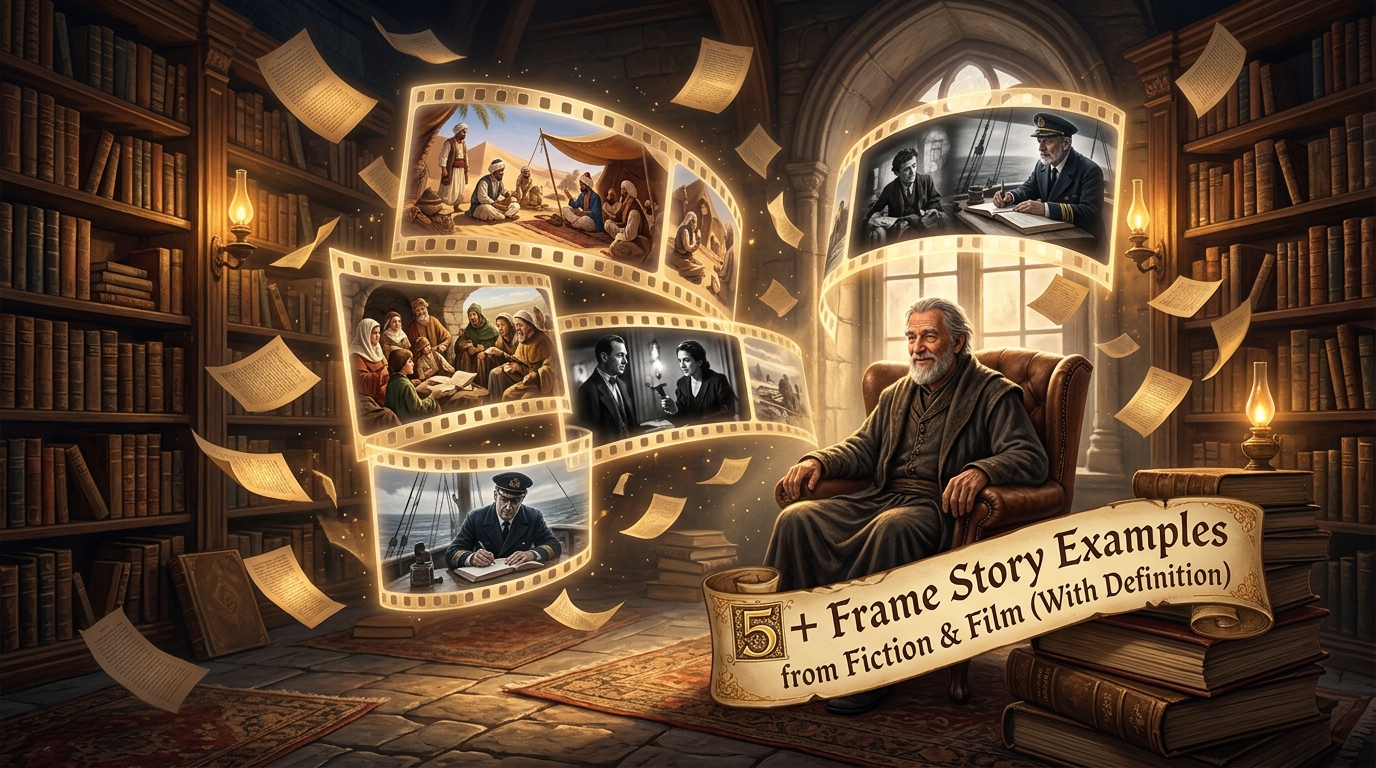
Stories have always traveled through other stories. Long before modern novels and streaming series existed, storytellers gathered around fires, inside royal courts, and across crowded marketplaces to share layered narratives where one voice opened the door for another. This structure, now commonly called a frame story, remains one of the most fascinating storytelling techniques in literature and film because it creates depth, mystery, emotion, and perspective all at once.
A frame story is more than just a clever narrative device. It changes the way audiences experience a story. Instead of moving directly from beginning to end, the audience enters through an outer narrative that introduces another tale hidden inside it. Sometimes the frame acts like a memory. Sometimes it feels like a confession, a testimony, a diary, or a conversation between strangers. In other cases, the frame becomes part of the emotional architecture of the story itself.
From classic novels to award-winning films, frame stories continue to shape some of the most memorable works in fiction. They allow writers to create unreliable narrators, emotional distance, dramatic irony, and layered meanings that would not exist in a straightforward narrative structure. Whether it is a survivor telling the story of their past, a traveler recounting an unbelievable adventure, or an old man sharing memories with a child, the frame gives the central narrative a different emotional weight.
Understanding frame stories is valuable not only for readers and film lovers but also for writers trying to create richer storytelling experiences. Once you begin recognizing this technique, you start seeing it everywhere. Many beloved books and films are built around narratives inside narratives.
This article explores what a frame story really is, why writers and filmmakers use it, and some of the strongest examples from fiction and cinema that demonstrate how powerful the structure can be.
What Is a Frame Story?
A frame story is a narrative structure in which one main story surrounds or contains another story. The outer narrative acts as the “frame,” while the inner narrative becomes the central tale being told. The frame often provides context, perspective, or emotional meaning to the events unfolding inside it.
The easiest way to understand a frame story is to imagine someone sitting down to tell a story from their past. The moment the storytelling begins, the audience enters the inner narrative. When the story ends and the narrative returns to the storyteller, the frame closes.
Frame stories can be simple or highly complex. Some contain only one inner narrative, while others include multiple layers of storytelling nested within each other. This structure has existed for centuries in mythology, folklore, literature, theater, and film.
The technique works because stories naturally feel more intimate when they are being shared by someone within the fictional world itself. Audiences become aware that the narrative has passed through a human perspective, which instantly creates questions about memory, truth, bias, and emotion.
Why Writers and Filmmakers Use Frame Stories
Frame stories create emotional texture that linear storytelling sometimes lacks. A straightforward narrative tells audiences what happened. A frame story often tells audiences why the story matters.
One reason writers use this structure is to create suspense. When audiences see a narrator recounting past events, they immediately begin questioning how those events changed the narrator. If a character looks broken, nostalgic, traumatized, or transformed in the frame narrative, the audience becomes curious about what happened in the inner story.
Frame stories also allow storytellers to manipulate perspective. Since the story is being filtered through a narrator, the audience may wonder whether the events are accurate, exaggerated, romanticized, or incomplete. This uncertainty can create psychological depth.
In film, frame stories often create visual contrast between past and present. The outer frame may appear colder, quieter, or older, while the inner narrative feels vivid and emotionally alive. This contrast strengthens nostalgia and emotional impact.
Writers also use frame stories to explore memory and storytelling itself. Sometimes the act of telling the story becomes as important as the story being told. The audience is not only watching events unfold but also witnessing how characters interpret those events years later.
Key Elements of a Frame Story
Most frame stories contain two essential layers. The first layer is the outer narrative, sometimes called the frame narrative. This is the setting where the storytelling begins. It could involve a conversation, a written account, an interview, a courtroom testimony, or a personal reflection.
The second layer is the embedded narrative. This is the main story unfolding within the frame. It usually occupies most of the plot and contains the primary emotional and dramatic events.
Some frame stories close by returning to the original frame, allowing the audience to see how the storyteller or listener has changed. This return often gives the narrative emotional completion.
Another common element is narrative perspective. Because the story is filtered through someone’s memory or interpretation, the audience experiences events through a subjective lens. This can create emotional richness and thematic ambiguity.
Famous Frame Story Examples from Fiction and Film
1. Frankenstein by Mary Shelley
Frankenstein is one of the most influential examples of a frame narrative in literature. Many readers remember the novel mainly for Victor Frankenstein and the creature he creates, but the story itself is actually layered within multiple narrative frames.
The novel begins with letters written by Robert Walton, an explorer traveling through the Arctic. Through these letters, Walton recounts meeting Victor Frankenstein, who then begins telling the tragic story of his scientific obsession. Later, even the creature tells his own story within Victor’s narrative.
This layered storytelling structure creates remarkable emotional complexity. Readers are never receiving events directly. Every experience passes through someone’s interpretation and memory. Walton admires Victor. Victor fears the creature. The creature explains his loneliness and suffering.
The frame narrative transforms the novel into more than a gothic horror story. It becomes a meditation on ambition, isolation, and the dangers of obsession. The multiple perspectives also encourage readers to question morality rather than accept a single interpretation.
Mary Shelley’s use of the frame story was revolutionary because it allowed emotional ambiguity to exist inside what could have been a simple monster tale. Even today, the structure makes the novel feel psychologically modern.
2. The Princess Bride
The Princess Bride uses one of the warmest and most emotionally effective frame stories in film. The movie begins with a grandfather reading a book to his sick grandson. That reading session becomes the frame surrounding the fantasy adventure.
The fairy tale narrative involving Westley, Buttercup, sword fights, pirates, revenge, and romance forms the inner story, but the outer frame quietly shapes how audiences emotionally experience the film.
Whenever the movie returns to the grandson and grandfather, viewers are reminded that storytelling itself is part of the emotional journey. The grandson initially resists the story, dismissing it as sentimental nonsense. Gradually, he becomes emotionally invested.
This transformation mirrors the audience’s own experience. The frame narrative creates a sense of intimacy and nostalgia because it reflects how stories are often passed between generations.
The film also uses the frame to balance sincerity and humor. The grandson’s interruptions allow the movie to acknowledge fairy tale clichés while still embracing emotional authenticity. Without the frame story, the film would lose much of its charm and emotional intelligence.
3. Titanic
Titanic uses a frame narrative that transforms a historical disaster into a deeply personal memory.
The film opens in the present day with treasure hunters exploring the wreck of the Titanic. They encounter an elderly Rose, who begins recounting her experiences aboard the ship decades earlier. Her memories form the main narrative of the film.
This framing device accomplishes several important things. First, it immediately creates emotional tension because audiences already know the Titanic will sink. The suspense no longer comes from whether disaster will happen but from how the characters will experience it.
Second, the frame narrative turns the story into an act of remembrance. Rose is not merely describing events. She is revisiting a defining emotional chapter of her life. Her narration gives the film a reflective and melancholic tone.
The older Rose also adds emotional perspective. She understands the meaning of experiences that her younger self could not fully comprehend at the time. This creates a powerful contrast between youthful passion and lifelong memory.
By ending with the older Rose once again, the film closes the emotional circle established by the frame narrative. The audience leaves not only with the tragedy of the ship but with the emotional legacy carried by a survivor.
4. Heart of Darkness
Heart of Darkness is another major literary example of a frame story. The novella begins aboard a ship on the River Thames, where an unnamed narrator listens as Charles Marlow recounts his journey into the Congo.
The majority of the novella unfolds through Marlow’s storytelling, creating a narrative filtered through memory and interpretation. This structure gives the work a haunting and reflective quality.
The frame narrative matters because it positions the audience as listeners alongside the other sailors. Readers become part of the experience of hearing Marlow’s unsettling account.
Joseph Conrad uses this structure to explore themes of colonialism, corruption, civilization, and moral darkness. Because the story comes through Marlow’s perspective, the audience constantly interprets not only the events themselves but also Marlow’s emotional reactions to them.
The frame story creates psychological distance while simultaneously increasing intimacy. Readers feel close to Marlow’s voice yet uncertain about objective truth. This tension is one reason the novella remains so influential.
5. Forrest Gump
Forrest Gump presents its narrative through a gentle but highly effective framing device.
The film repeatedly returns to Forrest sitting on a bench, telling strangers about his extraordinary life experiences. The stories he shares become the main narrative.
This frame structure allows the movie to blend humor, nostalgia, and emotional sincerity. Forrest narrates historical events with innocence and simplicity, which changes how audiences perceive those events.
The people listening to Forrest on the bench also shape audience reactions. Some dismiss him, others become fascinated, and some emotionally connect with him. These responses subtly guide viewers through the emotional rhythm of the film.
Without the frame narrative, the film could feel episodic or disconnected because Forrest experiences so many major events across different decades. The storytelling structure creates continuity and emotional coherence.
The bench scenes also reinforce one of the film’s central themes: that ordinary conversations can contain extraordinary stories.
6. Wuthering Heights
Wuthering Heights uses a layered frame narrative that intensifies the novel’s mysterious atmosphere.
The story begins with Mr. Lockwood arriving at Wuthering Heights and becoming curious about the strange people connected to the estate. Much of the narrative is then told to him by Nelly Dean, the housekeeper, who recounts the turbulent history of Heathcliff and Catherine.
This storytelling method creates emotional distance that actually strengthens the novel’s gothic tone. Readers never directly witness the central romance and conflicts. Instead, they encounter them through retelling and memory.
The frame narrative also shapes audience interpretation because Nelly Dean herself may not be entirely objective. Her judgments and personal feelings influence how events are described.
Emily Brontë’s use of the frame story adds complexity to the novel’s emotional landscape. The audience becomes aware that stories change depending on who tells them.
7. One Thousand and One Nights
One Thousand and One Nights is one of the oldest and most famous examples of frame storytelling.
The outer narrative centers on Scheherazade, who tells stories to a king each night in order to delay her execution. Within her stories, additional characters often tell their own stories, creating multiple narrative layers.
This structure demonstrates the incredible flexibility of frame narratives. The frame is not simply decorative. It is directly tied to survival, suspense, and emotional tension.
Every unfinished story becomes a strategy to keep the king listening. The audience experiences storytelling itself as a form of power.
The collection influenced countless later works in literature and cinema because it proved how narratives could expand infinitely through embedded storytelling.
How Frame Stories Affect Readers and Audiences
Frame stories change the emotional relationship between audiences and narratives. When viewers or readers understand that events are being remembered, narrated, or reconstructed, the story immediately gains emotional texture.
Audiences begin thinking not only about what happened but also about why the narrator chose to tell the story. This adds thematic depth.
Frame narratives also create a sense of realism because human beings naturally share experiences through storytelling. People often describe memories, explain past events, and interpret their lives through narratives. Frame stories imitate this human behavior.
In emotional dramas, the frame structure can create melancholy because audiences understand that the narrated events already belong to the past. In mysteries and thrillers, the frame can create suspense because audiences wonder whether the narrator is trustworthy.
This storytelling technique also allows creators to move between timelines more naturally. Films and novels can shift between present reflection and past action without feeling structurally chaotic.
Common Types of Frame Stories
Some frame stories use a single narrator recounting events from memory. Others involve written documents such as journals, letters, or diaries.
Certain stories use interview structures where one character listens while another recounts experiences. This format appears frequently in historical dramas and memoir-style fiction.
There are also anthology frame stories where multiple smaller tales exist inside a larger narrative structure. Collections of folklore and horror stories often use this technique.
Nested frame stories go even further by placing stories inside other stories repeatedly. This creates a layered labyrinth of narratives that can feel dreamlike or surreal.
Each variation changes how audiences interpret truth, memory, and emotional meaning.
Famous Frame Story Examples in Fiction and Film
| Title | Medium | Type of Frame Story | Why It Stands Out |
| Frankenstein | Novel | Letters and personal narration | Multiple perspectives create moral ambiguity |
| The Princess Bride | Film | Grandfather reading a story | Blends nostalgia, humor, and emotional warmth |
| Titanic | Film | Survivor recounting memories | Adds emotional reflection to historical tragedy |
| Heart of Darkness | Novella | Sailor telling a past journey | Creates psychological depth and uncertainty |
| Forrest Gump | Film | Character narrating life experiences | Connects personal memories with history |
| Wuthering Heights | Novel | Housekeeper recounting events | Enhances gothic mystery and emotional distance |
| One Thousand and One Nights | Folk literature | Stories within stories | Uses storytelling itself as survival |
Why Frame Stories Continue to Matter Today
Modern storytelling continues to embrace frame narratives because audiences remain fascinated by perspective and memory. Even contemporary television series, video games, and streaming films often use versions of this structure.
Part of the reason is that frame stories feel emotionally human. Real people rarely explain their lives in perfectly linear ways. Memories arrive with interpretation, regret, nostalgia, and reflection.
The frame structure also mirrors the experience of storytelling itself. Someone chooses to tell a story because it shaped them in some way. This emotional motivation creates intimacy between storyteller and audience.
In an era where audiences increasingly value character psychology and layered narratives, frame stories provide opportunities for emotional and thematic richness that straightforward storytelling sometimes cannot achieve.
Final Thoughts
Frame stories remain one of the most enduring storytelling techniques because they transform narratives into emotional experiences shaped by memory, perspective, and human connection. Instead of simply presenting events, they invite audiences to consider who is telling the story, why they are telling it, and how time has changed their understanding of those events.
From the icy letters of Frankenstein to the nostalgic storytelling of Titanic and the comforting bedtime frame of The Princess Bride, frame narratives create emotional layers that stay with audiences long after the story ends.
For writers, studying frame stories is incredibly valuable because the structure teaches how perspective can shape emotion. A story told directly may feel dramatic, but a story remembered years later often feels haunting, intimate, or deeply human.
That is the true strength of the frame story. It reminds audiences that stories are not only about events themselves but about the people who carry those memories forward and choose to share them with others.
