
For many writers, the journey from first draft to finished book can feel like navigating a maze without a map. You write, revise, tweak, and polish—yet the question lingers: when is the manuscript truly ready? One of the most misunderstood aspects of this process is proofreading. Often treated as a quick final scan or, worse, skipped altogether, proofreading actually occupies a precise and critical place within the larger editing workflow. Understanding where proofreading fits—and why its timing matters—can be the difference between a professional, polished book and one riddled with avoidable distractions. This article explores the full editing process, situates proofreading within it, and explains why getting the sequence right is essential for both quality and credibility.
Understanding the Book Editing Process as a Whole
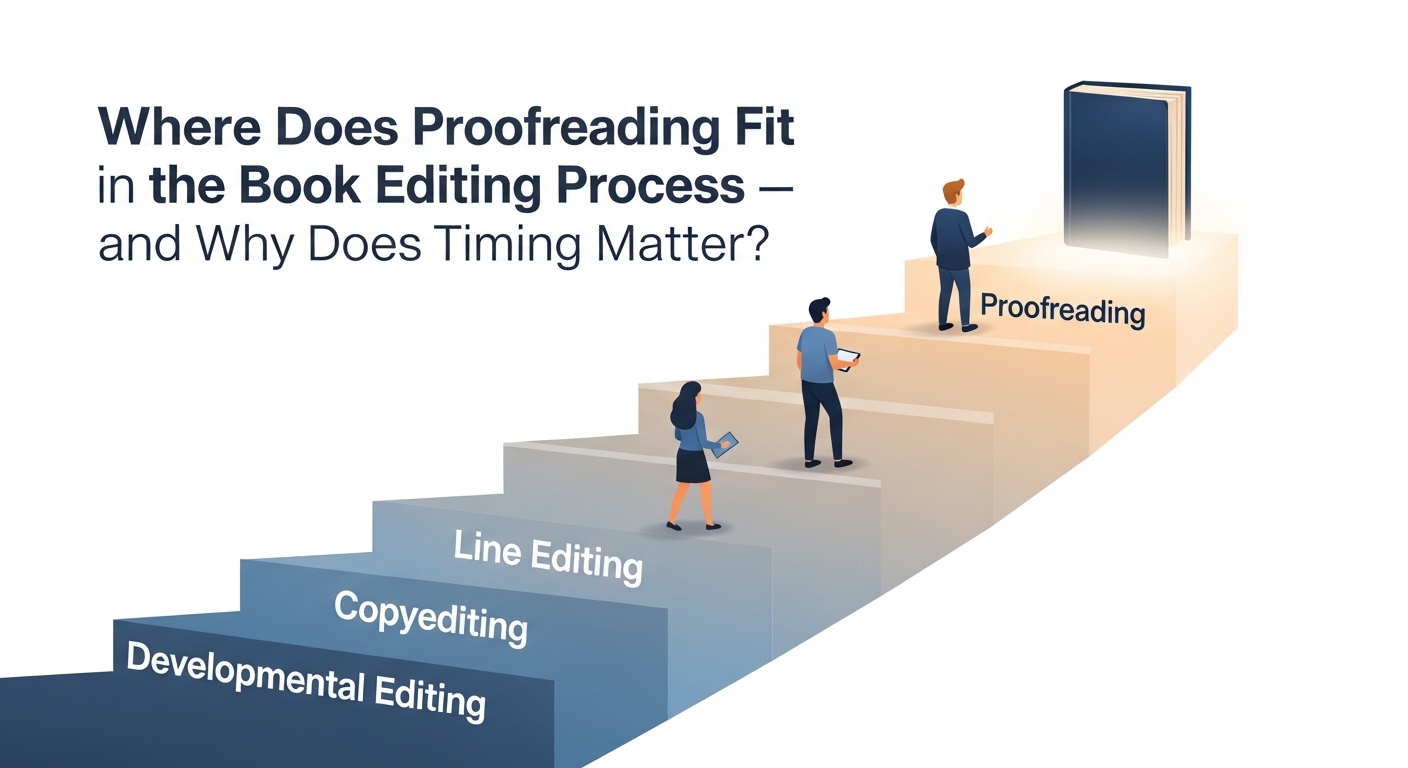
Before diving into proofreading, it helps to understand the broader editing landscape. Book editing is not a single step but a layered process, with each phase addressing different aspects of the manuscript. These stages typically include developmental editing, line editing, copyediting, and finally proofreading. Each serves a distinct purpose, building on the previous one to gradually refine the manuscript from a rough concept into a publication-ready work.
Developmental editing focuses on the big picture—structure, plot, pacing, argument coherence, and character development. Line editing moves closer to the text itself, refining language, tone, and flow at the sentence level. Copyediting addresses grammar, punctuation, consistency, and technical accuracy. Only after all these layers have been completed does proofreading step in as the final quality check.
This progression is not arbitrary. It reflects how writing evolves. You cannot effectively polish sentences that may later be deleted, nor can you correct grammar in a paragraph that will be restructured. Proofreading, therefore, sits at the end of this chain for a reason: it is meant to catch the last remaining surface-level errors after all major revisions are complete.
What Proofreading Actually Is—and What It Isn’t
Proofreading is often confused with editing, but the two are fundamentally different. Editing involves changing the text to improve it. Proofreading, on the other hand, is about identifying and correcting minor errors without altering the substance or structure of the content.
A proofreader looks for typographical mistakes, spelling errors, punctuation inconsistencies, formatting issues, and small grammatical slips that may have been missed earlier. They also check for consistency in elements such as capitalization, hyphenation, and style. In printed books, proofreading may extend to reviewing page proofs for layout issues like widows, orphans, and spacing irregularities.
What proofreading does not do is rewrite sentences, restructure paragraphs, or address deeper narrative or logical issues. If those problems still exist at the proofreading stage, it signals that earlier editing phases were incomplete or rushed. This distinction is crucial because it underscores why proofreading must come last. It is not a substitute for editing; it is the final safeguard.
The Importance of Timing in Proofreading
Timing is everything when it comes to proofreading. Conduct it too early, and you risk wasting time correcting text that will later change. Conduct it too late—or skip it entirely—and errors slip through to the final product. Proper timing ensures that proofreading is both efficient and effective.
When proofreading is done prematurely, the manuscript is often still in flux. Sentences are being rewritten, paragraphs moved, and sections added or removed. In such cases, any corrections made during proofreading may be undone by subsequent edits. This not only wastes effort but also creates confusion, as new errors can be introduced during later revisions.
On the other hand, delaying proofreading until after layout or formatting changes can also be risky. While proofreading should occur near the end, it must still allow time for corrections to be implemented properly. Ideally, proofreading happens after the manuscript has been fully edited and formatted but before final publication or printing. This ensures that the text is stable enough for detailed scrutiny while still allowing room for final adjustments.
Why Proofreading Cannot Replace Earlier Editing Stages
A common misconception among writers, particularly those new to publishing, is that proofreading can compensate for insufficient editing. This belief often leads to manuscripts being rushed to the proofreading stage without undergoing proper developmental or copyediting work.
The reality is that proofreading operates on a surface level. It cannot fix structural flaws, unclear arguments, inconsistent character motivations, or awkward phrasing. If such issues are present, they will either remain unaddressed or require significant rewriting—something that falls outside the scope of proofreading.
Skipping earlier editing stages places an unfair burden on the proofreader and compromises the final quality of the book. It also disrupts the logical workflow of the editing process. Each stage is designed to handle specific types of issues, and bypassing one creates gaps that cannot be fully resolved later.
The Psychological Dimension of Proofreading
Beyond its technical role, proofreading also has a psychological dimension. By the time writers reach this stage, they are often fatigued from multiple rounds of revisions. Familiarity with the text makes it difficult to spot errors, as the brain tends to read what it expects rather than what is actually written.
This is one reason why proofreading is often outsourced to a fresh set of eyes. A professional proofreader approaches the text without the biases that come from having written or extensively edited it. They can catch inconsistencies and errors that the author may overlook simply due to overexposure.
Timing plays a role here as well. Allowing some distance between the final edit and the proofreading stage can help the writer see the text more objectively. Even a short break can make a noticeable difference in error detection.
Proofreading in Traditional vs. Self-Publishing Workflows
The role and timing of proofreading can vary slightly depending on the publishing route. In traditional publishing, proofreading is typically handled by professionals within the publishing house. It occurs after the manuscript has been edited and typeset, often as part of the production process. Authors may also receive proofs to review, providing an additional layer of quality control.
In self-publishing, the responsibility for proofreading falls entirely on the author or their hired team. This makes timing even more critical, as there is no institutional safety net to catch errors. Authors must ensure that proofreading is scheduled after all revisions and formatting are complete but before the book is released.
In both cases, the principle remains the same: proofreading is the final checkpoint, not an intermediate step.
Common Mistakes in the Proofreading Stage
Writers often make several mistakes when approaching proofreading, many of which stem from misunderstanding its purpose or timing. One common issue is attempting to proofread while still making substantive changes to the manuscript. This blurs the line between editing and proofreading, reducing the effectiveness of both.
Another mistake is relying solely on automated tools. While spell checkers and grammar software can be helpful, they are not foolproof. They may miss context-specific errors, homophones, or stylistic inconsistencies that require human judgment.
Rushing through proofreading is another frequent problem. Because it is the final stage, there is often pressure to publish quickly. However, this urgency can lead to overlooked errors that undermine the professionalism of the book.
A Clear Overview of the Editing Process
To better understand where proofreading fits, it helps to visualize the editing process in a structured way. The table below outlines each stage, its purpose, and its place in the overall workflow.
| Editing Stage | Primary Focus | Timing in Process | Type of Changes Made |
| Developmental Editing | Structure, plot, argument, organization | First major revision | Large-scale revisions and rewrites |
| Line Editing | Style, tone, sentence flow | After structural changes | Sentence-level improvements |
| Copyediting | Grammar, punctuation, consistency | Near-final draft | Technical corrections |
| Proofreading | Surface errors, typos, formatting issues | Final stage before publication | Minor corrections only |
This progression highlights how each stage builds upon the previous one. Proofreading is not an isolated task but the culmination of a carefully sequenced process.
The Cost of Poor Timing
Mistiming proofreading can have tangible consequences. If done too early, it leads to inefficiency and duplicated effort. If done too late, it increases the risk of publishing errors that can damage the book’s credibility and the author’s reputation.
Readers may not consciously analyze every grammatical detail, but they do notice when something feels off. Typos, inconsistent formatting, and minor errors can disrupt the reading experience, pulling the audience out of the story or argument. In a competitive publishing landscape, such distractions can affect reviews, sales, and overall reception.
Moreover, correcting errors after publication—especially in print—can be costly and time-consuming. It may require issuing revised editions or updates, which could have been avoided with proper proofreading at the right time.
Integrating Proofreading into Your Workflow
For writers, the key to effective proofreading lies in planning. Rather than treating it as an afterthought, it should be built into the timeline from the beginning. This includes allocating sufficient time after final edits and before publication.
It also involves recognizing when the manuscript is truly ready for proofreading. If you are still making significant changes, it is not yet time. Proofreading requires stability. The text should be as close to final as possible, with no major revisions anticipated.
Collaboration can also enhance this stage. Whether working with a professional proofreader or seeking feedback from trusted readers, having multiple perspectives increases the likelihood of catching errors.
Conclusion
Proofreading is often underestimated, yet it plays a decisive role in shaping the final impression of a book. Positioned at the very end of the editing process, it serves as the last line of defense against errors that can undermine an otherwise well-crafted manuscript. Its effectiveness depends not only on attention to detail but also on precise timing. When integrated properly—after all major editing stages and before publication—proofreading ensures that the book is presented at its best. In the end, it is not just about correcting mistakes; it is about honoring the work that came before it and delivering a reading experience that feels seamless, professional, and complete.
