
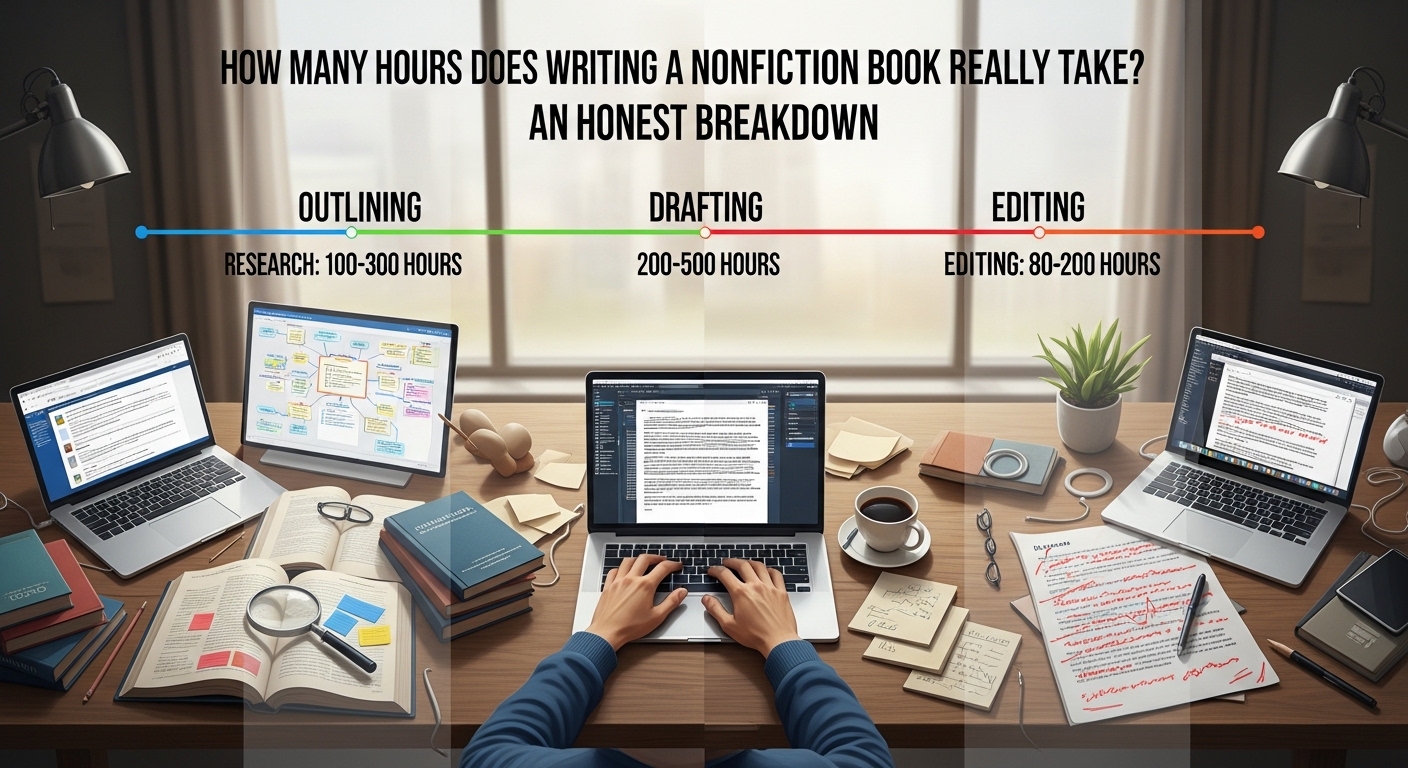
One of the most common questions aspiring authors ask is simple but difficult to answer: how many hours does it really take to write a nonfiction book? Many people imagine there must be a fixed number. They assume a short business guide might take one month, a memoir might take six months, or a detailed history book might take a year. The truth is far more nuanced.
Writing a nonfiction book is not a single task. It is a combination of research, planning, drafting, rewriting, editing, fact-checking, formatting, and decision-making. Some writers finish a manuscript in a few hundred focused hours. Others invest more than a thousand hours before they feel ready to publish.
The honest answer is that writing time depends on the type of nonfiction book, your experience level, the depth of research required, and how efficiently you work. A short practical guide written from personal expertise may move quickly. A heavily researched book with interviews, citations, and original insights may demand far more time.
This guide offers a realistic breakdown of how long nonfiction writing takes, where the hours go, and how to estimate your own timeline accurately.
Why There Is No Single Number
People often search for one universal answer because they want certainty. Unfortunately, books do not work that way. Two books with the same word count can require completely different workloads.
A 40,000-word motivational book based on your own professional experience may require less outside research and fewer revisions. Meanwhile, a 40,000-word investigative nonfiction book could involve interviews, source verification, and multiple rounds of structural rewriting.
Writing speed also varies dramatically. Some writers can produce 1,500 polished words in a session. Others need three hours to create 500 words that still need revision. Neither approach is wrong. They simply represent different workflows.
That is why hours matter more than months. Saying a book took six months tells us very little. Saying it took 420 focused working hours gives a much clearer picture.
A Realistic Range for Most Nonfiction Books
For most first-time authors, a nonfiction book commonly takes between 250 and 800 total hours from idea to completed manuscript. For larger or research-heavy books, that number can rise beyond 1,000 hours.
A short authority-building book of around 25,000 to 35,000 words may take 200 to 350 hours. A standard 45,000 to 60,000-word nonfiction title often lands between 400 and 700 hours. A deep-dive book with research, interviews, or technical complexity may require 800 to 1,500 hours.
This may sound intimidating, but it becomes manageable when divided into weekly sessions. A 400-hour project completed at 10 hours per week takes around ten months. At 20 hours per week, it can be finished in about five months.
Where the Time Actually Goes
Many first-time writers assume drafting consumes most of the schedule. In reality, drafting is only one part of the process. Planning and revision often take just as much time.
Here is a realistic breakdown for a 50,000-word nonfiction book.
| Stage of Work | Estimated Hours | What Happens |
| Idea Development and Positioning | 20–40 | Clarifying audience, purpose, angle |
| Research and Note Gathering | 50–200 | Reading, interviews, collecting data |
| Outline and Structure | 20–60 | Chapters, flow, argument design |
| First Draft Writing | 80–220 | Drafting the manuscript |
| Rewriting and Developmental Editing | 60–180 | Improving clarity and structure |
| Line Editing and Proofreading | 30–80 | Sentence polish, grammar, consistency |
| Formatting and Final Prep | 10–30 | Preparing for submission or publishing |
This table reveals an important truth: writing words is only part of writing a book.
Research Can Double the Timeline
Research is the biggest hidden time factor in nonfiction. If your book depends on statistics, expert sources, historical references, scientific interpretation, or interviews, expect the schedule to expand significantly.
A business coach writing from lived experience may spend modest time researching trends or examples. A health writer discussing evidence-based practices must spend many more hours validating claims. A memoir writer may need less formal research but still spend time reviewing journals, photographs, or family history.
Strong nonfiction earns reader trust. That trust often comes from careful preparation invisible on the page.
Drafting Speed: What Is Normal?
Many new writers worry they are too slow. In reality, drafting speed depends on how much thinking happens during writing.
If your outline is strong and your expertise is clear, you might draft 1,000 to 2,000 words in a productive session. If you are discovering your ideas as you write, checking facts as you go, or refining every sentence immediately, progress slows naturally.
A realistic average for nonfiction drafting is often 500 to 1,200 usable words per hour of focused work, depending on subject complexity. But raw speed can be misleading. A fast messy draft may still need major rewriting. A slower thoughtful draft may save revision time later.
Efficiency is not only about speed. It is about total hours to a quality result.
First-Time Authors Usually Need More Time
Experience changes everything. First-time authors often underestimate how much time is spent making decisions rather than writing sentences.
They may rethink chapter order repeatedly, struggle to define their audience, overwrite sections that later get cut, or spend weeks chasing perfection. This is normal. It is part of learning the craft.
Experienced authors usually move faster because they understand structure, trust their process, and know when to keep going instead of endlessly tweaking.
A first book may take 600 hours. A second similar book might take 350.
The Myth of Writing Every Day
Many people believe books are written only through daily discipline. Daily writing can help, but consistency matters more than frequency.
Some authors succeed with one focused three-hour block every Saturday and two shorter weekday sessions. Others write in 45-minute bursts before work. Some do seasonal sprints.
What matters is cumulative progress. Ten solid hours weekly beats seven distracted daily sessions.
If your schedule is busy, do not compare yourself to full-time writers. Build a system that matches your life.
Honest Timelines Based on Weekly Availability
Your available hours determine your completion date more than motivation does.
If you can dedicate five hours per week, a 400-hour book may take around 18 months. At ten hours weekly, it may take nine to ten months. At fifteen hours weekly, roughly six months becomes realistic. At twenty hours weekly, four to five months is possible.
This is why many smart professionals feel stuck. They are not lazy or untalented. They simply underestimate the math of available time.
When expectations become realistic, frustration often drops.
Why Rewriting Is Where Good Books Are Made
Many people imagine authors finish a first draft and move directly to publication. Strong nonfiction rarely works that way.
The first draft often contains repetition, weak transitions, unclear arguments, overexplained sections, and ideas that seemed brilliant during drafting but do not serve the reader.
Revision transforms information into a reading experience. It improves pacing, tone, logic, emotional connection, and authority.
For many books, rewriting takes as many hours as the initial draft. That is not failure. That is the process.
How to Estimate Your Own Book Hours
A practical method is to estimate by stages rather than guessing one giant number.
Start with word count. Decide whether your book needs 30,000 words, 50,000 words, or 70,000 words. Then assess research intensity: low, medium, or high. Then consider your experience level and weekly availability.
For example, a 35,000-word expertise-based guide with low research may require 250 to 350 hours. A 55,000-word thought leadership book with moderate research may need 450 to 650 hours. A 70,000-word serious research title could exceed 900 hours.
Once you know the range, divide by weekly hours. Suddenly the project becomes concrete.
How to Reduce the Total Time Without Hurting Quality
The smartest way to save time is not writing faster. It is removing friction.
A strong outline prevents wasted chapters. Clear audience definition prevents irrelevant content. Dedicated research days reduce constant context-switching. Writing first and editing later avoids sentence-level perfectionism too early.
You can also dictate rough drafts, use interview transcripts, repurpose lectures or newsletters, and work with an editor earlier in the process.
Many stalled books are not hard because of writing skill. They are hard because of workflow problems.
What If You Feel Slow?
Feeling slow is common because people compare their private messy process to polished public success stories.
You rarely hear that a respected nonfiction book took three abandoned outlines, two rewrites, and eleven months of uncertainty. You usually hear that the author “finished in six months.”
Progress that feels slow is often normal progress.
If you are consistently showing up, refining ideas, and adding quality pages, you are moving.
A More Honest Final Answer
So how many hours does writing a nonfiction book really take?
For many authors, somewhere between 250 and 800 hours is realistic. For complex books, the number may be much higher. For short experience-based books, it may be lower.
But the deeper answer is this: a book takes however many focused hours are needed to become genuinely useful to readers.
That number cannot always be rushed.
Conclusion
Writing a nonfiction book is less like completing a task and more like building an asset. It requires planning, research, thought, structure, patience, and revision. The final manuscript represents accumulated expertise shaped into something valuable for others.
Instead of asking how fast you can finish, ask how steadily you can progress. A book written in 400 deliberate hours often outperforms one rushed in 100 chaotic hours.
If you know your audience, commit weekly time, and respect the editing stage, the hours begin to compound into chapters, and chapters become a finished book.
That is the real breakdown: not magic, not shortcuts, just consistent work turned into something lasting.
