
Ghostwriting sits in a strange space between art and professional service. A book may carry one person’s name on the cover, but behind it often stands a skilled writer shaping voice, structure, emotion, and clarity. Because of this invisible collaboration, one question continues to dominate conversations among writers, entrepreneurs, and aspiring authors alike: how much should ghostwriting a full book actually cost?
The answer is rarely simple. Ghostwriting fees vary wildly—from a few thousand dollars to six-figure deals—and both writers and clients often struggle to understand what is fair. Pricing depends not only on word count but on expertise, research depth, creative responsibility, and the business value of the book itself.
This guide explores realistic industry pricing, how ghostwriters structure their fees, what influences cost, and how both sides can arrive at a number that reflects true value rather than confusion or guesswork.
Understanding What You’re Really Paying For
Before discussing numbers, it’s important to understand what ghostwriting actually involves. Many people assume ghostwriters are simply hired to “type up” someone else’s ideas. In reality, writing a full book is closer to building a house than assembling furniture.
A professional ghostwriter often handles interviews, research, outlining, narrative design, tone development, drafting, revisions, and structural editing. They must capture another person’s voice convincingly while maintaining storytelling quality and market readability.
Industry estimates suggest ghostwriters may spend 300 to 500 hours completing a full-length manuscript when research, collaboration, and revisions are included.
When viewed through this lens, ghostwriting becomes less about paying for words and more about paying for expertise, time, and intellectual partnership.
The Average Cost of Ghostwriting a Full Book
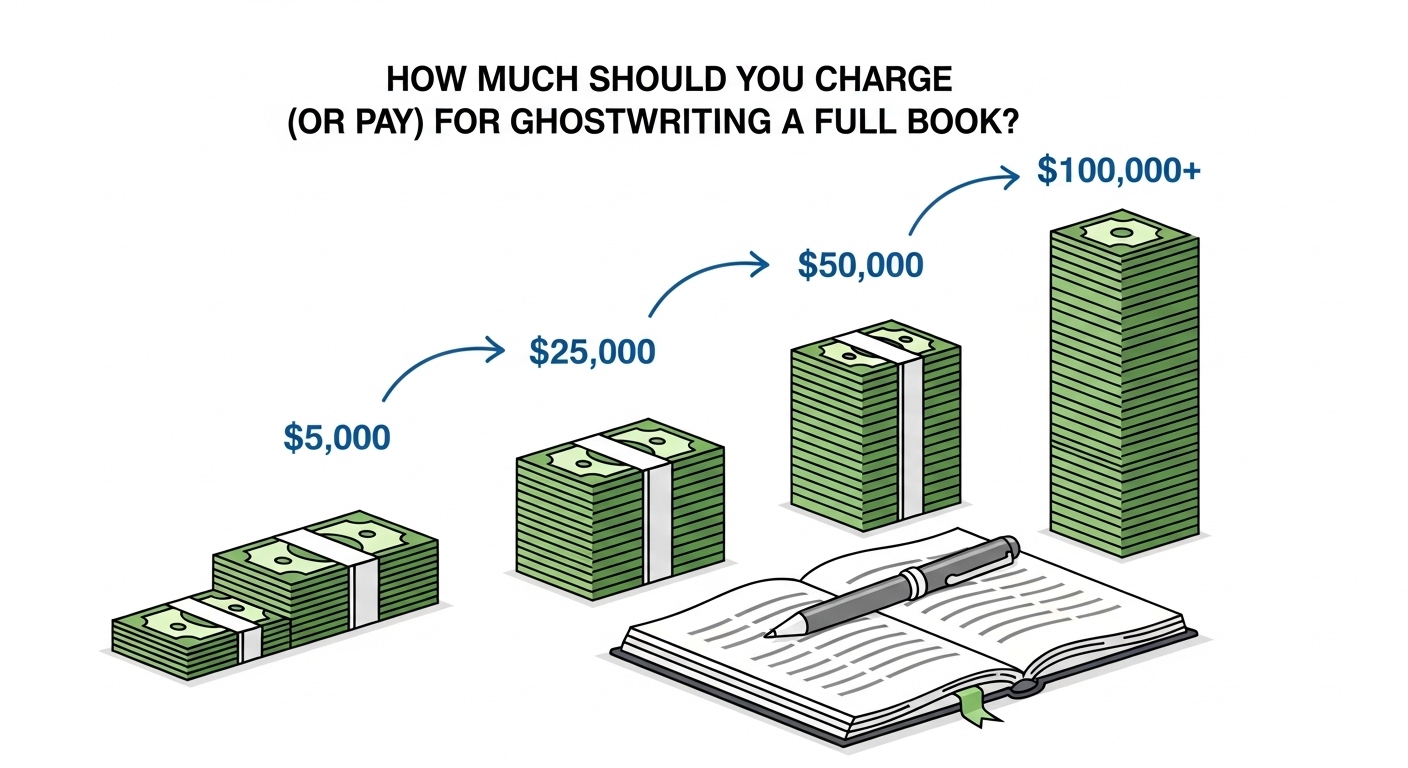
Across the publishing industry, ghostwriting prices fall into broad tiers rather than fixed rates. Research from multiple pricing guides shows that a full-length book typically costs between $5,000 and $100,000+, depending on experience level and complexity.
A more realistic breakdown looks like this:
Entry-level ghostwriters often charge between $5,000 and $15,000 for a book-length project. Mid-career professionals usually fall between $20,000 and $50,000, while premium or bestselling ghostwriters may command $60,000 to $150,000 or more.
For nonfiction books around 40,000–60,000 words, many industry guides place average budgets in the $20,000–$80,000 range, especially when interviews and research are involved.
These numbers may seem high at first glance, but they reflect months of specialized creative labor.
The Three Main Pricing Models Ghostwriters Use
Ghostwriting isn’t priced in only one way. Understanding the different pricing structures helps both writers and clients compare quotes fairly.
Per-Word Pricing
Per-word pricing is one of the most transparent methods. Industry averages typically range from $0.10 to $2.00 per word, depending on experience and genre.
A 60,000-word manuscript at $0.50 per word equals $30,000, which sits squarely in the mid-range professional tier.
This model works best when the scope is clearly defined and unlikely to change dramatically.
Flat Project Fee
Most professional ghostwriters prefer a flat project fee. This covers interviews, drafting, revisions, and delivery under a single agreed price.
Flat fees for full books commonly fall between $20,000 and $80,000, offering predictable budgeting for clients.
For writers, this structure protects against endless revisions that could otherwise extend hourly billing indefinitely.
Hourly or Retainer Pricing
Hourly rates typically range from $35 to $150+ per hour, though they are less common for complete books.
This model appears more often during consultation phases, developmental work, or partial collaborations.
Why Ghostwriting Prices Vary So Much
Two ghostwriters can quote radically different prices for the same book idea—and both may be correct.
Several factors influence cost.
Experience and Reputation
A writer with published bestsellers or industry recognition can charge significantly more. Clients are not just paying for writing ability but for reliability, storytelling skill, and market understanding.
Premium ghostwriters often help shape positioning, branding, and publishing strategy, which increases perceived value.
Genre and Complexity
A straightforward memoir requires a different level of work than a research-heavy business book or a multi-timeline novel. Technical or research-driven projects may increase costs by 20–50 percent due to additional workload.
Research and Interviews
Books requiring extensive interviews, data analysis, or fact-checking demand more hours. Research fees alone can add several thousand dollars to a project.
Timeline
Short deadlines dramatically increase cost. Accelerated timelines can raise fees by 25–100 percent because writers must prioritize one project over all others.
Client Involvement
Ironically, highly involved clients can increase project cost. Frequent revisions, structural changes, or evolving ideas extend production time and complexity.
How Much Ghostwriters Should Charge
For writers entering or growing within the field, pricing can feel uncomfortable. Many undercharge because they compare themselves to freelance article rates rather than book-level commitments.
A realistic way to think about pricing is through workload calculation.
If a book requires 400 hours of work and a writer wants to earn $50 per hour, the project should cost at least $20,000 before accounting for taxes, revisions, or administrative time.
Industry averages reinforce this logic, with professional book projects frequently landing between $20,000 and $50,000 for experienced writers.
Underpricing not only harms the writer financially but often signals inexperience to serious clients.
How Much Clients Should Expect to Pay
From the client perspective, ghostwriting should be viewed as an investment rather than an expense.
Business leaders often use books as authority-building tools, lead generators, or speaking credentials. Some publishing consultants note that authors recover ghostwriting costs through opportunities such as speaking engagements or consulting deals generated by the book’s credibility.
When evaluating cost, clients should consider:
The expertise required to shape their ideas into publishable form, the time saved by outsourcing writing, and the long-term professional value of a well-crafted book.
A cheap manuscript rarely delivers professional results.
The Hidden Costs Many People Forget
Ghostwriting fees do not always include every stage of publishing. Additional services may involve developmental editing, proofreading, publishing guidance, or proposal writing.
These services can add anywhere from $1,000 to $5,000 each depending on depth and specialization.
Understanding what is included in a quote prevents misunderstandings later.
Why Extremely Low Prices Are Often a Red Flag
Online marketplaces sometimes advertise full books for surprisingly low prices. While budget options exist, extremely low rates often mean one of three things: limited experience, rushed work, or outsourced writing.
Ghostwriting demands voice imitation, narrative skill, and sustained creative focus over months. When pricing drops far below industry averages, quality frequently suffers.
Professional guides consistently warn that ghostwriting is a premium service precisely because of the expertise involved.
Negotiation: Where Fair Pricing Actually Happens
Ghostwriting fees are rarely fixed. Negotiation is normal and expected.
Successful negotiations focus on scope rather than discounts. Instead of lowering price, clients and writers can adjust deliverables by changing word count, revision rounds, or research depth.
Clear contracts outlining milestones, payment schedules, and expectations protect both parties and create smoother collaborations.
Many ghostwriters structure payments in installments—commonly a deposit, milestone payments, and final delivery—ensuring shared commitment throughout the project.
Royalty Deals and Hybrid Payment Models
Occasionally, ghostwriters accept reduced upfront fees in exchange for royalties or revenue sharing. These arrangements usually appear in celebrity or high-visibility projects with strong commercial potential.
However, most professionals prefer guaranteed payment because book sales are unpredictable.
Hybrid deals work best when both parties clearly understand risk and potential reward.
Regional Differences in Pricing
Location also influences ghostwriting rates. Writers in North America and Western Europe typically charge higher fees due to market expectations and living costs, while global freelance platforms introduce wider price ranges.
Despite regional differences, experienced writers worldwide increasingly price according to international standards rather than local markets.
This global shift has gradually standardized professional ghostwriting pricing across borders.
The Psychology Behind Ghostwriting Prices
One overlooked aspect of ghostwriting is emotional labor. Writers must absorb someone else’s experiences, interpret personal stories, and translate identity into narrative form.
Clients often share deeply personal histories, making trust and communication essential parts of the process.
The price therefore reflects not only writing skill but creative empathy and intellectual collaboration.
Ghostwriting is closer to co-creation than outsourcing.
Finding the Right Price Balance
The ideal ghostwriting fee sits at the intersection of three realities:
The writer earns sustainably for months of work.
The client receives professional-level storytelling.
Both parties feel respected and invested in the outcome.
If either side feels undervalued, the collaboration rarely succeeds.
A fair price is not the lowest number—it is the number that allows the book to be written well.
Final Thoughts: Pricing Reflects Value, Not Just Words
Ghostwriting a full book is one of the most intensive forms of professional writing. It demands storytelling mastery, psychological insight, research ability, and long-term collaboration.
Industry data consistently shows that most serious book projects fall between $20,000 and $80,000, with wider ranges depending on expertise and ambition.
For writers, charging appropriately protects creative sustainability and professional growth. For clients, paying fairly ensures the book achieves the quality and authority they envision.
Ultimately, ghostwriting pricing is less about cost and more about transformation—the transformation of ideas into narrative, experiences into structure, and voices into books that can outlive the moment they were written.
A well-priced ghostwriting project is not simply a transaction. It is a partnership built on trust, skill, and shared belief in the power of a story worth telling.
