
Language does not remain fixed. It breathes, shifts, and adapts itself to the way people live, think, and communicate. One of the most fascinating signs of this evolution is the portmanteau, a linguistic creation where two separate words are blended into one to produce a new meaning. These words are not just shortcuts in vocabulary; they are cultural markers, creative expressions, and tools that reflect how rapidly human communication is changing in the modern world.
From everyday speech to journalism, branding, entertainment, and digital communication, portmanteaus have become deeply embedded in how we express ideas. They are compact, efficient, and often emotionally rich, allowing writers and speakers to communicate layered meaning in a single word. Understanding how they work, why they are effective, and how to use them creatively can significantly elevate both writing style and linguistic awareness.
The Linguistic Nature of Portmanteaus
A portmanteau is formed when parts of two or more words are combined into a single new word that carries meaning from both sources. The term itself comes from French, originally referring to a suitcase that opens into two compartments, symbolizing the idea of two separate elements being fused into one functional object. In language, this metaphor becomes especially powerful because it captures exactly what happens during the blending process.
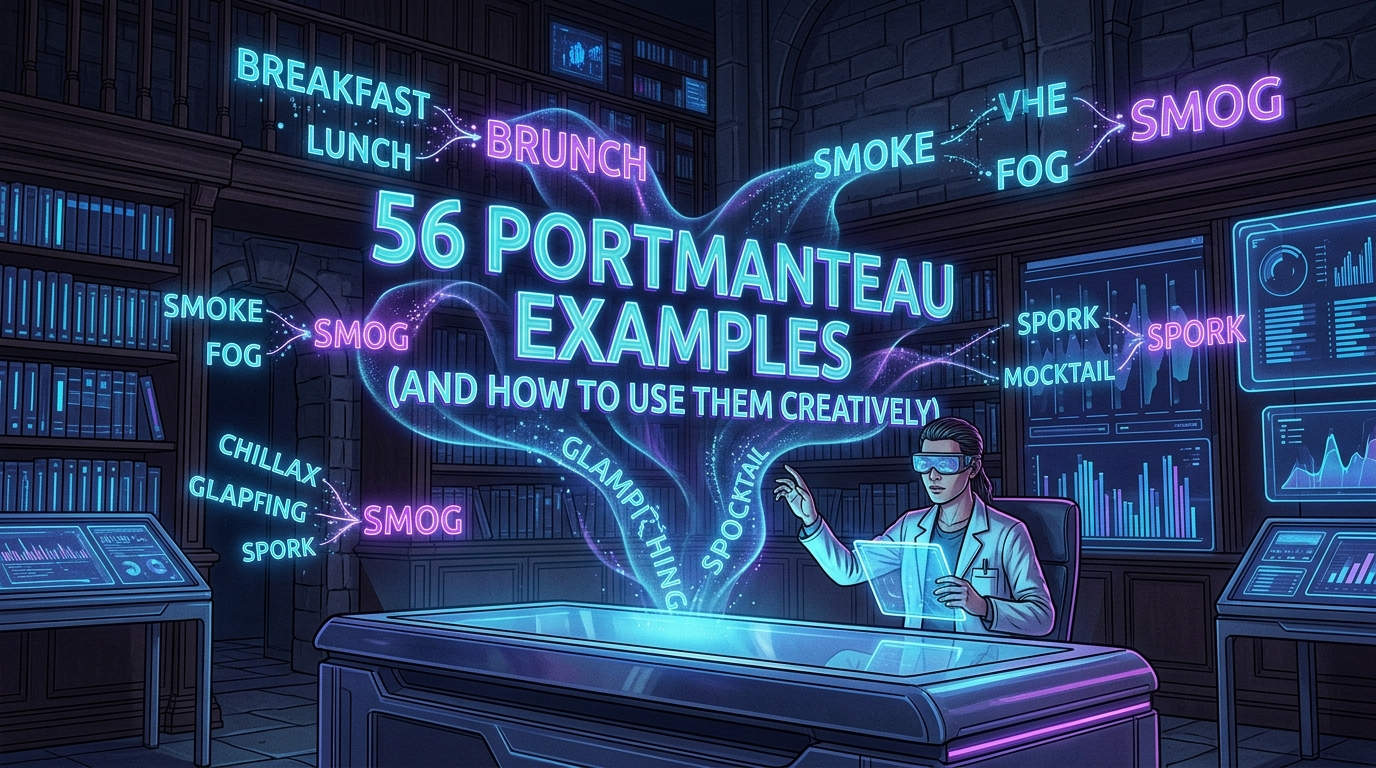
For example, when “breakfast” and “lunch” merge, they form “brunch,” representing a meal that exists between both timeframes. When “smoke” and “fog” combine, they become “smog,” describing polluted air that carries characteristics of both. In both cases, the new word is not just a shortening of expression but a transformation of meaning.
Linguistically, portmanteaus fall under a broader category of word formation processes known as morphological blending. Unlike compounding, where full words are joined, portmanteaus rely on partial overlap, sound merging, and syllable reduction. This makes them unique in how flexible and creative they can be.
The Historical Evolution of Portmanteaus
Although portmanteaus feel modern, they are not a recent invention. The term itself was popularized in the nineteenth century by writer Lewis Carroll, who used it in “Through the Looking-Glass” to describe words like “slithy” (slimy + lithe) and “mimsy” (miserable + flimsy). Carroll’s playful experimentation showed how language could be stretched and reshaped for artistic effect.
Over time, portmanteaus moved beyond literature into everyday usage. The industrial era introduced words like “motorhotel” evolving into “motel,” while scientific advancements produced terms like “breathalyzer.” In the late twentieth century, media and advertising accelerated this trend, creating catchy hybrid words designed to attract attention and simplify complex ideas.
In the digital age, the process has become even faster. The internet produces new concepts almost daily, and portmanteaus are often the quickest way to name them. Words like “blog,” “vlog,” and “podcast” demonstrate how technology reshapes language in real time.
Why Portmanteaus Are So Effective in Communication
The effectiveness of portmanteaus lies in cognitive efficiency. Human brains prefer patterns and minimal effort when processing language. A portmanteau reduces multiple ideas into a single recognizable unit, making comprehension faster and easier.
Instead of processing a full descriptive phrase, the brain decodes a blended word and immediately reconstructs meaning using prior knowledge. This creates a smooth mental shortcut. For example, hearing “hangry” instantly activates both hunger and anger associations, producing immediate emotional understanding.
Another reason portmanteaus work so well is their emotional and cultural resonance. Many of them carry humor, irony, or relatability. Words like “frenemy” or “bridezilla” are not just descriptive; they are expressive. They communicate attitude as well as meaning, which makes them highly memorable.
The Creative Power of Portmanteaus in Writing
Writers often use portmanteaus to create tone, rhythm, and modernity in their work. In fiction, they help build immersive worlds. In nonfiction, they simplify complex ideas. In marketing, they create brand identity. Their versatility makes them one of the most powerful linguistic tools available.
In storytelling, a portmanteau can instantly define a concept without lengthy explanation. A word like “mockumentary” immediately signals a fictional documentary style. Similarly, “docudrama” communicates a blend of documentary realism and dramatic storytelling.
In creative branding, companies often rely on portmanteaus to create memorable names that stick in the audience’s mind. These words are short, catchy, and easy to pronounce, which increases recognition and recall.
56 Portmanteau Examples with Meanings
Below is a structured table of 56 widely used and meaningful portmanteaus that appear in everyday language, media, and modern communication.
| Portmanteau | Meaning |
| Brunch | Breakfast + Lunch |
| Smog | Smoke + Fog |
| Motel | Motor + Hotel |
| Webinar | Web + Seminar |
| Blog | Web + Log |
| Vlog | Video + Blog |
| Podcast | iPod + Broadcast |
| Infotainment | Information + Entertainment |
| Sitcom | Situation + Comedy |
| Spork | Spoon + Fork |
| Emoticon | Emotion + Icon |
| Chillax | Chill + Relax |
| Ginormous | Gigantic + Enormous |
| Hangry | Hungry + Angry |
| Mockumentary | Mock + Documentary |
| Biopic | Biography + Picture |
| Brexit | Britain + Exit |
| Frenemy | Friend + Enemy |
| Workaholic | Work + Alcoholic |
| Advertorial | Advertisement + Editorial |
| Edutainment | Education + Entertainment |
| Guesstimate | Guess + Estimate |
| Cybernaut | Cyber + Astronaut |
| Netiquette | Internet + Etiquette |
| Shopaholic | Shopping + Alcoholic |
| Textpectation | Text + Expectation |
| Staycation | Stay + Vacation |
| Flexitarian | Flexible + Vegetarian |
| Listicle | List + Article |
| Breathalyzer | Breath + Analyzer |
| Infomercial | Information + Commercial |
| Docudrama | Documentary + Drama |
| Frankenfood | Frankenstein + Food |
| Glamping | Glamorous + Camping |
| Bridezilla | Bride + Godzilla |
| Carjack | Car + Hijack |
| Cosplay | Costume + Play |
| Pixel | Picture + Element |
| Malware | Malicious + Software |
| Ransomware | Ransom + Software |
| Mansplain | Man + Explain |
| Mocktail | Mock + Cocktail |
| Netizen | Internet + Citizen |
| Screenager | Screen + Teenager |
| Booktuber | Book + YouTuber |
| Soundscape | Sound + Landscape |
| Workcation | Work + Vacation |
| Automagically | Automatic + Magically |
| Biohack | Biology + Hack |
| Medtech | Medical + Technology |
| Situationship | Situation + Relationship |
| Technopreneur | Technology + Entrepreneur |
| Vagitainment | Viral + Entertainment |
This list demonstrates how deeply embedded portmanteaus are in modern communication. They range from humorous expressions to serious technological terminology, showing their adaptability across contexts.
Types of Portmanteaus in Language
Portmanteaus can be understood in different categories based on how and where they are used. Some are casual and humorous, others are technical, and some are culturally or politically driven.
Casual portmanteaus often arise in everyday conversation. Words like “hangry” or “chillax” are informal and emotionally expressive. They are usually born from spoken language and quickly spread through social interaction.
Technical portmanteaus are common in science and technology. Words like “malware” and “medtech” simplify complex systems into accessible terms. These are especially important in fields where communication efficiency is essential.
Cultural portmanteaus reflect societal trends. Words like “staycation” or “workcation” describe lifestyle changes. These terms often emerge when society adopts new habits that require naming.
Political or media-based portmanteaus also exist, often summarizing complex events or ideas. “Brexit” is one of the most well-known examples, condensing an entire political movement into a single term.
How Portmanteaus Spread and Become Popular
The spread of portmanteaus is closely tied to social communication patterns. In earlier times, literature and print media were the main vehicles for word adoption. Today, digital platforms accelerate this process dramatically.
Social media plays a major role in popularizing new words. A catchy portmanteau can go viral within hours if it resonates emotionally or humorously with users. Once widely shared, it often enters mainstream vocabulary.
Television, advertising, and entertainment also contribute significantly. When a portmanteau is used in a popular show or campaign, it gains instant exposure and credibility.
How to Create Your Own Portmanteaus
Creating portmanteaus is both an analytical and creative process. The key is to identify two concepts that naturally belong together and merge them in a way that preserves meaning and sound clarity.
A successful portmanteau should feel intuitive. Readers should be able to guess its meaning without needing explanation. It should also sound smooth when spoken aloud, avoiding awkward or forced combinations.
Writers often experiment by blending syllables, trimming word endings, or combining beginnings. The most effective creations are those that sound natural in context rather than artificially constructed.
Common Mistakes When Using Portmanteaus
One common mistake is overuse. While portmanteaus are engaging, using too many in a single piece of writing can make the text feel cluttered or gimmicky. Balance is essential.
Another mistake is forced blending. If a portmanteau feels unnatural or difficult to understand, it disrupts readability rather than enhancing it. Clarity should always come first.
Writers should also avoid using obscure or invented portmanteaus without context. If the reader cannot infer meaning, the effectiveness of the word is lost.
Psychological Appeal of Portmanteaus
Portmanteaus are powerful because they align with how the human brain processes language. The brain prefers compression and association. When two familiar words merge, the mind automatically links their meanings, creating instant comprehension.
They also trigger curiosity and engagement. A new or unusual blended word encourages readers to pause and interpret it, increasing cognitive interaction with the text.
Emotionally, portmanteaus often carry humor, irony, or intensity, which strengthens memory retention. This is why they tend to stick in popular culture longer than standard vocabulary.
The Future of Portmanteaus in Language
As communication continues to evolve, portmanteaus will likely become even more common. Emerging technologies, social behaviors, and global cultural exchange constantly generate new ideas that require naming.
Artificial intelligence, virtual reality, and evolving digital identities are already producing new linguistic blends. As long as new concepts emerge, language will continue to adapt through fusion and creativity.
Portmanteaus are not just linguistic trends; they are evidence of language in motion. They show how humans continuously reshape expression to fit new realities.
Final Reflection
Portmanteaus represent one of the most creative and efficient aspects of language. They capture complexity in simplicity, emotion in brevity, and meaning in fusion. From casual slang to technological terminology, they exist everywhere because they work everywhere.
For writers, understanding portmanteaus is not just about vocabulary expansion. It is about learning how language evolves, how meaning is constructed, and how creativity can reshape communication. When used thoughtfully, portmanteaus add freshness, clarity, and personality to writing, making them an essential tool in modern expression.
