
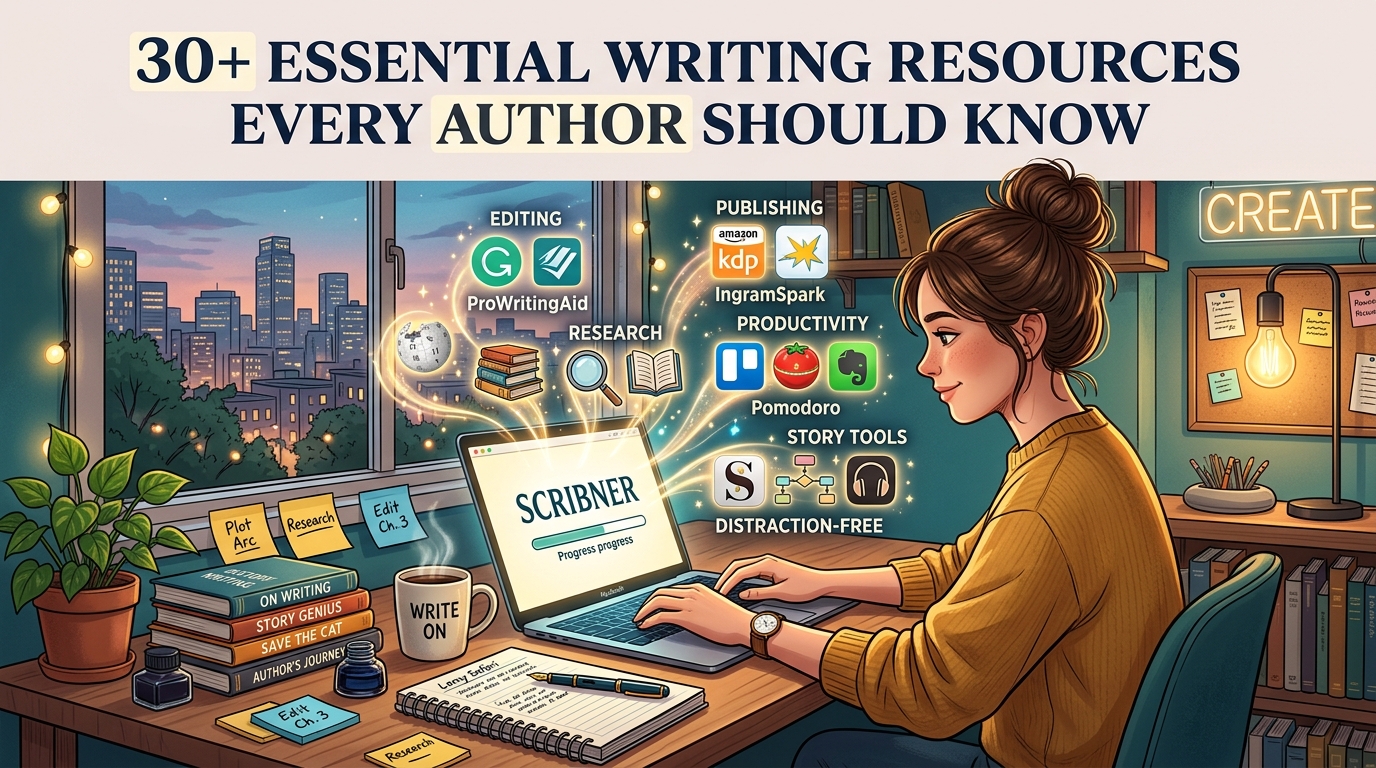
Writing has evolved dramatically over the last two decades. What once required stacks of notebooks, shelves of dictionaries, physical libraries, and endless printed drafts can now be done from a single laptop connected to the internet. Modern writers have access to thousands of digital tools, educational platforms, research databases, editing systems, productivity apps, and publishing services designed to make the writing process smoother and more professional. Yet despite this abundance of resources, many writers still struggle to identify which tools genuinely improve their work and which simply add more noise.
The truth is that successful writing rarely happens through inspiration alone. Behind every finished novel, polished blog post, researched nonfiction book, or published article lies a system. Writers who consistently produce quality work often rely on carefully chosen resources that support their creativity, sharpen their skills, and simplify the technical side of the writing process. These resources help writers organize ideas, maintain productivity, strengthen grammar, improve storytelling, conduct research, market their books, and connect with readers.
For modern authors, understanding these tools is no longer optional. The writing industry has become increasingly competitive, and readers expect higher standards than ever before. Authors today are not only writers. They are often editors, marketers, content strategists, publishers, and personal brands all at once. That reality makes writing resources more valuable than they have ever been before.
Whether someone is an aspiring novelist, a freelance writer, a blogger, a screenwriter, or a nonfiction author, the right resources can save countless hours and dramatically improve the final quality of their work. Some platforms help writers brainstorm story ideas. Others organize complex manuscripts. Some focus entirely on editing and readability, while others assist with publishing and promotion.
This guide explores more than 30 essential writing resources every author should know, explaining not only what these tools are but why they matter in real-world writing careers.
Why Writing Resources Matter in Modern Publishing
The romantic image of writers creating masterpieces in complete isolation has always been somewhat misleading. Even famous authors throughout history relied on editors, literary communities, publishers, mentors, researchers, and assistants. Writing has always been collaborative in one form or another. The difference today is that these support systems have become digital, faster, and far more accessible.
Modern writing resources exist because writing itself has become more demanding. Authors are expected to produce cleaner drafts, meet faster deadlines, maintain online visibility, and compete in crowded digital spaces. At the same time, readers have unlimited options, which means weak writing loses attention quickly.
Good writing resources reduce friction during the creative process. Instead of wasting hours fixing formatting issues or manually organizing research, writers can focus more energy on creativity and storytelling. These tools also help writers stay consistent, which is one of the biggest factors behind long-term success.
A talented writer who rarely finishes projects will struggle more than a moderately skilled writer with strong systems and discipline. Resources help bridge that gap by improving workflow, reducing distractions, and encouraging structure.
Writing Platforms That Help Authors Draft Efficiently
Every writing journey begins with drafting. While creativity matters most during this stage, the environment in which a writer works can heavily influence productivity and focus.
Google Docs
Google Docs remains one of the most practical writing tools available today because of its simplicity and accessibility. Writers can open their drafts from nearly any device, collaborate with editors in real time, and avoid losing work thanks to automatic cloud saving.
For freelance writers and content creators, this flexibility is especially useful. Multiple people can review a document simultaneously, making revisions and feedback much faster than traditional editing systems. Google Docs also removes the stress of managing different file versions since updates happen automatically.
Although it lacks some advanced features found in specialized writing software, its ease of use makes it a core resource for millions of writers worldwide.
Microsoft Word
Despite the rise of newer tools, Microsoft Word remains one of the most important writing platforms in publishing. Literary agents, publishers, academic institutions, and editors still rely heavily on Word documents because of their formatting compatibility and editing features.
The “Track Changes” system is particularly valuable during editing. It allows editors and authors to review modifications clearly without losing original text. For writers seeking traditional publishing opportunities, familiarity with Microsoft Word remains essential.
Scrivener
Scrivener is widely considered one of the best resources for long-form writing projects. Unlike ordinary word processors, it was designed specifically for authors managing large manuscripts.
Novelists often work with dozens of chapters, character profiles, timelines, research notes, and plot outlines simultaneously. Scrivener allows all these elements to exist within one organized workspace. Writers can move scenes around easily, split manuscripts into manageable sections, and visualize the structure of an entire book without feeling overwhelmed.
One reason many fiction writers love Scrivener is that it makes large projects psychologically easier to handle. Instead of facing a giant 120,000-word document, writers can focus on one scene or chapter at a time.
Ulysses
Ulysses appeals to writers who prefer minimalist writing environments. Its clean interface removes unnecessary distractions while still offering organizational tools for larger projects.
Many writers struggle with overstimulation while drafting. Notifications, complicated menus, and crowded interfaces can interrupt concentration. Ulysses creates a calmer writing experience that encourages deeper focus and creative flow.
Editing and Grammar Resources That Improve Writing Quality
Even brilliant ideas lose impact when grammar mistakes and awkward phrasing distract readers. Editing tools cannot replace human creativity, but they significantly improve clarity and professionalism.
Grammarly
Grammarly has become one of the most widely used editing assistants because it combines grammar correction with readability suggestions. Beyond identifying spelling mistakes, it analyzes sentence structure, punctuation, tone, and clarity.
One of Grammarly’s greatest strengths is that it teaches while correcting. Instead of silently fixing mistakes, it explains why certain changes improve readability. Over time, writers naturally become more aware of recurring weaknesses in their writing.
For bloggers, business writers, students, and nonfiction authors, Grammarly can dramatically reduce editing time.
ProWritingAid
ProWritingAid is particularly popular among fiction writers because of its deeper storytelling analysis. While basic grammar tools focus mainly on errors, ProWritingAid examines pacing, sentence variation, dialogue patterns, overused words, and narrative flow.
Writers often discover habits they never noticed before. For example, some authors repeatedly begin sentences the same way, overuse filler words, or rely too heavily on passive voice. ProWritingAid highlights these patterns clearly.
This level of analysis makes it especially valuable for novels and long-form storytelling.
Hemingway Editor
The Hemingway Editor focuses on simplicity and readability. It identifies dense sentences, excessive adverbs, passive voice, and overly complicated phrasing.
Many writers unintentionally make their work harder to read by trying too hard to sound sophisticated. Hemingway encourages concise, direct writing that communicates ideas clearly.
This resource is especially helpful for online content, business writing, and nonfiction books where clarity matters more than decorative language.
Research Resources Every Writer Should Know
Strong writing depends on accurate information and believable detail. Even fiction writers need research to create convincing worlds, realistic dialogue, and authentic settings.
| Writing Resource | Main Purpose | Best For |
| Google Scholar | Academic studies and journals | Nonfiction and research-heavy writing |
| JSTOR | Historical and scholarly archives | Historical fiction and essays |
| Evernote | Saving notes and references | Research organization |
| Notion | Workflow and planning | Complex writing projects |
| Archive.org | Historical texts and media | Historical references |
| WorldCat | Global library access | Book and source discovery |
| Reddit Communities | Real-world experiences | Character and dialogue research |
| Wikipedia | Quick introductory research | Topic exploration |
| Zotero | Citation management | Academic and technical writing |
Google Scholar
Google Scholar provides access to academic research papers, journals, and scholarly publications. Writers creating educational content or nonfiction books often use it to find reliable evidence and expert studies.
In an era where misinformation spreads rapidly online, scholarly resources help authors maintain credibility.
JSTOR
JSTOR offers extensive archives of academic journals, literary criticism, and historical documents. Writers working on historical fiction frequently use JSTOR to understand the culture, politics, and language of specific time periods.
Detailed research often separates immersive stories from shallow ones.
Evernote
Evernote helps writers collect and organize information efficiently. Writers constantly encounter ideas, quotes, articles, and inspirations throughout the day, and Evernote creates a central place to store them.
Without organization systems, research can quickly become chaotic.
Notion
Notion has become one of the most versatile organizational tools for writers. It combines note-taking, project management, calendars, databases, and writing plans into one customizable platform.
Authors use Notion to track chapters, manage deadlines, organize research, and even plan marketing campaigns. Its flexibility makes it useful for both individual writers and collaborative teams.
Productivity Resources That Help Writers Stay Consistent
One of the biggest myths about writing is that successful authors constantly feel inspired. In reality, consistency matters far more than motivation.
Pomodoro Timers
The Pomodoro Technique encourages writers to work in short, focused intervals followed by brief breaks. This method helps prevent burnout while improving concentration.
Large writing projects often feel intimidating. Writing for twenty-five focused minutes feels much more manageable than trying to write for several exhausting hours.
Freedom
Freedom blocks distracting websites and apps during writing sessions. Social media platforms are one of the biggest enemies of deep creative focus, and many writers struggle to maintain concentration while notifications constantly compete for attention.
By temporarily blocking distractions, writers can enter a more productive mental state.
Cold Turkey Writer
Cold Turkey Writer takes focus even further. It locks the screen until the writer reaches a specific word count goal.
Although it sounds extreme, many writers appreciate the forced accountability because it removes opportunities for procrastination.
Trello
Trello allows writers to organize projects visually using boards and task cards. Authors often use it to outline stories, track revisions, manage article deadlines, or organize publishing schedules.
Complex writing careers involve far more than drafting alone, and organizational systems become increasingly important over time.
Story Development and Plotting Resources
Writing compelling stories requires structure, pacing, and emotional progression.
Plottr
Plottr helps writers visually organize timelines, character arcs, and plotlines. This is especially useful for fantasy, mystery, and historical fiction writers managing complicated narratives.
Seeing story elements visually often helps writers identify pacing issues or missing connections.
The Snowflake Method
The Snowflake Method breaks story development into gradual stages. Writers begin with a simple concept and slowly expand it into detailed outlines, character profiles, and complete narratives.
This method works particularly well for writers who feel overwhelmed by large projects.
Save the Cat Beat Sheet
Originally created for screenwriting, the Save the Cat structure has become highly influential in novel writing. It provides clear story beats that help writers maintain emotional momentum and pacing throughout a story.
Many bestselling novels unknowingly follow similar narrative rhythms.
Learning Resources for Writers Who Want to Improve
The best writers continue learning throughout their careers.
MasterClass
MasterClass offers lessons from bestselling authors, screenwriters, and storytellers. Watching experienced writers discuss their creative processes often provides valuable insight and inspiration.
Learning directly from successful creators can also make the writing process feel less mysterious and intimidating.
Coursera
Coursera provides access to university-level writing courses covering creative writing, storytelling, editing, and professional communication.
Writers who enjoy structured learning environments often benefit greatly from online education platforms.
Writing Podcasts
Podcasts have become an important educational resource because they allow writers to learn while multitasking. Many podcasts feature interviews with published authors, editors, literary agents, and marketers.
Hearing real experiences from professionals often teaches lessons unavailable in textbooks.
YouTube Writing Channels
YouTube contains thousands of free writing tutorials covering everything from dialogue writing to publishing strategies. Visual explanations can make storytelling concepts easier to understand.
Writing Communities That Support Growth
Writing can feel isolating, which is why communities matter so much.
Reddit Writing Communities
Writing-focused Reddit communities allow authors to exchange advice, discuss industry changes, and share experiences openly.
Writers often learn practical publishing lessons through community conversations that formal courses never mention.
Scribophile
Scribophile allows writers to exchange critiques and feedback. Honest criticism is one of the fastest ways to improve writing quality because it reveals weaknesses writers may overlook themselves.
Absolute Write
Absolute Write forums contain years of discussions about publishing, literary agents, editing, and writing craft. Many professional writers still use these forums for advice and networking.
NaNoWriMo
National Novel Writing Month motivates writers to complete 50,000 words during November. While the challenge itself is demanding, the sense of community and accountability often helps writers finish projects they might otherwise abandon.
Publishing Resources Every Modern Author Should Understand
Completing a manuscript is only part of becoming an author. Publishing requires its own knowledge and systems.
Kindle Direct Publishing (KDP)
Amazon’s Kindle Direct Publishing platform transformed self-publishing by giving authors direct access to global readers.
Writers can publish ebooks and paperbacks independently while maintaining creative control and earning royalties directly.
Draft2Digital
Draft2Digital simplifies ebook distribution across multiple retailers. Instead of uploading books individually to different platforms, writers can distribute widely through one service.
Reedsy
Reedsy connects writers with professional editors, cover designers, and publishing experts. It also provides educational resources about book marketing and publishing strategy.
QueryTracker
Writers pursuing traditional publishing use QueryTracker to manage literary agent submissions and track responses efficiently.
Marketing Resources Every Author Needs Today
Modern authors cannot rely entirely on publishers for promotion. Marketing has become a major part of writing careers.
Canva
Canva allows writers to create professional-looking graphics for book promotions, websites, newsletters, and social media.
Strong visual branding helps authors stand out online.
Mailchimp
Email newsletters remain one of the most effective marketing tools for writers because they create direct communication with readers.
Mailchimp helps authors manage subscriber lists and automate campaigns.
Buffer
Buffer simplifies social media scheduling, allowing writers to maintain online consistency without constantly interrupting their writing time.
BookFunnel
BookFunnel helps authors distribute ebooks for promotions, review campaigns, and reader giveaways.
AI Tools and the Future of Writing
Artificial intelligence has introduced entirely new possibilities for writers. AI tools can assist with brainstorming, outlining, editing, and idea generation. They can help writers overcome creative blocks or organize research more efficiently.
However, strong writing still depends on human emotion, perspective, originality, and storytelling instincts. AI works best as a support tool rather than a replacement for authentic creativity.
The writers who benefit most from AI are those who use it strategically without losing their personal voice.
Building a Personal Writing System
Not every resource works for every writer. Some authors thrive using minimalist systems with only a notebook and basic word processor. Others prefer complex workflows involving multiple apps and planning tools.
The key is experimentation.
Writers should focus on solving their biggest problems first. Someone struggling with productivity may benefit more from focus tools than advanced editing software. Another writer may need research organization systems more than grammar correction tools.
Over time, most professional writers develop personalized ecosystems that support their habits and goals.
Final Thoughts
Modern writers have access to more opportunities and resources than any generation before them. Editing software, research databases, online communities, publishing platforms, productivity systems, and educational tools have transformed the writing landscape completely.
Yet despite these technological advances, the heart of writing remains unchanged. Great writing still requires curiosity, discipline, emotional honesty, observation, and persistence.
Resources cannot replace creativity, but they can remove obstacles that prevent creativity from flourishing. They help writers stay organized, focused, informed, and professional in an increasingly competitive industry.
For aspiring authors, the sheer number of available tools may initially feel overwhelming. The best approach is not to use everything at once but to gradually build a system that genuinely improves the writing process.
The most successful authors are not necessarily the ones with the most expensive software or the largest number of productivity apps. They are the writers who consistently sit down, improve their craft, and finish meaningful work.
Writing resources simply make that journey more manageable, more efficient, and sometimes even more enjoyable.
