
Entrepreneurship is often imagined as a fast-moving journey filled with bold decisions, uncertain risks, and unexpected rewards. But behind every successful entrepreneur lies something far less visible yet deeply powerful: continuous learning. While experience teaches lessons the hard way, books offer a way to absorb decades of wisdom in a few hours. The right business books do not just share strategies; they reshape how you think about money, leadership, innovation, discipline, and long-term vision.
For entrepreneurs, reading is not a passive activity but a strategic advantage. It sharpens decision-making, strengthens problem-solving skills, and builds mental frameworks that help in navigating real-world business challenges. The following collection brings together twelve influential business books that have shaped modern entrepreneurship. Each of these works offers a unique lens into how successful businesses are built, scaled, and sustained.
Why Business Books Still Matter in a Fast Digital Age
In a world dominated by short-form content, reels, and instant information, long-form reading might seem outdated. Yet, business books remain one of the most reliable sources of deep, structured knowledge. Unlike fragmented online advice, these books are written through years of experience, research, and reflection.
Entrepreneurs often face problems that do not have simple answers. Whether it is building a startup from scratch, managing a growing team, or making financial decisions under pressure, clarity is essential. Business books provide that clarity by presenting tested frameworks rather than temporary trends. They help entrepreneurs think beyond quick wins and focus on sustainable success.
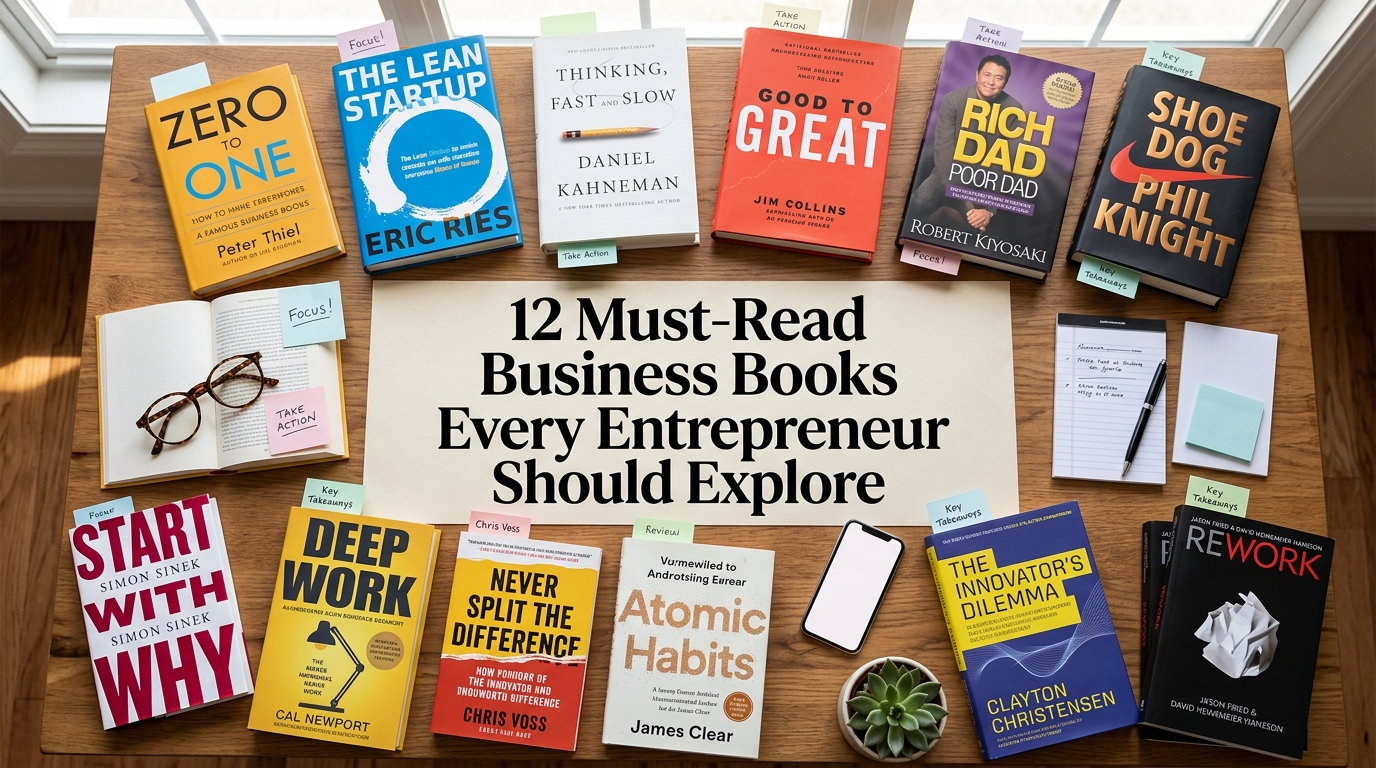
12 Must-Read Business Books Every Entrepreneur Should Explore
1. Think and Grow Rich – The Foundation of Success Mindset
Think and Grow Rich is often considered the cornerstone of modern success philosophy and personal development literature. First published in 1937, it continues to influence entrepreneurs, leaders, and creators because it focuses on something that never becomes outdated: the human mind and its role in shaping achievement.
Napoleon Hill’s work is based on more than two decades of research into some of the most successful individuals of his era, including industrial leaders and innovators. Instead of focusing on external strategies alone, Hill went deeper into understanding why these individuals succeeded. He discovered that wealth and achievement consistently begin with a clearly defined desire, reinforced by belief and sustained through persistence.
The most powerful idea in this book is that success is not accidental but psychological before it becomes material. Entrepreneurs often focus heavily on business models, funding, or competition, but this book redirects attention to internal alignment. It argues that without clarity of purpose and emotional conviction, external strategies lose their effectiveness.
Another key aspect is the concept of “specialized knowledge,” which highlights the importance of focused learning rather than general information. In today’s entrepreneurial landscape, this translates into mastering a niche, building expertise, and applying that knowledge with consistency. Ultimately, the book teaches that disciplined thinking is the real foundation of wealth creation.
2. Rich Dad Poor Dad – Understanding Financial Intelligence
Rich Dad Poor Dad remains one of the most influential books in shaping modern financial thinking. It challenges conventional beliefs about education, employment, and financial security by presenting two contrasting financial philosophies that shaped the author’s life.
On one side is the “poor dad” mindset, which prioritizes job security, stable income, and academic achievement as the safest route in life. On the other side is the “rich dad” mindset, which emphasizes financial education, asset-building, and understanding how money flows in the real world. The contrast between these two perspectives creates a powerful shift in how readers view money.
For entrepreneurs, the book is particularly important because it breaks the illusion that earning a high salary automatically leads to wealth. Instead, it introduces the idea that financial freedom comes from building assets that generate income independently. These assets can include businesses, investments, or intellectual property.
The book also highlights the importance of cash flow literacy—understanding how money moves in and out of systems. Entrepreneurs benefit from this perspective because it encourages them to design businesses that generate sustainable and scalable income rather than short-term profits.
In essence, the book pushes readers to shift from employee thinking to ownership thinking, which is one of the most important transitions in entrepreneurial growth.
3. The Lean Startup – Building Smarter Businesses
The Lean Startup introduces a revolutionary approach to building businesses in uncertain environments. Traditional business planning assumes that success can be predicted in advance, but Eric Ries challenges this idea by emphasizing experimentation over prediction.
At the core of the book is the “Build–Measure–Learn” cycle, which encourages entrepreneurs to start with a minimum viable product, release it quickly, collect feedback, and then improve it based on real-world data. This approach helps reduce waste, eliminate guesswork, and avoid building products that nobody actually needs.
One of the most valuable insights in this book is that failure is not only acceptable but essential when it leads to learning. Instead of spending months or years perfecting an idea in isolation, entrepreneurs are encouraged to test early and adapt continuously.
The Lean Startup methodology is especially relevant in fast-moving industries like technology, digital services, and e-commerce, where customer expectations evolve rapidly. It helps founders remain flexible, data-driven, and responsive rather than rigid and assumption-based.
Ultimately, the book teaches that success is not about having the perfect idea from the beginning, but about continuously improving through validated learning.
4. Zero to One – Creating Unique Value
Zero to One presents a powerful argument for innovation in entrepreneurship. Peter Thiel’s central idea is that progress happens when we create something entirely new rather than improving what already exists.
He describes innovation as moving from “zero to one,” meaning the creation of something that did not exist before. This contrasts with “one to many,” which refers to scaling existing ideas or copying successful models.
For entrepreneurs, this book is a guide to thinking independently and avoiding competitive traps. Instead of entering saturated markets and competing on price or features, Thiel encourages founders to identify unique opportunities that others overlook. This could involve technological breakthroughs, new business models, or entirely new categories of products.
A key theme in the book is the importance of contrarian thinking—believing in ideas that others may dismiss initially. Many successful startups begin as unpopular or misunderstood ideas that later reshape industries.
The book ultimately challenges entrepreneurs to think long-term, act creatively, and focus on building monopolistic value through uniqueness rather than competition.
5. Good to Great – Transforming Average Companies into Exceptional Ones
Good to Great is based on extensive research analyzing companies that transitioned from average performance to sustained excellence. Jim Collins and his research team studied patterns across industries to identify what truly separates good companies from great ones.
One of the most important discoveries is the concept of “Level 5 Leadership,” where leaders combine deep humility with strong professional determination. These leaders are not driven by personal fame but by long-term organizational success.
Another key principle is disciplined thinking and disciplined action. Successful companies do not rely on sudden breakthroughs but on consistent execution over time. They build systems, maintain focus, and avoid distractions that dilute their core mission.
The “Hedgehog Concept” is another important idea, which suggests that great companies find clarity in three areas: what they are deeply passionate about, what they can be best in the world at, and what drives their economic engine. When these three areas align, sustainable success becomes possible.
For entrepreneurs, the book emphasizes that greatness is not accidental. It is built through discipline, focus, and consistent decision-making over time.
6. The Hard Thing About Hard Things – Reality of Leadership
The Hard Thing About Hard Things is one of the most realistic and unfiltered books about entrepreneurship. Unlike idealistic business literature, it focuses on the emotional weight and difficult decisions that come with leading a company.
Ben Horowitz draws from his experience as a CEO navigating crises, layoffs, competition, and financial instability. The book makes it clear that there is no perfect roadmap for leadership. Instead, entrepreneurs are constantly forced to make difficult choices with incomplete information.
One of the key lessons is that courage in leadership does not mean the absence of fear, but the ability to act despite it. Entrepreneurs often face moments where the right decision is unclear, and this book teaches how to navigate those situations with clarity and resilience.
It also highlights the emotional toll of entrepreneurship, including stress, doubt, and responsibility for employees. This honest perspective helps founders prepare mentally for the realities of running a business.
7. Start With Why – Building Purpose-Driven Brands
Start With Why explores the idea that the most successful organizations are built around a clear sense of purpose rather than just products or services.
Simon Sinek introduces the “Golden Circle” framework, which consists of why, how, and what. According to this model, most businesses communicate from the outside in, focusing on what they do. However, inspiring leaders and companies communicate from the inside out, starting with why they exist.
For entrepreneurs, this book is essential because it connects branding with emotional meaning. Customers are more likely to remain loyal to businesses that share their values or beliefs, not just those that offer functional benefits.
A strong “why” helps businesses build identity, attract aligned customers, and create long-term trust. It also helps teams stay motivated because they understand the deeper purpose behind their work.
8. Blue Ocean Strategy – Finding Untapped Markets
Blue Ocean Strategy introduces a strategic framework for avoiding competition by creating entirely new market spaces.
The concept divides markets into “red oceans,” where companies compete aggressively, and “blue oceans,” where competition is irrelevant because demand is created rather than fought over.
For entrepreneurs, this book encourages innovation in value creation. Instead of improving existing offerings slightly, businesses are guided to rethink industry boundaries and design new solutions that redefine customer expectations.
It also emphasizes strategic differentiation, where success comes not from competing better but from competing differently. This approach allows businesses to avoid price wars and build stronger profit margins.
9. The E-Myth Revisited – Understanding Small Business Failures
The E-Myth Revisited explains why many small businesses struggle despite having skilled and passionate owners.
Michael E. Gerber argues that the main issue is that most entrepreneurs work in their business rather than on their business. This means they focus too much on daily tasks instead of building systems that allow the business to operate independently.
The book introduces the idea that successful businesses are built like franchises, with structured processes and repeatable systems. This ensures consistency, scalability, and long-term stability.
For entrepreneurs, this book is essential because it highlights the importance of delegation, structure, and systemization. Without these elements, businesses often remain dependent on the founder and struggle to grow beyond a certain point.
10. Atomic Habits – The Power of Small Improvements
Atomic Habits explains how small, consistent habits compound over time to produce significant results. James Clear breaks down the science of behavior change into practical strategies that are easy to apply.
The core idea is that success is not the result of one big action but the accumulation of small, repeated improvements. Over time, these small habits shape identity and outcomes.
For entrepreneurs, this is especially important because business success often depends on consistency in execution. Whether it is marketing, product development, or leadership, small daily improvements can lead to major long-term growth.
The book also emphasizes systems over goals. Instead of focusing only on outcomes, entrepreneurs are encouraged to build processes that naturally lead to success.
11. Shoe Dog – The Real Journey of Building Nike
Shoe Dog is not a typical business book filled with strategies, frameworks, or step-by-step methods. Instead, it is a deeply personal memoir that captures the raw, unpredictable, and often chaotic journey of building Nike from a small idea into one of the most iconic global brands in history.
Phil Knight takes readers inside the early years of the company, when uncertainty was constant, money was always tight, and success was far from guaranteed. What makes this book so powerful for entrepreneurs is its honesty. It does not present entrepreneurship as a clean or structured process but as something messy, emotional, and filled with constant doubt.
One of the most important lessons in the book is that even legendary companies begin in confusion. Nike was not built with certainty or perfect planning. It grew through trial and error, risky decisions, and relentless belief in an idea that many people did not initially understand. This is a reminder that early-stage entrepreneurship is often about endurance more than perfection.
The book also highlights the emotional weight carried by founders. Phil Knight constantly struggles with financial pressure, supplier issues, and internal uncertainty about whether the business will survive. Yet, what drives him forward is persistence and an almost irrational belief in the vision.
For entrepreneurs, this book is valuable because it removes the illusion of overnight success. It shows that behind every global brand lies years of struggle, doubt, and persistence. It also reinforces the idea that passion and resilience often matter more than perfect planning.
Ultimately, Shoe Dog is not just about building Nike—it is about surviving the journey of building anything meaningful.
12. Principles – A System for Decision Making
Principles presents a structured and highly disciplined approach to thinking, decision-making, and organizational design. Written by billionaire investor Ray Dalio, the book is built around the idea that life and business become significantly more effective when guided by clear principles rather than emotional reactions.
At its core, the book emphasizes “radical truth” and “radical transparency.” Dalio argues that most failures in business and life come from avoiding uncomfortable truths or making decisions based on ego rather than reality. By confronting reality directly and openly, individuals and organizations can make far better long-term decisions.
One of the most valuable aspects of this book for entrepreneurs is its focus on systematic thinking. Instead of relying on intuition alone, Dalio encourages building decision frameworks that can be reused and refined over time. This reduces inconsistency and helps leaders make better choices even under pressure.
The book also introduces the idea that mistakes are essential for growth, as long as they are properly analyzed and learned from. In this sense, failure is not a setback but a data point that improves future decision-making.
For entrepreneurs building teams or companies, Principles is especially useful because it explains how to design organizations that function efficiently even when the founder is not directly involved in every decision. It promotes clarity, accountability, and structured thinking at every level.
Ultimately, the book teaches that success is not random—it is the result of clear thinking, disciplined execution, and continuous learning from reality.
Key Insights from the 12 Must-Read Business Books
| Book Title | Core Idea | Why It Matters for Entrepreneurs |
| Think and Grow Rich | Success starts with mindset | Builds mental discipline and goal clarity |
| Rich Dad Poor Dad | Financial intelligence over job security | Teaches wealth-building thinking |
| The Lean Startup | Build, test, learn quickly | Reduces startup failure risk |
| Zero to One | Create unique innovation | Encourages originality in business |
| Good to Great | Systems drive greatness | Helps scale businesses effectively |
| The Hard Thing About Hard Things | Leadership is difficult | Prepares for real-world challenges |
| Start With Why | Purpose builds loyalty | Strengthens branding and vision |
| Blue Ocean Strategy | Avoid competition | Encourages market innovation |
| The E-Myth Revisited | Work on your business | Helps structure scalable systems |
| Atomic Habits | Small habits create big results | Improves consistency and productivity |
| Shoe Dog | Entrepreneurship is messy | Offers real startup insights |
| Principles | Structured decision-making | Builds clarity in leadership |
Final Thoughts
Entrepreneurship is not a single skill but a combination of mindset, strategy, discipline, and adaptability. These twelve books collectively cover all essential dimensions of building and sustaining a successful business. Some focus on financial intelligence, others on innovation, leadership, or personal growth, but together they form a powerful knowledge foundation.
For any entrepreneur, reading these books is not just about gaining information; it is about reshaping thinking patterns. The real value lies not in how many books you read, but in how deeply you apply their lessons in real-world situations. Success in business often comes down to perspective, and these books are designed to expand exactly that.
