
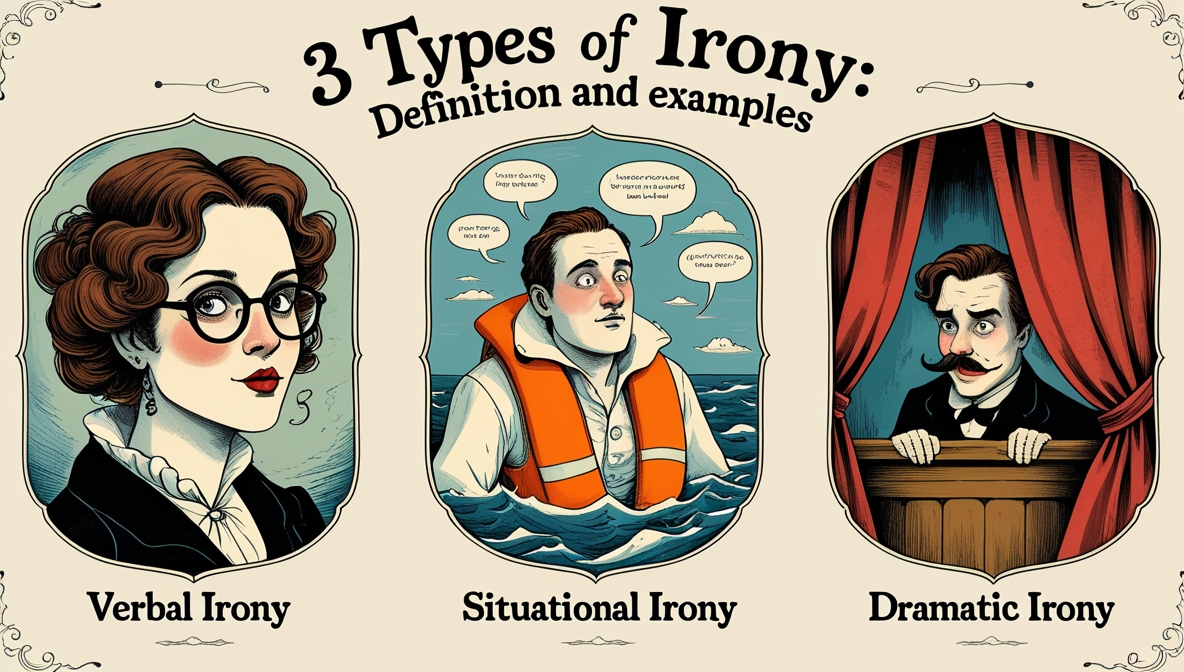
Irony is one of the most powerful and versatile tools in literature, storytelling, and communication. It adds depth, humor, surprise, and even suspense to writing and speech. Whether you’re reading a novel, watching a movie, or having a casual conversation, you’ve likely encountered irony—sometimes without even realizing it.
In this article, we’ll explore:
- What irony is and why it matters
- The three main types of irony
- Clear definitions of each type
- Multiple real-world and literary examples
- Tips for identifying and using irony in writing
📌 Quick Summary & Overview
The three main types of irony are:
- Verbal irony: Saying the opposite of what one means (often sarcastic).
- Situational irony: When the outcome is the opposite of what is expected.
- Dramatic irony: When the audience knows something the characters do not.
Each type creates contrast between appearance and reality, enhancing engagement and emotional impact.
🎭 What Is Irony?
Irony occurs when there’s a discrepancy between expectations and reality—when what is said or happens contradicts what was meant or anticipated. Irony is often used to provoke thought, add humor, highlight contradictions, or intensify drama.
🔍 1. Verbal Irony
📖 Definition:
Verbal irony happens when someone says something that is opposite to what they truly mean. It’s often sarcastic but doesn’t always have to be mocking in tone.
🔹 Key Element: The speaker intentionally contrasts their words with their meaning.
✅ Examples of Verbal Irony:
- Everyday Use:
- You step out into a hurricane and say, “Lovely weather we’re having!”
- After burning dinner: “Well, guess I’m the next MasterChef!”
- Literary Example:
- In Julius Caesar by Shakespeare, Mark Antony says:
“Brutus is an honourable man,”
—even though he clearly believes Brutus betrayed Caesar. The repetition becomes ironically charged.
- In Julius Caesar by Shakespeare, Mark Antony says:
- Pop Culture:
- In The Office, Jim says, “Great, another meeting. Exactly what I needed today.”
—His tone and situation make it clear that’s the opposite of what he means.
- In The Office, Jim says, “Great, another meeting. Exactly what I needed today.”
🎯 When to Use Verbal Irony:
- To express frustration or humor
- To develop character voice or sarcasm
- To critique or subtly mock a situation
⚖️ 2. Situational Irony
📖 Definition:
Situational irony occurs when there’s a stark contrast between what is expected to happen and what actually occurs.
🔹 Key Element: The outcome defies logic or audience expectations in a meaningful way.
✅ Examples of Situational Irony:
- Everyday Use:
- A fire station burns down.
- A marriage counselor files for divorce.
- A police station gets robbed.
- Literary Example:
- In The Gift of the Magi by O. Henry:
A woman sells her hair to buy a chain for her husband’s watch—while he sells his watch to buy her a comb. The gift is useless, yet deeply meaningful.
- In The Gift of the Magi by O. Henry:
- Film Example:
- In Toy Story, Buzz Lightyear insists he’s not a toy—yet everything he does proves otherwise. The irony drives his character arc.
🎯 When to Use Situational Irony:
- To create plot twists or emotional impact
- To add humor or satirical commentary
- To reinforce themes about fate, chance, or human limitations
🎬 3. Dramatic Irony
📖 Definition:
Dramatic irony occurs when the audience knows something that the characters do not. This creates tension, anticipation, or sometimes humor.
🔹 Key Element: The audience is “in on the secret,” creating a disconnect between character understanding and reality.
✅ Examples of Dramatic Irony:
- Everyday Analogy:
- In a surprise party, the guest of honor complains that no one remembered their birthday—while the audience knows a party is being prepared.
- Literary Example:
- In Romeo and Juliet, the audience knows Juliet isn’t dead, but Romeo doesn’t—so he takes his life. This tragic misunderstanding creates heartbreak.
- Film/TV Example:
- In Titanic, passengers claim the ship is “unsinkable,” but the audience knows the inevitable outcome.
- In horror films, the killer is hiding in the closet—but the character walks right into the trap.
🎯 When to Use Dramatic Irony:
- To build suspense or tragedy
- To deepen emotional engagement
- To allow the audience to reflect on mistakes, fate, or decisions
🤔 Why Use Irony in Writing?
Irony serves multiple creative and thematic purposes:
| Purpose | How Irony Helps |
| Add humor | Sarcasm and unexpected reversals often amuse the audience |
| Highlight absurdity | Irony draws attention to contradictions or irrational behavior |
| Increase suspense | Especially with dramatic irony, where the audience anticipates the truth emerging |
| Offer social critique | Irony can expose hypocrisy, injustice, or folly |
| Create memorable moments | Irony makes stories and lines stick in the reader’s mind |
🧠 How to Identify Irony (Cheat Sheet)
| Irony Type | Definition | Clue to Spot It |
| Verbal Irony | Says the opposite of what’s meant | Tone, sarcasm, exaggerated compliments/insults |
| Situational Irony | Outcome is opposite of what’s expected | A twist or reversal in plot or outcome |
| Dramatic Irony | Audience knows what the character doesn’t | You’re yelling at the screen: “Don’t go in there!” |
✍️ Tips for Using Irony in Your Own Writing
- Subtlety is key – Don’t explain the irony. Let readers discover it.
- Match tone and context – Sarcasm doesn’t fit in all genres; be strategic.
- Use irony to reveal theme – Irony can help explore fate, justice, betrayal, or love.
- Avoid overuse – Too much irony can confuse the reader or dilute your message.
- Pair irony with symbolism – The best literature uses irony to reinforce symbolic meaning.
📚 Famous Quotes Featuring Irony
“Water, water, everywhere, nor any drop to drink.” – The Rime of the Ancient Mariner
Situational irony: Surrounded by water but dying of thirst.
“Go ask his name: if he be married. / My grave is like to be my wedding bed.” – Romeo and Juliet
Dramatic irony: Juliet speaks her fate unknowingly.
“I can resist everything except temptation.” – Oscar Wilde
Verbal irony: Wittily contradicts himself in a humorous way.
✅ Conclusion
Irony enriches language by highlighting contrasts between appearance and reality. Mastering the three main types—verbal, situational, and dramatic—can make your writing sharper, your storytelling deeper, and your communication more effective.
Whether you’re analyzing Shakespeare, writing a novel, or crafting a clever tweet, understanding irony lets you play with language in ways that surprise, provoke, and engage.
Irony isn’t just a literary device—it’s a reflection of life’s unpredictability.
